IP for Sustainable Innovation: Niles Beadman and Eleanor Maciver on Patent Intelligence, Circular Value Chains and Licensing

Sustainable innovation often depends on bringing a specialised technology into an industrial system that already exists. A new recycling process, material or energy technology needs investment, implementation partners and a commercially viable role within that system. Intellectual property helps determine whether the innovator can secure that role and retain value as adoption grows.
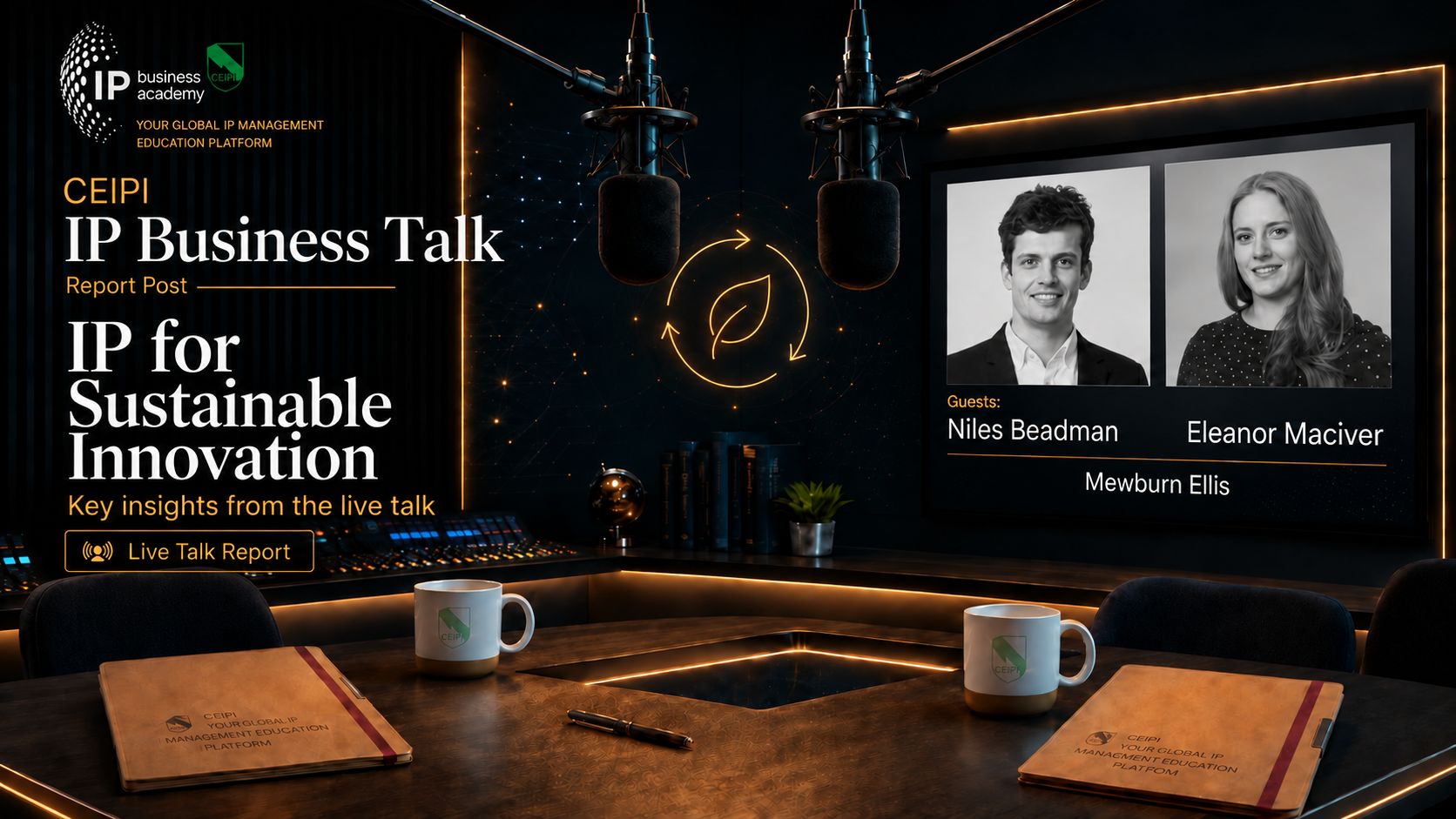
In the CEIPI IP Business Talk on 23 September 2026, Niles Beadman and Eleanor Maciver from Mewburn Ellis joined Prof. Dr. Alexander J. Wurzer to discuss how IP can support this journey. The conversation connected patent intelligence with circular business models, investment and licensing. A recurring question was how a company can protect the contribution that makes it valuable to others while helping those partners succeed.
Patent intelligence needs a clear understanding of the business context
GreenTech covers overlapping technical fields, and this makes patent landscaping demanding. An innovation aimed at improving sustainability may sit within the same technical classification as developments pursuing entirely different objectives. A search based on classification codes alone can therefore produce a picture that requires considerable interpretation.
Maciver explained the importance of investigating the organisations behind the documents. Known applicants, competitors and other businesses active in the field can provide useful starting points for a search. Understanding what those organisations are trying to achieve helps distinguish relevant activity within a much broader technical area.
Patent information can also reveal businesses entering an unfamiliar market, universities developing complementary technology or smaller companies with capabilities that could support a partnership. In an interdisciplinary field, these organisations may sit outside the networks a company already knows. The commercial value of a landscape grows when it helps the business identify whom to investigate, approach or monitor.
AI and citation analysis can help direct attention
Patent documents are written to define and support legal protection. Their structure and language can make them difficult to use for readers seeking a straightforward account of a technology. Beadman described how AI can assist with reading and summarising lengthy documents, helping users locate passages that deserve closer examination.
The discussion retained an important qualification. A summary provides a starting point for investigation, and its reliability still needs to be assessed. Understanding what a document actually protects requires attention to the claims and the surrounding disclosure.
Maciver also highlighted citation analysis as a way to prioritise large collections of patent information. Documents repeatedly cited during examination can help identify technically relevant work and applicants worth studying. Citation patterns offer a practical signal for directing expert attention, although they provide an incomplete measure of significance. Both approaches can reduce the effort involved in deciding where a more detailed review is worthwhile.
Circular businesses need to identify their contribution to the wider system
Circular business models depend on connected activities. Materials, manufacturing, use and recovery have to work together, and a young company may initially imagine controlling much of that cycle. Beadman described a more focused role that often emerges in practice: a smaller business supplies the enabling technology that allows an established industrial process to become more circular.
Polymer recycling and battery-material recycling illustrated this perspective. The opportunity may lie in a particular technical step that makes recovery commercially useful. A company supplying that step needs to understand how it fits into the operations and economics of the organisations around it.
Maciver extended the analysis to process know-how, data and platforms that allow the system to function. Valuable positions can exist well before the final product reaches a customer. Mapping those positions helps a company decide what to protect and explain why an industrial partner should work with it. IP then becomes part of the negotiation over access to a capability that the wider value chain needs.
Protection should remain useful as applications change
Choosing what to protect requires a conversation about the business plan. Maciver described asking founders what they do today, what they expect to do in several years and how the company might eventually develop or exit. These questions help connect an immediate filing decision with the period over which the protection is expected to create value.
Beadman pointed to the risk of defining an invention too closely around its first application. A technology developed to improve one existing industrial installation may later prove useful elsewhere. Where the technical contribution supports wider application, patent drafting should explore that potential and avoid unnecessary dependence on the surrounding equipment or original use case.
This is especially relevant for technologies designed to fit into existing infrastructure. The first commercial opportunity provides essential context, yet future partners may use the same contribution in different settings. Exploring those possibilities early can help preserve a position that remains relevant as the market develops.
Investors need to understand how IP supports the proposed business
Many sustainable technology companies face a long development period before commercial revenues become substantial. During that period, IP expenditure competes with other demands on limited funding. Maciver therefore placed business value at the centre of the decision to obtain and maintain protection.
For an investor, the important relationship is between the IP position and the business the company proposes to build. Does the protection cover the contribution on which the commercial plan depends? Can it help preserve an advantage for a period that supports a return on investment? Where patents are unsuitable, is valuable know-how being managed deliberately?
IP cannot guarantee commercial success. It can help a company retain the benefits if its technology succeeds. A coherent strategy shows investors that the company understands which assets matter, why they matter and how they support the next stage of development.
The same logic applies to industrial partnerships. A small innovator may negotiate with an organisation that has much greater financial resources and implementation experience. A protected contribution can give the innovator a credible basis for participating in the project and negotiating the terms of its involvement.
Licensing combines rights with the ability to implement a technology
The licensing discussion examined why a partner would continue to rely on a technology provider. Patent protection may form part of the answer. Beadman also identified know-how, practical implementation support and, where relevant, branding as contributions that can make the relationship valuable.
A licensing arrangement therefore needs to reflect what the licensee requires to use the technology successfully. Access to a patent may be accompanied by expertise about how a process works in practice, assistance during implementation and continuing technical cooperation. These elements can help explain both the attractiveness of the licence and the continuing role of the licensor.
The discussion also addressed ownership of the technology brought into a partnership and the improvements produced through joint work. An innovator needs to consider how subsequent developments affect its future position. Clear arrangements concerning those results help the parties understand what they may use and how the relationship can develop.
Licensing income depends on the business of the licensee
Wurzer drew attention to a consequence of choosing a licensing model: the licensor’s income is connected to another company’s business. Understanding the technology provider’s own plans is therefore only part of the commercial analysis. The provider also needs to understand how its partner creates value and how changes to the partner’s products or processes could affect the licence.
Maciver connected this point with technical assistance. In the licensing relationships she described, supporting successful implementation is an important part of the wider agreement. Patent advisers work alongside the legal teams responsible for those arrangements to help connect protection with the practical use of the technology.
For IP management, this makes the licensee’s success a continuing concern. A commercially useful licensing strategy considers how the partner will adopt the technology, what support it needs and why continued cooperation will remain attractive. The quality of that relationship influences the prospects for recurring income.
Wider collaboration models remain a developing field
An audience question extended the discussion to cross-licensing, patent pools and shared platforms such as WIPO GREEN. Maciver was careful to distinguish awareness of these mechanisms from direct experience. She did not present large cleantech licensing pools as an established part of her own practice.
She did point to collaborative research programmes as settings that can bring organisations from different disciplines together. The exchange highlighted the need to examine the practical experience behind a proposed collaboration model. Bilateral licensing, joint development and broader mechanisms for sharing technology each raise questions about participation, incentives and control that require their own assessment.
IP firms also have a sustainability role
The final part of the talk turned to the profession itself. As Sustainability Champion at Mewburn Ellis, Maciver described both the firm’s own operational responsibilities and its contribution through supporting sustainable innovators.
That contribution includes engaging with innovation networks, incubators and accelerators to help young businesses address IP questions early. Professional services firms can influence the development of sustainable technologies through the advice and support they provide, alongside efforts to improve their own environmental performance.
On measurement, Maciver favoured using established frameworks and reporting tools to assess progress. She acknowledged the difficulty of navigating different approaches, particularly where reporting systems are designed primarily for larger industrial organisations. Existing tools can nevertheless provide a basis for benchmarking and improving a professional services business.
Connecting protection with successful adoption
The talk placed IP within the practical relationships that bring sustainable technology into use. Patent intelligence helps companies understand the organisations and developments around them. Analysis of circular value chains clarifies which contribution an innovator can control. Protection and collaboration agreements then shape how that contribution reaches industrial partners.
Licensing brings these questions together because the innovator’s returns depend on successful use by another business. Managing that dependency requires attention to implementation, future improvements and the commercial position of the licensee. For sustainable innovators, a useful IP strategy develops alongside these relationships and the technology they bring to market.
Eleanor Maciver
 Eleanor Maciver is a Partner, UK and European Patent Attorney and Sustainability Champion at Mewburn Ellis. She advises on chemical and materials technologies, including sustainable polymers, battery materials and carbon capture. Her client work and responsibility for the firm’s sustainability activities brought complementary perspectives to the discussion.
.
Niles Beadman
 Niles Beadman is a Senior Associate and Patent Attorney in Mewburn Ellis’s Chemistry team. His work includes energy storage, cleantech and bio-derived materials, spanning patent drafting, portfolio management and freedom-to-operate advice. He works with universities, startups and established businesses on the relationship between technical innovation and commercial objectives.
.
Explore the discussion further in our GreenTech Industry Focus.