
IP Market Study Robotics & Autonomous Systems 2026: From Machine Protection to System Control

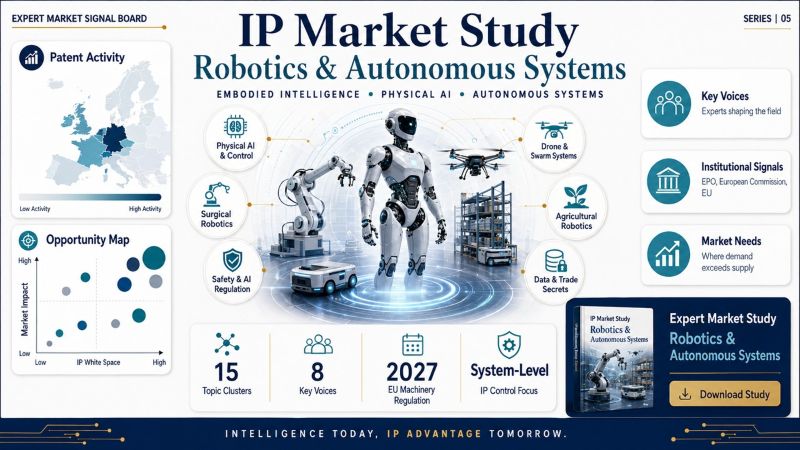
Robotics and autonomous systems are developing from individual machines into integrated physical-intelligence systems. Modern robots combine mechanical components, sensors, actuators, embedded software, AI models, operational data, connectivity and safety architecture. Their commercial value increasingly arises not from one component alone, but from the interaction between these different layers. This changes the central intellectual property question.
It is no longer enough to ask which mechanical feature, control method or software function can be patented. Robotics companies increasingly need to understand:
Which parts of the system must they control in order to scale, collaborate, attract investment, enter regulated markets and preserve freedom to operate?
This is the starting point of the new IP Market Report on Robotics and Autonomous Systems. The report is designed as a market-intelligence and business-development companion for patent attorneys, trade-secret specialists, design and trade mark advisers, law firms and adjacent IP service providers advising companies that develop, manufacture, deploy or operate robotic and autonomous systems.
Its central conclusion is:
Robotics turns IP from a narrow protection function into a strategic control system for embodied intelligence.
Robotics companies still need patents. But they increasingly need advisers who can connect patents with trade secrets, data governance, software architecture, safety regulation, contracts, supplier relationships and commercial strategy.
Robotics is becoming a system market
The European robotics market is advancing at several levels simultaneously.
Humanoid and physical-AI companies are attracting significant investment. Surgical robotics is moving from hardware-centred competition towards navigation, simulation, training and workflow integration. Drone companies are developing increasingly autonomous and swarm-capable systems. Agricultural robots combine physical machinery with sensing, positioning and AI-based decision-making. Warehouse robotics has become a mature platform market in which fleet orchestration and coordination software increasingly determine competitive advantage.
Across these segments, value increasingly sits at the interfaces:
- between sensors and actuators;
- between perception and movement;
- between AI models and safety rules;
- between simulation and real-world performance;
- between the individual robot and the wider fleet;
- between the machine and the operational data it generates.
A robotics company may own patents covering individual components and still lack strategic control over the complete system. It may depend on third-party software, external sensor technology, communication standards, cloud infrastructure, supplier know-how or customer-generated data. A competitor may avoid individual component patents while reproducing the commercially relevant system function through a different technical architecture.
Effective robotics IP strategy must therefore begin with the complete system rather than with isolated inventions. The relevant task is to identify where control over the system is created, how that control can be protected and which dependencies could later weaken the company’s position.
Physical AI requires a different patenting logic
The rise of physical AI makes this system-level perspective particularly important.
Unlike AI systems operating primarily in digital environments, robots and autonomous vehicles must function under real-world constraints. They have limited computing power, energy, space and connectivity. They must react safely to changing physical conditions, incomplete sensor information and unexpected human behaviour. The patentable contribution may therefore lie less in the abstract AI model and more in the engineering required to make that model operate inside a physical system.
This may include:
- sensor fusion;
- edge processing;
- model compression;
- adaptive control;
- energy management;
- fault detection;
- safety-related decision logic;
- interaction between perception and movement.
For vertically integrated robotics companies, the protectable surface becomes even broader.
Businesses that develop their own motors, encoders, brakes, gearboxes, sensors or edge-computing systems can create patents and trade secrets across the entire robotic stack. Their IP strategy must cover not only the visible product, but also manufacturing knowledge, component integration, control loops and system architecture.
This creates an important distinction between robotics companies that mainly integrate third-party technologies and companies that control essential elements of the stack themselves. The second group may possess a much stronger strategic position, but only if the relevant assets are identified, protected and managed coherently.
Who controls the robotics learning loop?
One of the most important shifts identified in the report concerns the data generated after a robot has been deployed.
Robotic and autonomous systems produce information about movement, performance, wear, failure modes, user behaviour, safety events and physical environments. This information can be used to improve predictive maintenance, model performance, system reliability and future product generations. A strategic learning loop emerges:
Operation generates data. The data improves the model. The improved model improves the system. The improved system generates more valuable data.
The company that controls this loop may control one of the most important assets in the business. But ownership and access are often unclear.
The customer may control the operating environment. A cloud provider may host the data. A technology partner may process it. A supplier may receive diagnostic information. A hospital, factory, warehouse or agricultural operator may restrict how deployment data can be reused.
Robotics companies therefore need clear answers to questions such as:
- Who may access operational data?
- Who may use it to train or improve a model?
- Who owns improvements generated during a customer deployment?
- Can those improvements be transferred across the wider fleet?
- Which datasets, parameters and integration methods should remain confidential?
- What information must be disclosed to customers, partners or regulators?
These questions cannot be answered through patent law alone. They require a coordinated approach combining patents, contracts, trade-secret management, software architecture and data governance. This is one of the areas where demand is growing faster than the maturity of the available IP services.
Regulation and IP strategy are converging
Robotics is also entering a new regulatory phase. The EU Machinery Regulation becomes fully applicable on 20 January 2027. It expressly reaches autonomous mobile machinery, industrial and collaborative robots, AI-based safety components and machinery with remote-operation functions.
At the same time, the EU AI Act introduces an additional regulatory layer for many AI-enabled robotic systems. These frameworks cannot be treated separately from IP strategy.
The Machinery Regulation recognises that a substantial physical or digital modification may make the party responsible for that change the legal manufacturer of the modified machine. This can be relevant where robots receive over-the-air updates or adapt their behaviour through continuous or fleet-based learning.
A software update may therefore affect:
- conformity assessment;
- product liability;
- technical documentation;
- cybersecurity requirements;
- patent drafting;
- trade-secret classification;
- disclosure of system functions.
Robotics companies increasingly need one documentation architecture that supports these different objectives simultaneously.
Technical files prepared for regulatory purposes may contain information that is highly relevant for patent applications, invention capture and trade-secret evidence. At the same time, uncontrolled disclosure in regulatory or collaboration processes can weaken the company’s IP position.
The opportunity for IP experts is therefore not simply to add another compliance service. It is to connect regulatory documentation, system architecture and IP strategy from the outset.
The report identifies this intersection between the Machinery Regulation, the AI Act, safety architecture and IP as one of the clearest opportunity zones in the European market.
Different robotics segments create different IP priorities
The report also demonstrates why generic “robotics IP” positioning is becoming less effective. Different segments create different technical architectures, market dynamics and strategic control points.
Humanoid and service robotics
Humanoid robotics requires portfolios covering locomotion, dexterous manipulation, sensing, actuation, human-machine interaction and safety. Where robots learn across a fleet, data and improvement rights become equally important.
The size of Chinese patent activity also means that European companies require freedom-to-operate work extending well beyond Europe and the United States.
Surgical and medical robotics
In surgical robotics, value is moving beyond the visible robotic platform.
Navigation, simulation, clinician training, patient-specific planning and workflow integration are becoming increasingly important sources of differentiation. Patent drafting must also navigate the European exclusion of methods of treatment and surgery.
Drones and swarm autonomy
Drone companies need protection that reaches beyond the individual airframe.
Fleet coordination, mission assignment, communication structures, fault-aware routines and edge-AI decision-making may be more strategically important than individual hardware features. In defence and dual-use contexts, IP strategy must also be aligned with export-control requirements.
Agricultural and field robotics
Agricultural robots combine autonomous machinery, sensors, positioning systems and AI-based processing.
For EPO patentability, the AI contribution must be connected to a technical effect or a real-world technical problem. At the same time, commercially valuable training data, crop models and system parameters may be better protected as trade secrets.
Logistics and warehouse automation
Warehouse robotics is already a mature competitive field.
The dispute between Ocado and AutoStore showed how robotics patent litigation can develop simultaneously across national courts, EPO proceedings and the Unified Patent Court.
As the market matures, competition is increasingly moving from hardware form factors towards fleet intelligence, orchestration software and heterogeneous multi-robot coordination.
For IP experts, the implication is clear:
Segment-specific positioning is more credible and commercially useful than a broad claim of robotics expertise.
The key voices shaping the European discussion
The report identifies practitioners whose publications are already influencing the European robotics and autonomous-systems IP conversation.
Fabian Kiendl of Maiwald examines how AI inventions can be patented once they leave the server and must operate under the hardware, energy and processing constraints of physical systems.
Jack Severs of GJE shows how surgical-robotics innovation is shifting from core robotic hardware towards planning, simulation, navigation, clinician training and workflow integration.
Mohammad Ahmadi Bidakhvidi of V.O. Patents & Trademarks focuses on the technical contribution required for patenting applied AI inventions, including autonomous vehicles and other systems operating in real-world technical contexts.
Darena Slavova of Mewburn Ellis brings autonomous subsea systems into the discussion. Her work connects autonomous inspection vehicles, software retrofits, digital twins and the monitoring of critical seabed infrastructure.
Andrew White of Mathys & Squire provides a data-led view of drone and counter-drone patent activity, showing how autonomous aerial systems have moved from a niche technology into a mainstream security and infrastructure-protection market.
Pamela Bryer of Marks & Clerk examines the increasing diversity of surgical-robotics platforms and highlights the importance of clinician training and supporting infrastructure.
Ben Hunter and Jonathan Jackson of D Young & Co analyse AI patentability, trade secrets and patent trends in agricultural robotics.
The report also highlights the European Patent Office and the European Commission as important institutional voices. The EPO provides the patent-data foundation needed to understand the digital technologies underlying robotics, while the Commission shapes the regulatory environment through the Machinery Regulation, the AI Act and wider European robotics policy.
Together, these voices demonstrate that the European robotics IP conversation is active but fragmented.
Strong expertise exists in AI patentability, surgical robotics, drones and agritech. Considerably fewer practitioners publicly connect these topics with system control, operational data, safety documentation and commercial dependencies. This creates room for differentiated expert positioning.
Where the strongest service opportunities lie
The report translates the market developments into concrete service propositions for IP experts.
Robotics System IP Audit
A structured review of the mechanical, sensing, software, AI, data, safety and supplier layers of a robotic system.
The objective is not simply to list patents and applications. It is to identify where strategic control exists, where it is missing and which dependencies could weaken the company’s future position.
Fleet-Learning Data and Trade-Secret Governance
A combined contractual and trade-secret framework defining access to operational data, ownership of improvements and the conditions under which learning generated in one customer deployment can be transferred across the wider fleet.
Machinery Regulation and AI Act IP Alignment
A review connecting conformity-assessment documentation and AI risk documentation with patent drafting, invention capture and trade-secret classification.
This can reduce duplicated work and prevent regulatory disclosure from undermining the wider IP position.
Swarm and Fleet-Intelligence Patent Strategy
Portfolio development for drone and multi-robot systems covering communication, task allocation, adaptive coordination, fault management and edge-AI logic rather than only the individual machine.
Robotics Start-Up IP Audit for Fundraising
An investor-facing assessment demonstrating what the company controls across hardware, software, data, know-how and suppliers.
Investors increasingly need more than a patent count. They need evidence that the company has built a defensible position around its product architecture and business model.
Robotics M&A IP Due Diligence
Due diligence that distinguishes ownership of formal IP rights from actual strategic control.
A robotics company may own patents while remaining exposed through supplier restrictions, unclear data rights, open-source dependencies, missing improvement clauses or freedom-to-operate risks.
The principle connecting all these services is straightforward:
Robotics companies need advice organised around their business and system decisions, not around isolated legal categories.
What this means for private practice
For IP firms and individual experts, robotics should not remain only one technical term in a long list of industries.
A credible position requires several adjustments.
First, robotics should be treated as a multi-right and system-level practice. Patents, trade secrets, software, data, contracts and regulatory disclosure need to be considered together.
Second, public communication should focus on integration and control questions rather than repeating general explanations of software or AI patentability.
Third, firms should select specific robotics segments in which they can build recognisable expertise. Surgical robotics, humanoid systems, warehouse automation, agricultural robotics and drones create very different client needs.
Fourth, patent attorneys, data lawyers, regulatory specialists and commercial advisers need a shared understanding of the robotic system. Separate internal silos will struggle to deliver the integrated advice the market increasingly requires.
Fifth, firms should be present inside robotics ecosystems, not only inside the IP profession. Robotics trade fairs, medical-technology events, agricultural conferences, defence and dual-use forums, investor networks and technical associations are where relevant client problems become visible.
Finally, expertise should be packaged into named and understandable service propositions.
A Robotics System IP Audit or a Fleet-Learning Governance Review is easier for a prospective client to recognise and purchase than a general promise to provide “robotics IP advice”.
The stronger positioning message is no longer simply:
“We protect robotic inventions.”
It is:
“We help robotics companies identify and secure the control points that make their systems scalable, defensible and investable.”
Download the IP Market Report
The full IP Market Report on Robotics and Autonomous Systems provides:
- an overview of current market and IP developments;
- the key voices influencing the European conversation;
- a heatmap of fifteen robotics IP topic clusters;
- an analysis of market needs and service gaps;
- concrete business-development opportunities for IP experts;
- implications for private-practice positioning and capability development;
- an outlook for the next 18 to 36 months.
The central lesson is clear:
Robotics companies do not only need stronger IP rights. They need IP strategies that secure control over the systems, data and relationships that make embodied intelligence commercially valuable.
Download the complete IP Market Report on Robotics and Autonomous Systems here: