Workflow Automation in IP: Why companies need to turn IP work into reliable systems

Every IP department lives with a paradox. The work is highly strategic, but much of the daily reality is operational. Invention disclosures need to be collected. Deadlines need to be monitored. Portfolio reviews need to be prepared. Contract clauses need to be checked. Reports need to be created. Decisions need to be documented. External patent firms need instructions, feedback, status updates, budgets, and strategic context. Across all these activities, value is not only created by brilliant legal or technical judgment, but also by whether the right information reaches the right people at the right time.
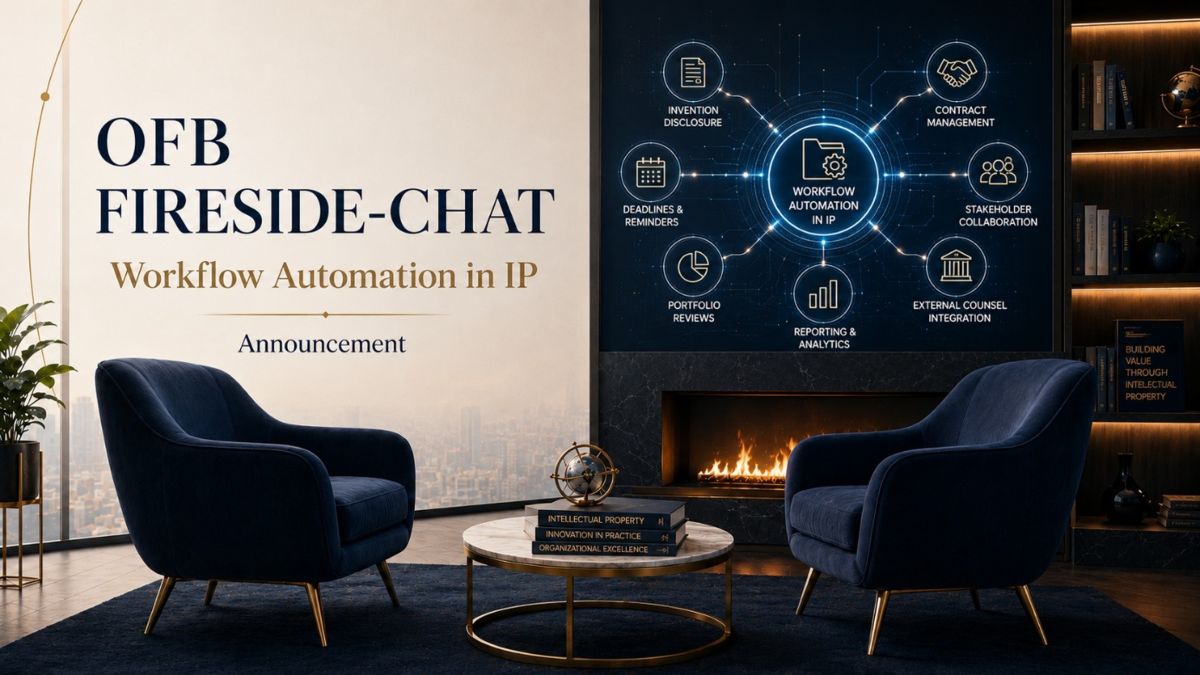
This is why Workflow Automation in IP will be the topic of an upcoming OFB Fireside Chat. The discussion will focus on a question that many companies only begin to ask when the workload has already become difficult to manage: Which IP workflows are repetitive, slow, fragile, or error prone, and how can they be redesigned so that automation improves not only efficiency, but also the quality of IP decisions? In practice, IP automation is often treated as a software question. But the real issue is organizational.
That gap becomes critical in a business environment where innovation cycles are shorter, product teams move faster, R&D work is more distributed, and IP decisions need to be connected to commercial priorities earlier than before. The challenge is no longer only whether an IP department can manage filings, deadlines, contracts, and reports. The deeper issue is whether the company has IP workflows that make strategic knowledge visible, usable, traceable, and actionable across the organization.
Automation is not just about speed
A common misunderstanding is that workflow automation mainly means doing the same tasks faster. That view is too narrow for IP management. Speed matters, of course. It is valuable if invention disclosures are routed automatically, deadline reminders are generated reliably, standard reporting is produced with less manual effort, and routine contract checks can be supported by structured review logic. But speed alone does not make IP management better.
The real management question is whether automation helps the company make better decisions. A faster invention disclosure process is useful only if it captures the information needed to assess business relevance, technical contribution, ownership, publication risk, freedom to operate relevance, and strategic fit. A faster portfolio review is useful only if it connects patents to products, markets, competitors, licensing opportunities, risks, and budget decisions. A faster reporting process is useful only if the report helps leadership understand what needs attention.
Good Workflow Automation therefore begins with a simple but demanding question: Which decisions should the workflow support? If that question is not answered first, automation may only make unclear processes move faster. It may create dashboards without insight, approvals without responsibility, data fields without meaning, and notifications that people learn to ignore.
The process clarity problem
Many companies discover during automation projects that the real bottleneck is not technology. It is process clarity. Before a workflow can be automated, the company must understand what happens today, who is involved, which information is required, which decisions are made, which exceptions occur, and where responsibility changes from one function to another.
This becomes visible in typical IP processes. An invention disclosure may start in R&D, but it quickly touches product management, IP management, legal, business development, finance, and sometimes external patent firms. A portfolio review may look like an IP task, but it depends on market priorities, product roadmaps, competitor activity, licensing potential, and budget constraints. A contract review may begin with legal wording, but the business impact may depend on background IP, access rights, confidentiality, open source use, data rights, and future exploitation.
If these interfaces are not understood, automation can create a false sense of control. A workflow tool may show that a task is complete, while the strategic question behind the task remains unanswered. That is why Workflow Automation in IP requires more than a technical implementation. It requires process design, role clarity, data discipline, and a shared understanding of what good IP management should achieve.
From manual coordination to organizational capability
In many companies, IP work still depends heavily on personal coordination. Someone remembers to ask R&D for more information. Someone knows which business unit cares about a certain patent family. Someone understands which external patent firm has the necessary technical context. Someone keeps track of why a certain filing decision was made three years ago. This personal knowledge is valuable, but it is also fragile.
Workflow Automation can help transform this fragile coordination into organizational capability. It can make sure that invention disclosures follow a defined path, that missing information is requested consistently, that decision points are documented, that responsibility is visible, and that knowledge from previous decisions remains accessible. The goal is not to replace professional judgment. The goal is to make sure that judgment is applied at the right moments and supported by reliable information.
This is especially important because IP work often has long time horizons. Decisions made today may become relevant years later in litigation, licensing, M&A, fundraising, product launches, or competitor disputes. A workflow that documents why a patent was filed, why a claim strategy was chosen, why a technology was kept confidential, or why a portfolio was reduced can become an important strategic memory for the company.
The link between workflow automation and IP strategy
Workflow Automation is often treated as an operational topic, but it has a direct connection to IP strategy. A company cannot implement its IP strategy reliably if the underlying workflows do not carry strategy into daily decisions. Strategy needs touchpoints. It needs review gates. It needs structured input from R&D and business teams. It needs evidence. It needs escalation rules. It needs feedback loops.
For example, if a company wants to prioritize patents that protect commercially relevant product features, then the invention disclosure workflow must ask for commercial context. If a company wants to improve freedom to operate readiness, then product development workflows must include IP checkpoints before market entry. If a company wants to manage trade secrets more systematically, then documentation, access rights, project transitions, and exit processes must be connected to IP workflows. If a company wants leadership to understand IP risk, then reporting workflows must translate IP information into business relevance.
This makes Workflow Automation a bridge between strategy and execution. It turns IP management from a set of expert tasks into a repeatable management system. That does not make IP work mechanical. On the contrary, it gives experts more room to focus on interpretation, prioritization, negotiation, and strategic judgment.
Interfaces are where automation matters most
The most important IP workflow problems often occur at interfaces. R&D creates technical information, but may not know what the IP department needs. Product management understands market relevance, but may not connect it to protectability or risk. Legal reviews contracts, but may not see the technical background. Finance controls budgets, but may not see the strategic reason for maintaining a patent family. External patent firms draft applications, but may not receive enough commercial context.
Workflow Automation can make these interfaces more reliable. It can create structured handovers, defined information requirements, automatic reminders, review stages, approval paths, and shared status visibility. But it must also respect the fact that IP decisions are rarely simple. Many IP questions require interpretation. Automation should therefore not hide complexity. It should make complexity easier to handle.
The key is to design workflows with appropriate control points. Some steps can be automated fully. Some can be supported by templates, prefilled data, classification logic, or AI based summaries. Some require human review. Some require escalation to senior IP management, business leadership, or external experts. A good workflow does not remove responsibility. It makes responsibility visible.
AI changes the workflow question
Artificial intelligence adds a new layer to Workflow Automation in IP. AI tools can support prior art searches, classify invention disclosures, summarize patent documents, detect portfolio patterns, extract contractual clauses, identify missing information, prepare reports, and support monitoring. They can reduce manual effort and make large volumes of information easier to use.
But AI also increases the need for governance. Companies need to know which data may be used, how confidential information is protected, how outputs are validated, how errors are detected, and where human responsibility remains essential. AI supported workflows can be powerful, but they can also create new risks if outputs are accepted without review or if sensitive information is processed in unsuitable systems.
The important question is therefore not simply whether AI should be used in IP workflows. The more important question is how AI changes the lifecycle of IP information. What is captured? What is classified? What is inferred? What is recommended? What is documented? What becomes part of a decision record? What remains subject to human judgment?
Why this OFB Fireside Chat matters
The upcoming OFB Fireside Chat will address Workflow Automation in IP as a practical business issue. The focus will not be on software buzzwords, but on the organizational questions behind automation. Which IP processes are suitable for automation? Which interfaces create avoidable friction? Which data quality is needed before automation makes sense? How can automation support better decision making? How do roles, responsibilities, and control points change when IP work becomes more system based?
These questions matter because many companies are already managing IP in environments that are too complex for purely manual coordination. They need faster processes, but they also need better evidence, clearer responsibilities, stronger interfaces, and more reliable strategic execution. Workflow Automation gives companies a way to close that gap. It helps them turn IP work into a system that supports people, protects value, and connects daily operations with long term IP strategy.
Further reading and contact
For readers who would like to explore the topic in more depth, the related dIPlex Deep Dive Workflow Automation in IP provides a structured perspective on why automation should not be treated only as a way to reduce manual workload, but as an organizational IP management issue:
👉 https://profwurzer.com/diplex/docs/ip-and-organization/workflow-automation-in-ip/
The Deep Dive complements the upcoming OFB Fireside Chat by looking beyond questions of software implementation and focusing on the core challenges to turn IP work into a reliable organizational system.
For questions regarding the Open Foresight Board or the upcoming OFB Fireside Chat, please contact:
Theo Grünewald
Secretary of the CEIPI IP Business Academy’s Open Foresight Board
theo.gruenewald@ipbaportal.com
More details on the upcoming OFB Fireside Chat will follow soon.