Keeping an Expanding RNA Platform Clear from Clinical Development to Partnered Scale-Up with Prof. Dr. Christian Plank

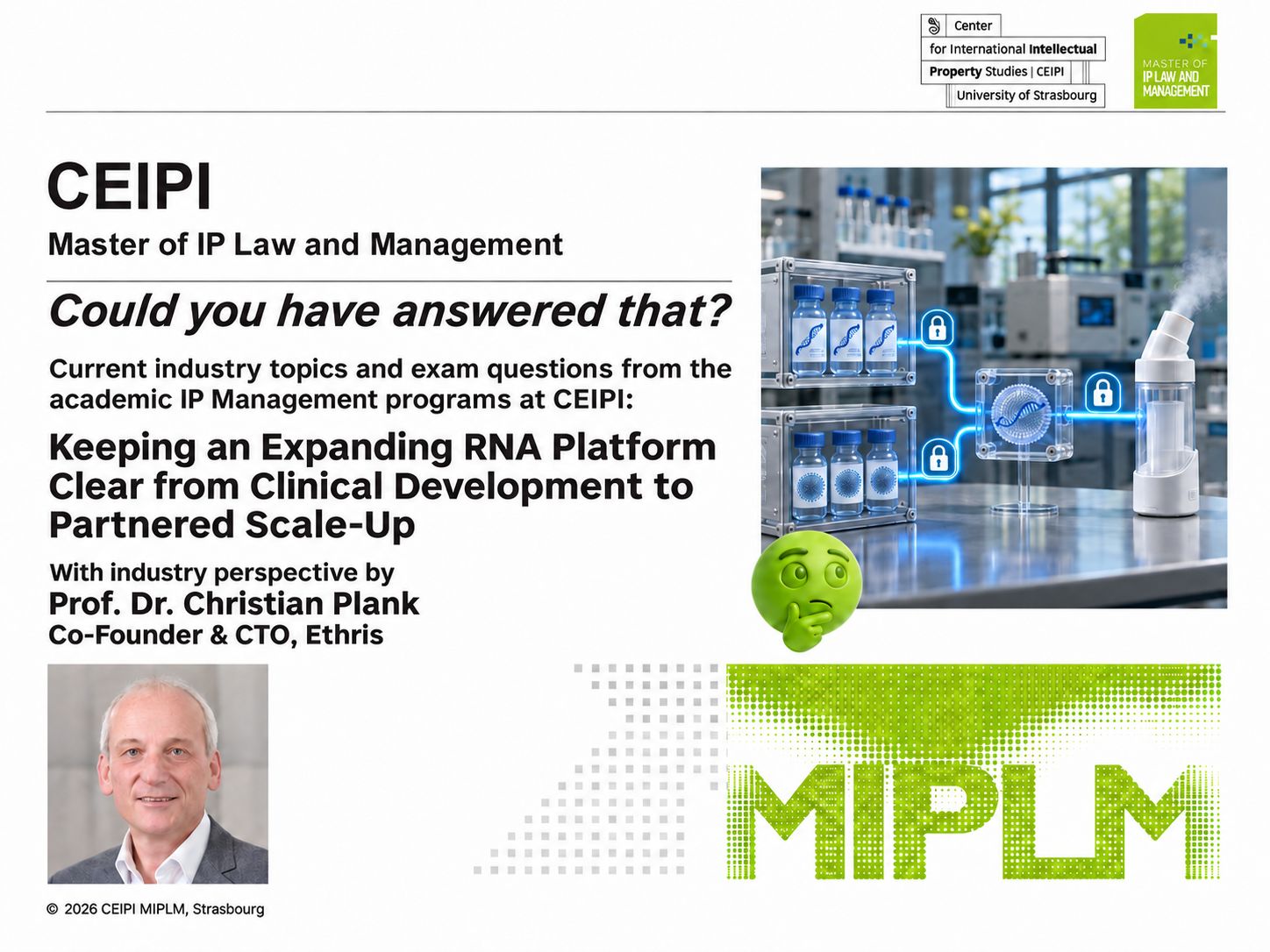
RNA therapeutics create value through the interaction of several technical layers. The RNA construct, delivery particles, formulation, manufacturing process and route of administration must work together, while each layer can be affected by a different patent landscape. As a platform expands from one clinical candidate into vaccines, partner programmes and additional applications, freedom to operate becomes a continuing management task rather than a one-time legal review.
The difficult decisions often begin when monitoring identifies a potentially relevant third-party position. Management must decide what can still be changed, whether access should be negotiated, when a licence should be sought and how a transaction can be structured when cash for a substantial upfront payment is limited. Even an existing licence may leave residual uncertainty if it does not cover every technical layer, field of use, territory, manufacturing arrangement or future programme.
Practice-based questions at the CEIPI IP Business Academy enable future IP managers to examine these choices in a concrete business setting. We are pleased to present this case with Prof. Dr. Christian Plank, Co-Founder and Chief Technology Officer of Ethris. He reviewed the abstracted scenario and confirmed that both the underlying situation and the questions are continuously relevant in biotechnology practice.
Christian Plank assesses the practical relevance in the following statement, translated from German:
“I think the text is very good. It describes the situation very accurately, and the questions formulated are continuously relevant to us.”
His additional questions extend the case beyond risk identification to the decisions that follow: the timing and financing of licensing, the treatment of unresolved third-party positions and the residual FTO risk that can remain even when enabling technology has already been licensed in. The following fictional mini case study abstracts these challenges for teaching.
Mini Case Study
A European clinical-stage biotechnology company develops RNA-based therapeutics and vaccines for local administration to the respiratory system. Its technology combines stabilised RNA constructs with proprietary delivery particles, formulation know-how and administration processes designed to preserve biological activity during manufacturing and application.
The company creates value through several routes. It advances proprietary therapeutic candidates, develops vaccine applications and provides selected partners with access to elements of its RNA and delivery technologies. Its pipeline covers different biological functions, including immune modulation, protein replacement and preventive applications.
Recent financing enables the company to advance its clinical respiratory portfolio. At the same time, collaborations with research organisations, manufacturing specialists and pharmaceutical technology providers are extending the platform into additional applications and partner offerings. Some collaborations focus on clinical products, while others address formulation, delivery, manufacturing or broader access to the technology.
This expansion increases the number of technical interfaces that must remain clear to develop and commercialise. Relevant third-party rights may concern RNA design, chemical modification, delivery particles, excipients, manufacturing processes, formulation methods, administration devices, encoded proteins or therapeutic applications. Their relevance changes as formulations are optimised, manufacturing processes are scaled and individual candidates progress through development.
Continuous monitoring has now identified a third-party patent position that may be relevant to a delivery component selected for the lead inhaled programme. The scope and practical significance are not yet fully resolved, but the company is approaching decisions on formulation lock, regulatory-enabling work and manufacturing scale-up. Redesign remains technically possible, although it could delay development and require new performance studies. A licence may preserve the current route, but the company has limited cash for a substantial upfront payment.
A separate platform component is already used under an in-licence. Management cannot assume that this agreement removes every FTO risk around the resulting product. The licensed rights may be limited by field, territory, activity or sublicensing scope, and other patent owners may control adjacent or overlapping technology. Partner manufacturing and future programmes could therefore require additional analysis or access rights.
The CTO needs a continuous FTO process that follows the evolving technology stack and converts findings into timely business decisions. It must support rapid technical development while creating sufficient clarity for clinical investment, manufacturing commitments, platform collaborations and future partnering decisions.
Practical Question
How should the CTO establish a continuous freedom-to-operate process for a modular RNA technology platform that converts emerging third-party-rights risks into timely, financeable and evidence-based decisions across proprietary programmes, vaccine development and external collaborations?
1 . How should the company divide the technology stack into meaningful FTO layers covering RNA design, delivery particles, formulation, stabilisation, manufacturing, administration and therapeutic use, and at which development and commercial milestones should each layer be reassessed?
2 . When monitoring indicates that a selected technical route may lack clear freedom to operate, how should management compare redesign, licensing, challenging the third-party position, postponing a commitment or proceeding with a defined residual risk? Which evidence, decision owners and escalation thresholds are required?
3 . When should the company approach a rights holder, and how should it assess licensing structures that reduce immediate cash requirements, such as staged fees, milestones, royalties, options or other forms of consideration, while preserving sufficient scope for manufacturing, partnering and future platform applications?
4 . How should the company manage residual FTO risk across in-licensed technologies and collaborations so that the exact scope of access rights, partner-specific developments, jointly generated improvements, additional third-party dependencies and reusable platform capabilities remain transparent for future programmes?
Why This Question Matters in Practice
RNA therapeutics depend on an interconnected set of technologies. The biological payload, delivery system, formulation, manufacturing process and route of administration jointly determine whether a product can be developed and used successfully. A clearance conclusion for one component or a licence to one patent family does not establish freedom to operate for the complete product and all intended activities.
The relevant configuration also changes during development. A formulation selected for early testing may be modified for stability, scale-up or clinical administration. Each commitment can make alternatives more expensive. Continuous FTO therefore needs to be connected to formulation lock, supplier selection, technology transfer, regulatory-enabling studies, clinical advancement and partner integration.
A potentially blocking position rarely leads to a purely legal choice. Management must compare the technical feasibility and delay of redesign with the scope, timing and economics of access. For a cash-constrained biotechnology company, the structure of a licence can be as important as the headline price. The decision also needs to distinguish an unresolved risk that can be monitored from a dependency that must be addressed before the next irreversible commitment.
Collaboration adds further complexity because platform components and improvements may move between internal programmes, manufacturing partners, research consortia and external customers. Future IP managers must translate patent analysis into defined authorised activities, decision records, responsibilities and review triggers. A continuous FTO process provides the framework needed to protect development investments, maintain partnering flexibility and preserve the long-term value of a modular technology platform.
CEIPI Lecture: Continuous Freedom to Operate: Product Decisions, Platform Rights and Partner Readiness
About Prof. Dr. Christian Plank
 Prof. Dr. Christian Plank is Co-Founder and Chief Technology Officer of Ethris, a biotechnology company established to advance messenger RNA as a therapeutic modality. He contributes broad expertise in targeted drug delivery and nucleic acid delivery, connecting platform science with the practical requirements of therapeutic and vaccine development. Company profile.
He is the author of more than 170 scientific publications and co-inventor of numerous patents in the field of nucleic acid delivery. Christian Plank is a Professor at the Technical University of Munich and obtained his PhD in biochemistry from the University of Vienna. His contribution to this case brings the CTO perspective to continuous FTO decisions involving modular technology stacks, clinical commitments, licensing constraints and platform partnerships.