IP Management for Biotechnological Platforms and Collaborations

A customer asks a biotech company to improve a method for a particular application. The development team succeeds, and the improvement also looks useful for other projects. The customer needs dependable access to the result. The provider wants the next customer to benefit from what it has learned. Before either side makes a broader commitment, someone must decide where the project ends and the reusable platform begins.
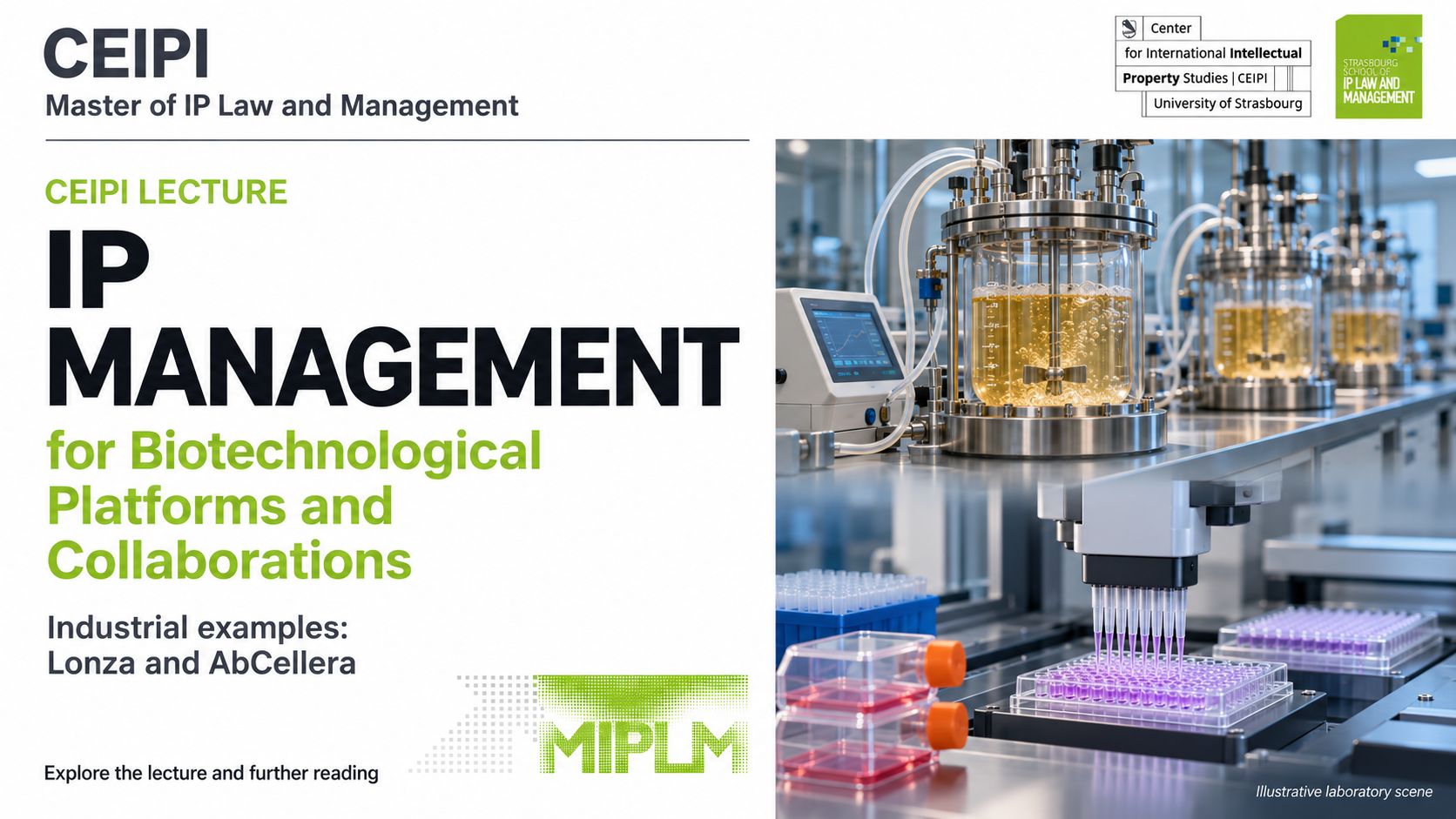
This is the business setting for a new CEIPI lecture on IP Management for Biotechnological Platforms and Collaborations. It examines how companies can keep improvements available for future applications while giving partners rights that support investment. The lecture connects choices about patents, confidential know-how and licensing with the routines needed to make those choices consistently.
The commercial decisions inside a research project
A successful experiment may generate several assets at once: a result about a customer’s compound, an improved technical method and practical experience that makes the next experiment more reliable. These assets may have different owners, different confidentiality obligations and different commercial uses. Classifying them requires an understanding of the technology, the contributions and the agreements already in place.
Exclusivity adds another dimension. A partner may need confidence that a competitor cannot immediately obtain the same application. The provider must assess which future opportunities a proposed restriction would remove. Field of use, duration, rights to later improvements and conditions for continued exclusivity all affect the economics. An approaching publication or technical presentation makes the timing of these decisions equally relevant.
An established management problem
Three established perspectives help explain these choices. David Teece’s work on profiting from innovation connects innovation returns to appropriability and complementary assets. For a platform provider, a partner’s development capability or market access may be essential to commercialisation. The question is how access to those capabilities affects the provider’s ability to capture value.
Jay Barney’s resource-based view focuses attention on the capabilities that sustain an advantage. A platform’s value may depend on a combination of methods, experience and relationships that a patent count cannot describe. Oliver Williamson’s transaction cost economics explains why specialised investment and uncertain future changes create a need for workable governance. These perspectives help connect the allocation of rights to the commercial relationship.
Lonza and the reuse of a technology base
Lonza’s expression-technology offering illustrates how customers can access a shared technology base for distinct development programmes. Developers can license expression technologies through the Lonza in Your Lab offering. Its 2025 annual report reports more than 400 active licensing customers and more than 100 approved therapeutics containing Lonza’s out-licensed IP. These figures cover the broader licensing portfolio and demonstrate repeated adoption.
A publicly filed agreement with Avidity provides a view of the contractual structure. It distinguishes background IP from categories of newly developed IP and identifies a separate GS Xceed technology licence. Parts of the agreement are redacted, so the complete allocation cannot be reconstructed. The transferable lesson is the separation of platform access and customer-specific results. The evidence does not isolate licensing profitability or establish that every biotech platform should adopt the same terms.
AbCellera and the boundary of reusable learning
AbCellera’s 2025 annual report describes contracts that allow generated data to improve discovery capabilities while firewall protocols restrict the use of partner target-specific data in other partners’ projects. This shows how reuse permissions can coexist with limits that preserve customer confidentiality. It also makes the operating process visible: a contractual permission needs a corresponding boundary in how teams handle information.
The economic potential of downstream participation is visible in AbCellera’s 2022 results, which reported US$443.0 million in royalties associated with two COVID-19 antibodies. Its 2023 results reported no royalty revenue. Pandemic demand made the earlier outcome exceptional, and the company has since placed greater emphasis on its internal pipeline. The case demonstrates realised participation in product success alongside the uncertainty of such revenues. It provides no earnings forecast for a research-service platform.
Decisions that a team can implement
The lecture turns these examples into a practical sequence. Participants identify existing assets and new contributions, assess which improvements have wider commercial relevance, and compare patenting, confidentiality and publication. They then examine partner access and the opportunity cost of exclusivity. Finally, they assign responsibility for recording improvements, reviewing commitments and approving disclosure.
ISO 56005:2020 provides guidance for systematic IP management within innovation, while DIN 77006:2020 specifies requirements for IP management systems. The lecture uses their management orientation to develop proportionate processes. A shared register, named decision owners and review points can make the approach usable by a small team. The illustrated process is a teaching application, rather than a claim of conformity.
The related practical question draws on an approved contribution from TissUse, which already describes allocating partner usage rights and retaining rights to improvements of its contributed platform. The fictional teaching scenario adds an exclusivity request and an approaching disclosure. This abstraction lets participants examine an industry-typical decision without implying an unresolved problem at the contributing company.
Further learning and the planned expert model solution
The six readings accompanying the slides offer several routes into the subject. Fourteen Success Principles of Modern IP Strategy and Rolling Out Modern IP Strategy connect strategic choices to implementation. Know-how Management and Smart Licensing Models develop the knowledge and commercial dimensions. Axel Oldekop’s contribution on documenting trade secrets and the licensing discussion with Andreas Jacob and Tomas Geerkens add documented expert perspectives.
A planned expert model solution will show how to combine these decisions for the approved practical question. It will explain the trade-offs between reusable improvements, dependable partner rights and future commercial opportunities, including which decision to prepare first and what information is missing. The slides below introduce the concepts, compare the two industrial cases and provide the foundation for developing a reasoned management concept.