Knowledge Map 2.0: Mapping Know-how, Data, Code and Models

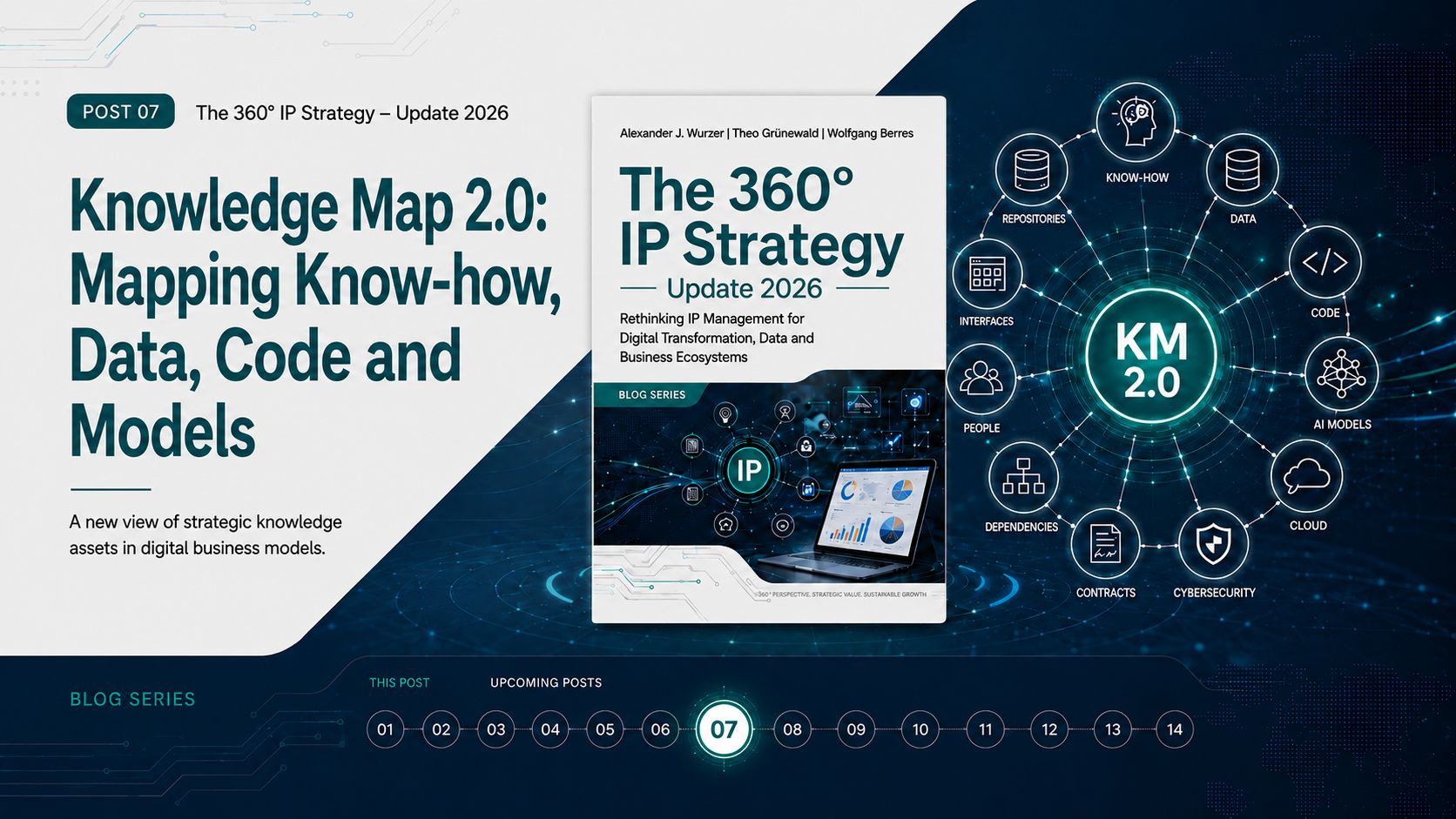
Knowledge Map 2.0 updates the original 360° IP Strategy for digital business models. Strategically relevant know-how no longer resides only in employees or technical documents, but also in source code, datasets, AI models, repositories, cloud environments, interfaces and supplier relationships. The management task is to identify which knowledge units support customer value, where they are stored, how they were created, who may use them and which dependencies threaten control. Data, code and models require traceable lineage, clear ownership and reproducibility. Protection must combine IP, cybersecurity, HR, procurement and operations. As a living decision system, the Knowledge Map supports trade secret management, synthetic inventing, due diligence, collaboration and capability building.
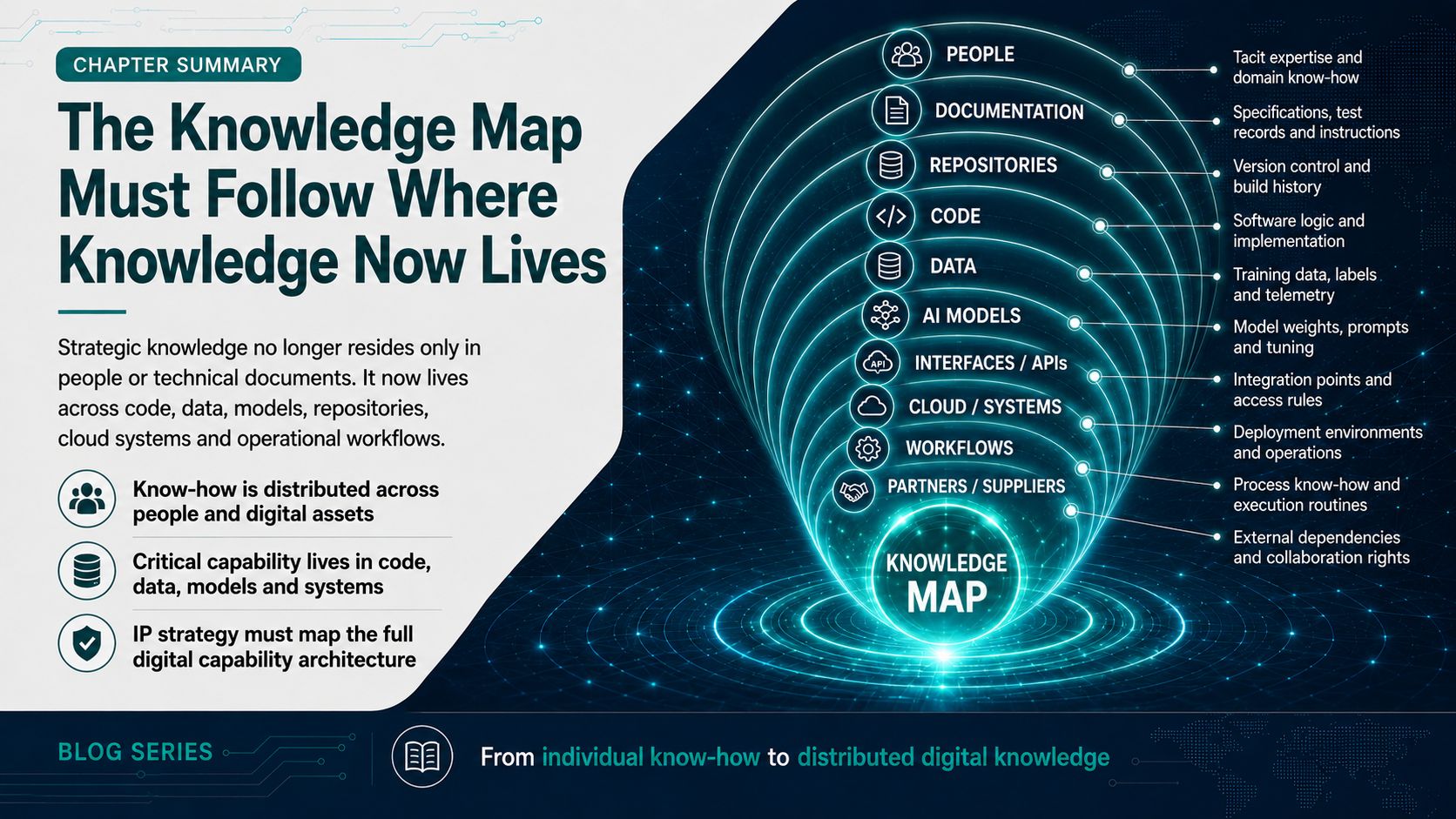
The Knowledge Map must follow where knowledge now lives
The original 360° IP Strategy introduced the Knowledge Map as a practical bridge between IP needs and the competences required to satisfy them. It showed which technical knowledge existed, which processes depended on it and who carried it. Combined with a technology taxonomy, the map helped management find the right experts for synthetic inventing, compare present and required capabilities, and recognise risks of diffusion, destruction, disorder or replacement. The logic remains sound, but the object being mapped has changed.
In a digital business, strategically relevant knowledge rarely sits in one engineer’s head or one design drawing. It may be embedded in a source-code repository, a labelled dataset, model weights, a prompt library, a simulation environment, a deployment configuration, an API gateway, a cloud account, a test harness or a supplier’s toolchain. It may exist only through the interaction of several elements. A machine-learning model without its training data, feature engineering, evaluation logic and deployment parameters may be practically useless. A codebase without build instructions, dependency records and operational knowledge may be legally owned but commercially difficult to maintain.
The map must therefore move from “Who knows the technology?” to “Where does the capability that creates customer value actually reside?” People remain essential, but they are only one class of carrier. The modern map must also show repositories, databases, automated pipelines, model registries, external platforms and contractual relationships. It should reveal dependencies that determine whether a capability can be used, reproduced or improved.
This broader perspective matters because digital assets are fluid. Code changes continuously, data is transformed, models are retrained, configurations differ between customers, and suppliers update libraries or services. Knowledge can therefore deteriorate without a visible loss event. A critical capability may quietly become dependent on one employee, one vendor, one undocumented script or one dataset whose permitted use was never clarified.
Knowledge Map 2.0 preserves the original purpose of making competence and risk visible, but expands the field from personal and technical know-how to the complete digital capability system through which value is created, operated and improved over time.
Map value-bearing knowledge, not every information object
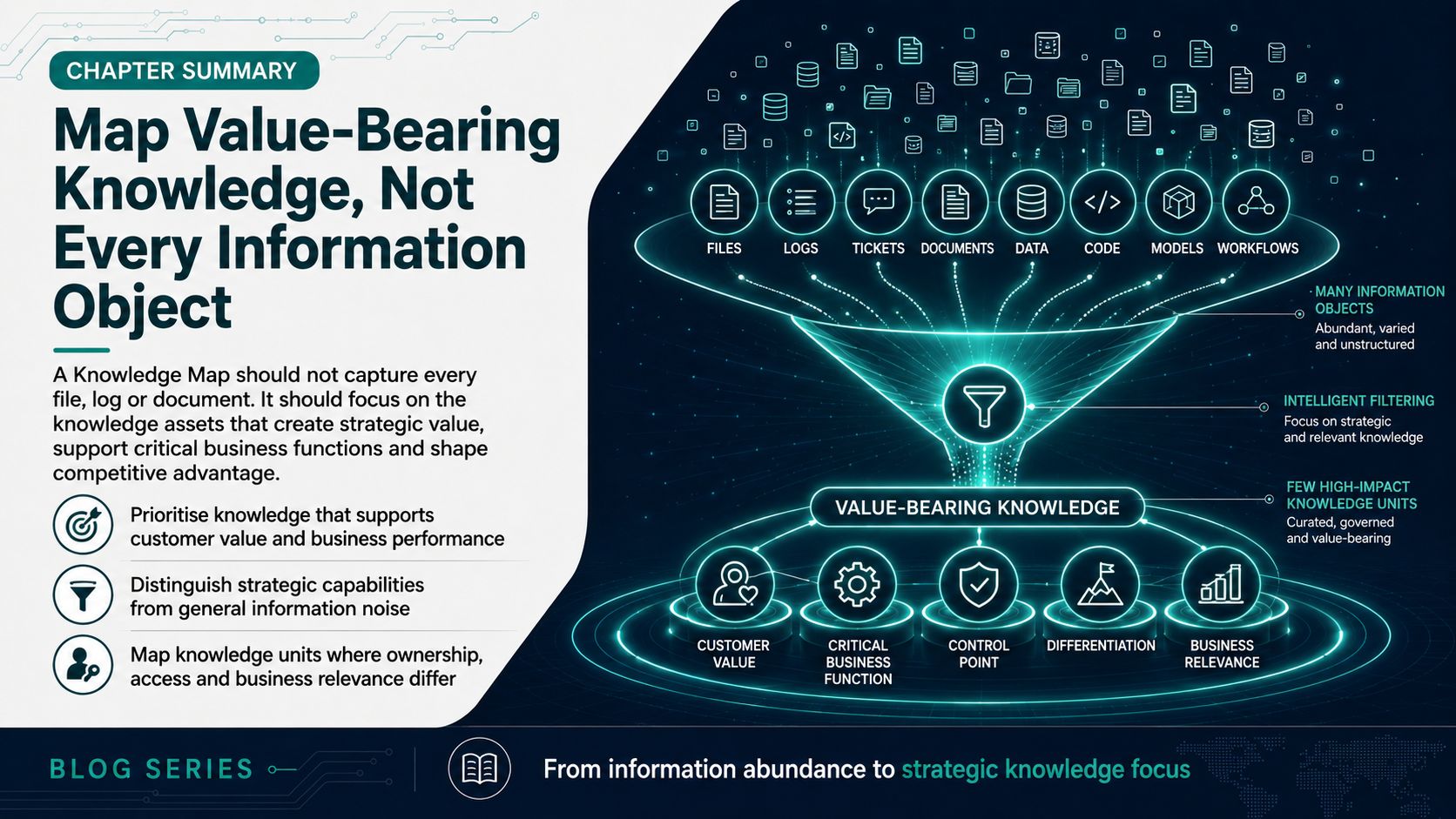
A modern company generates millions of files, logs, tickets and model artefacts. Mapping everything would produce a data graveyard rather than a management instrument. The task is to identify the knowledge that supports a strategically relevant business function and whose loss of control would weaken differentiation, bargaining power or freedom of action.
The original map used technology decomposition and process analysis. That remains useful, but the decomposition should now begin with the value architecture. Which customer promise depends on superior knowledge? Which service outcome relies on proprietary data or implementation experience? Which workflow becomes difficult to replace because the company understands exceptions better than competitors? Which interface, evaluation method or deployment process allows the offer to perform reliably? These questions connect the map to IP-needs and target matrices instead of turning it into general knowledge management.
Strategic filtering can still use the logic of value, rarity, difficulty of imitation and difficulty of substitution. Digital assets require additional questions. Can the company lawfully use the asset for the intended purpose? Can it demonstrate origin and contribution? Can the capability be reproduced without a particular person or provider? Is it documented well enough to survive a release cycle, audit, dispute or transaction? Does its value depend on secrecy, exclusive access, speed of learning, regulatory evidence or network position?
Each priority item should be described as a knowledge unit linked to a business function. The record might contain its operational effect, carriers, owner, contributors, external inputs, access groups, restrictions, evidence, dependencies and review triggers. A “predictive failure classification capability,” for example, may connect sensor histories, labelled failure cases, feature definitions, code, model weights, threshold logic, maintenance feedback and domain experts. Treating them separately would hide the capability competitors must reproduce.
The right granularity is decisive. “Software” is too broad; every file is too narrow. The map should separate knowledge units wherever ownership, access, protection, dependency or business relevance differs, while remaining understandable enough to guide management decisions.
Knowledge Map 2.0 is not an inventory of everything the organisation knows. It is a prioritised representation of the capabilities that make the business model work and of the knowledge units whose control determines whether those capabilities remain defensible.
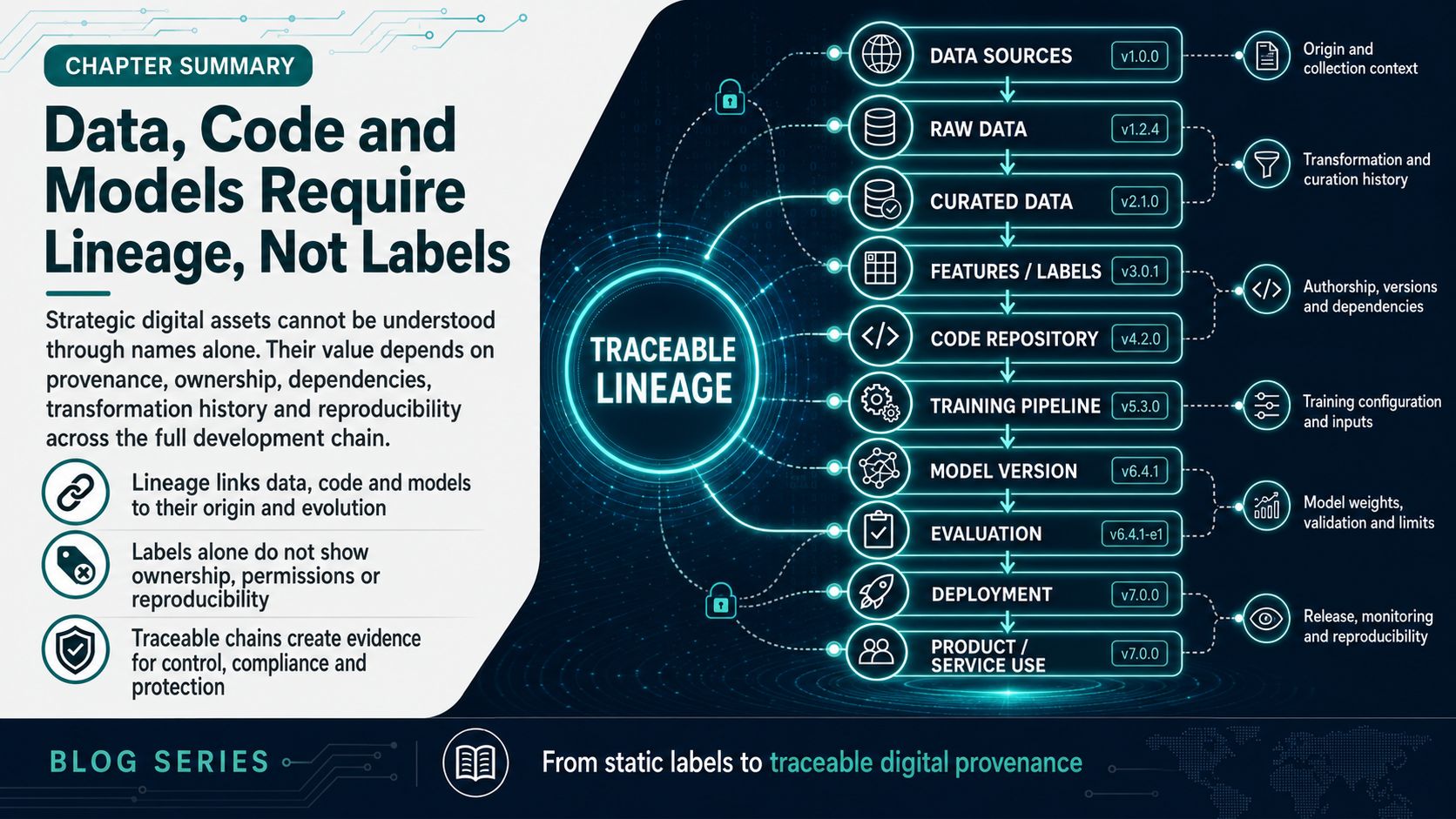
Data, code and models require lineage, not labels
Traditional mapping asks where knowledge is stored. Digital knowledge asks how the asset arose and what must accompany it for confident use. A repository name, dataset title or model identifier provides location, but not provenance, ownership, permitted use or reproducibility.
For data, the map should show source, collection context, legal or contractual basis, transformations, labelling, quality assumptions, third-party elements and permitted purposes. Raw data, curated data, derived features and evaluation sets should not be collapsed into one object. They may carry different rights and strategic functions. Selection and annotation logic may be more valuable than the raw records.
For code, lineage includes authorship, contractor status, external libraries, licence obligations, code-generation tools, version history, build environments and product releases. Copyright ownership does not eliminate operational dependence. A company may own code yet lack the knowledge to deploy or modify it. Open-source components may be appropriate, but their licences and provenance must remain visible to avoid unexpected constraints.
For AI models, the file is only one component. The map should connect base models, training data, configurations, prompts, fine-tuning, evaluation sets, thresholds, safety controls, limitations and update history. It should distinguish what is reproducible from documented inputs and what still depends on tacit expertise. A model whose behaviour cannot be reconstructed becomes a risk even when its weights are securely stored.
Lineage shows which dataset influenced which model, which code version produced which release, which supplier component enters which workflow, and who contributed each result. This creates evidence for ownership, trade-secret protection, licensing, regulatory submissions, due diligence and disputes. It also exposes concentration: several products may rely on one undocumented preprocessing routine or one externally hosted model.
The map should not duplicate engineering systems. It should link to authoritative records and add the business and IP context those tools usually lack. Version-control systems know what changed; the Knowledge Map explains why the changed asset matters, who may use it and what control is required.
For data, code and models, the decisive asset is not merely the latest file. It is the traceable chain of inputs, transformations, decisions and permissions that allows the company to prove, reproduce and strategically control the capability.
Protection is cross-functional and operational
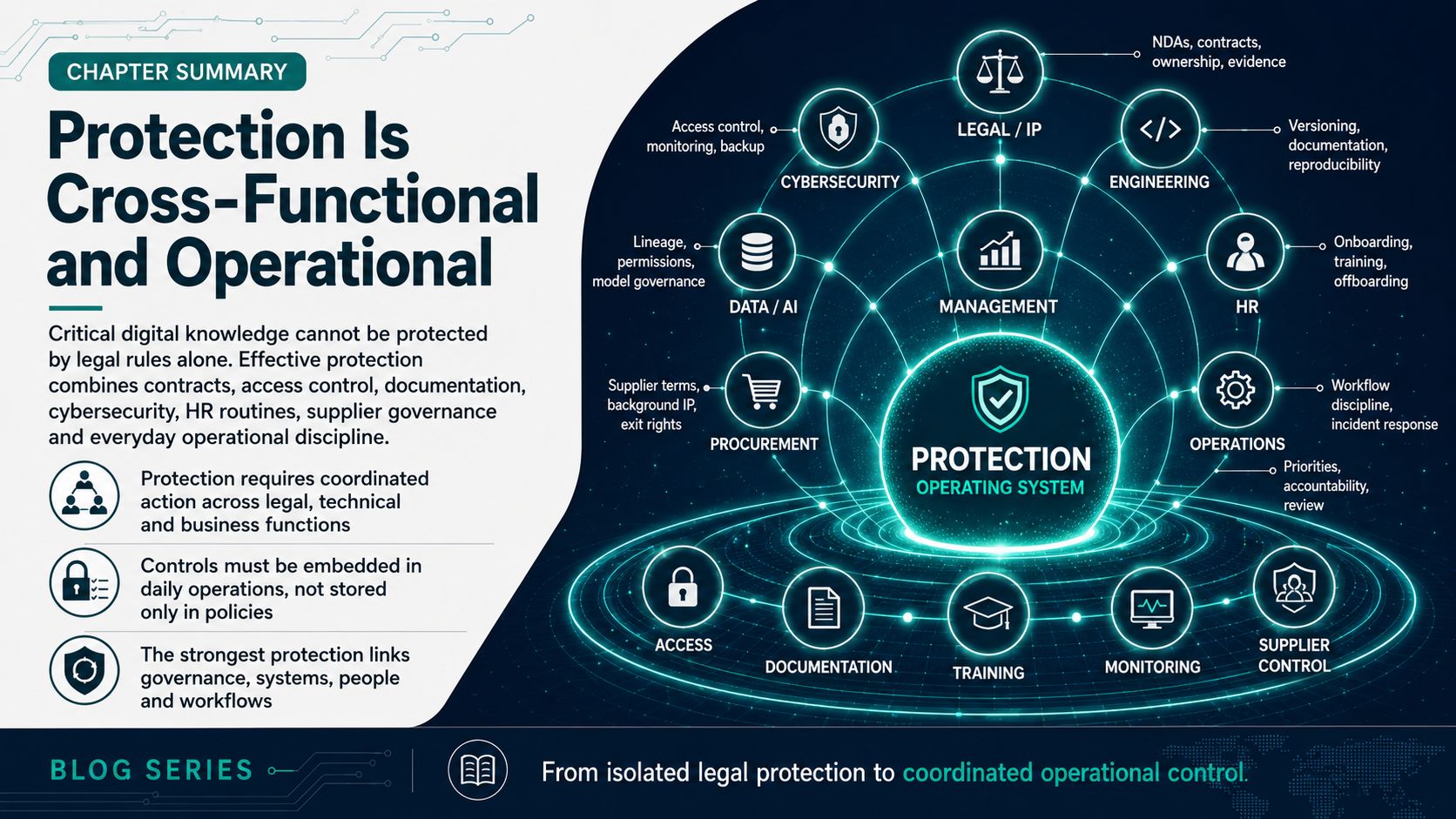
Once critical knowledge is visible, protection cannot remain with the IP department alone. Digital know-how is controlled through legal rules, technical architecture and everyday behaviour. A confidentiality clause cannot compensate for unrestricted repository access. Encryption cannot solve unclear ownership. A secure model registry does not help when an external provider may reuse training inputs under broad terms.
The map should connect every material risk with an accountable function and operational measure. IP and legal teams define protection logic, contractual boundaries and evidence. Cybersecurity translates criticality into access controls, encryption, monitoring, backup and incident response. Software and data teams maintain versioning, dependencies, model documentation and reproducible pipelines. HR integrates knowledge protection into onboarding, role changes, training and offboarding. Procurement addresses supplier access, background IP, improvement rights, continuity and exit options.
The original risk categories remain useful but need digital interpretation. Diffusion includes repository leakage, uncontrolled downloads, partner reuse and model extraction. Destruction includes corrupted datasets, lost keys, deleted environments and unavailable cloud services. Disorder appears as undocumented versions, inconsistent labels, orphaned code and uncertainty about the authoritative model. Replacement becomes technological obsolescence, unsupported dependencies or loss of access to a vendor-controlled capability. Two further risks deserve attention: contamination through third-party code, data or content with incompatible conditions, and dependency on actors who can change access, price or function.
Protection should follow proportionality. Not every item requires maximum secrecy. Some interfaces must be shared for adoption; some datasets must be accessible to partners; some code should be open source. The map should clarify the intended control effect: confidential, access-limited, licensable, publishable, escrowed, patentable, replaceable or deliberately open. This prevents blanket restrictions that slow innovation without protecting strategic value.
The strongest measures sit inside normal workflows. Access is granted by role and reviewed. Contributions are logged when code or data enters a project. Collaboration spaces apply agreed classifications. Offboarding closes accounts and confirms return or deletion. Backups are tested, and supplier exits are planned. Protection becomes verifiable behaviour rather than a policy that exists only on paper.
Knowledge Map 2.0 makes cross-functional protection manageable by linking each critical knowledge unit to concrete risks, owners and controls, so legal protection, cybersecurity, people processes and technical operations reinforce the same strategic objective.
Turn the map into a living decision system
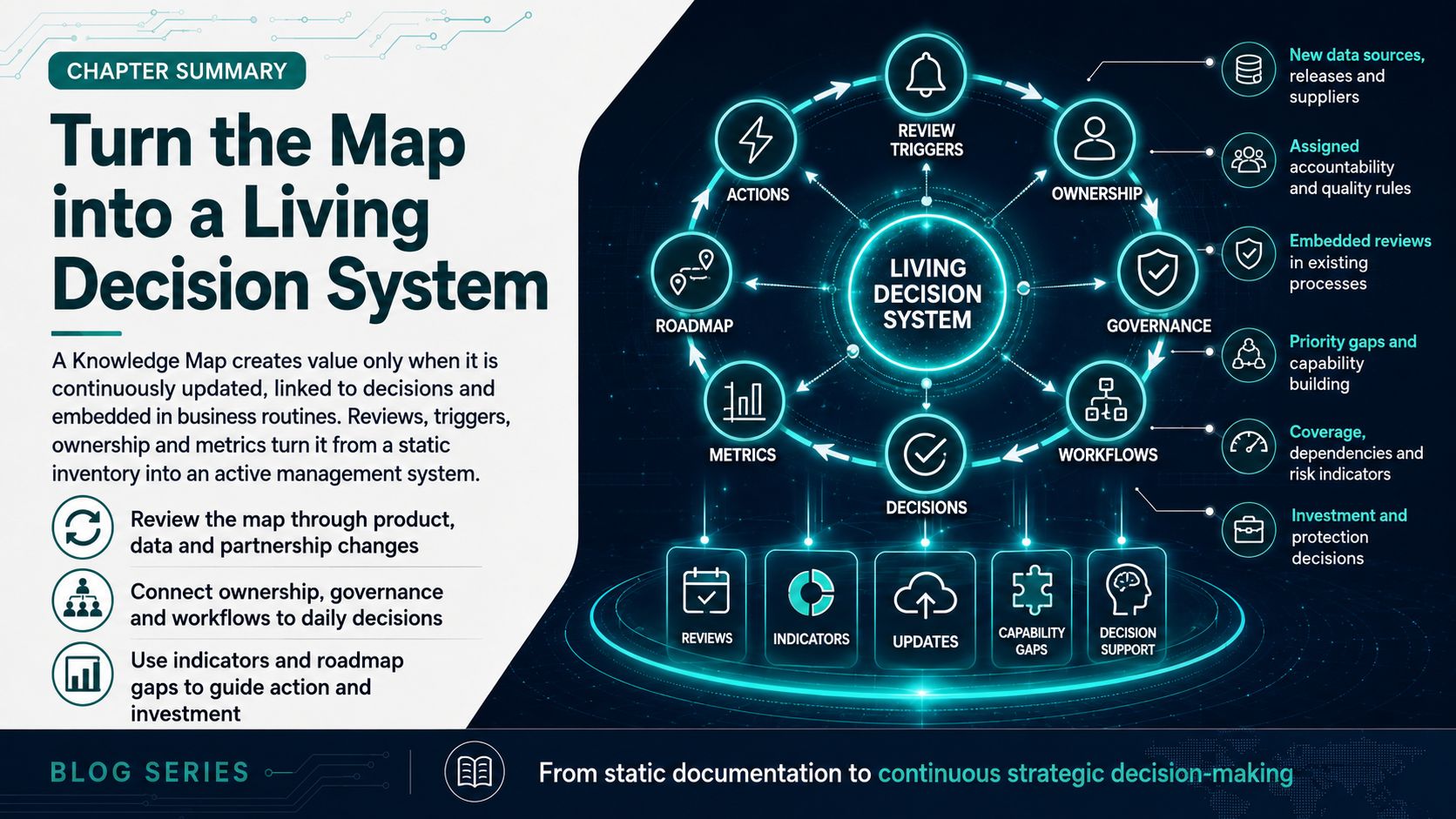
A static map ages as soon as it is completed. Digital products change through releases, retraining, integrations, customer deployments and external dependencies. Its value lies less in the visualisation than in its routines.
Review triggers should sit inside existing processes. New data sources require checks on rights, lineage and permitted learning. Major code contributions require ownership and dependency review. Model updates reopen documentation, evidence and confidentiality decisions. New suppliers, cloud services or base models require dependency and exit analysis. Partnerships should clarify contributions, improvement rights and what survives termination. Role changes and departures should trigger access review and knowledge transfer.
The map should feed other IP processes. It identifies experts and knowledge combinations for synthetic inventing. It highlights trade-secret candidates and the evidence needed to protect them. It reveals third-party components for freedom-of-action and licence analysis. It supports patent decisions by showing which effects matter commercially and which details should remain undisclosed. It improves due diligence by connecting formal rights with the capabilities, people and operational assets that make them valuable.
Governance should be distributed but explicit. Capability owners confirm business relevance. Technical owners maintain links to engineering records. Data and model owners maintain lineage and use conditions. IP, legal, cybersecurity, HR and procurement own their respective controls. A coordinator maintains taxonomy, quality rules and escalation paths. Reviews should focus on exceptions and change rather than forcing teams to remap stable assets repeatedly.
Useful indicators measure control, not document volume: coverage of priority capabilities, completeness of ownership and lineage, critical single-person or single-vendor dependencies, overdue access reviews, untested recovery paths, unresolved third-party conditions, and the time required to reconstruct a released capability. Management can prioritise remediation according to business impact instead of treating every gap equally.
The map becomes especially powerful when it compares the current capability structure with the future roadmap. The difference shows where knowledge must be built, acquired, partnered or protected before the business model depends on it. It turns strategic ambition into a visible competence agenda.
Knowledge Map 2.0 is a living decision system that connects business value with people, data, code, models, evidence and dependencies, enabling management to build future capability while preserving control over the knowledge that makes competitive advantage possible.
Supplementary content on the IPBA® platform:
Know-how Management: Why Companies Need to Understand What Only They Know
Connects source code, technical documentation, development history, employee mobility and external collaboration within one operational approach to identifying and controlling company-specific knowledge.
👉 Read more
Protecting Digital Value: Trade Secret Management
Shows how legal, cybersecurity, HR, R&D and management measures must work together when confidential knowledge is stored and exchanged through digital systems.
👉 Read more
Trade Secrets: Why Documentation Determines Whether You Have a Case at All
Explains why confidential algorithms, processes, customer data and internal strategies require documented identification, access controls and protection measures before enforcement becomes necessary.
👉 Read more
How to Introduce a Trade Secret Management System to Your Company
Provides a practical route from asset identification and documentation to confidentiality agreements, technical security, employee training and an organisation-wide culture of protection.
👉 Read more
Cybersecurity in IP Management
Extends the Knowledge Map into the technical protection environment by linking source code, datasets, models, documentation and deployment knowledge with access control, monitoring and resilience.
👉 Read more
Human Resource and IP Management
Clarifies the role of HR in protecting algorithms, technical workflows and confidential business knowledge through role-based access, awareness, onboarding and employee-transition processes.
👉 Read more
IP Collaboration Interface
Introduces the classifications, contribution logs, data-lineage records, repository manifests and model-development documentation needed when knowledge moves between teams, contractors and partners.
👉 Read more
DIN 77006 and Software License Management
Demonstrates how third-party software, open-source obligations, make-or-buy decisions and licence risks can be integrated into a systematic and continuously improved IP-management process.
👉 Read more
AI-based Medical Device IP Strategy
Offers a detailed system example in which software, training data, model configurations, validation evidence, workflows and regulatory documentation must be mapped as interconnected strategic assets.
👉 Read more
Robotics & Autonomous Systems in Motion: How IP Becomes the Control Layer of Embodied Intelligence
Provides practical context for mapping operational data, AI, software, integration know-how, suppliers and regulated deployment as one connected knowledge and control environment.
👉 Read more