Building a European UPC Litigation Strategy: Chris de Mauny on Forum Choice, Litigation Readiness and Territorial Reach

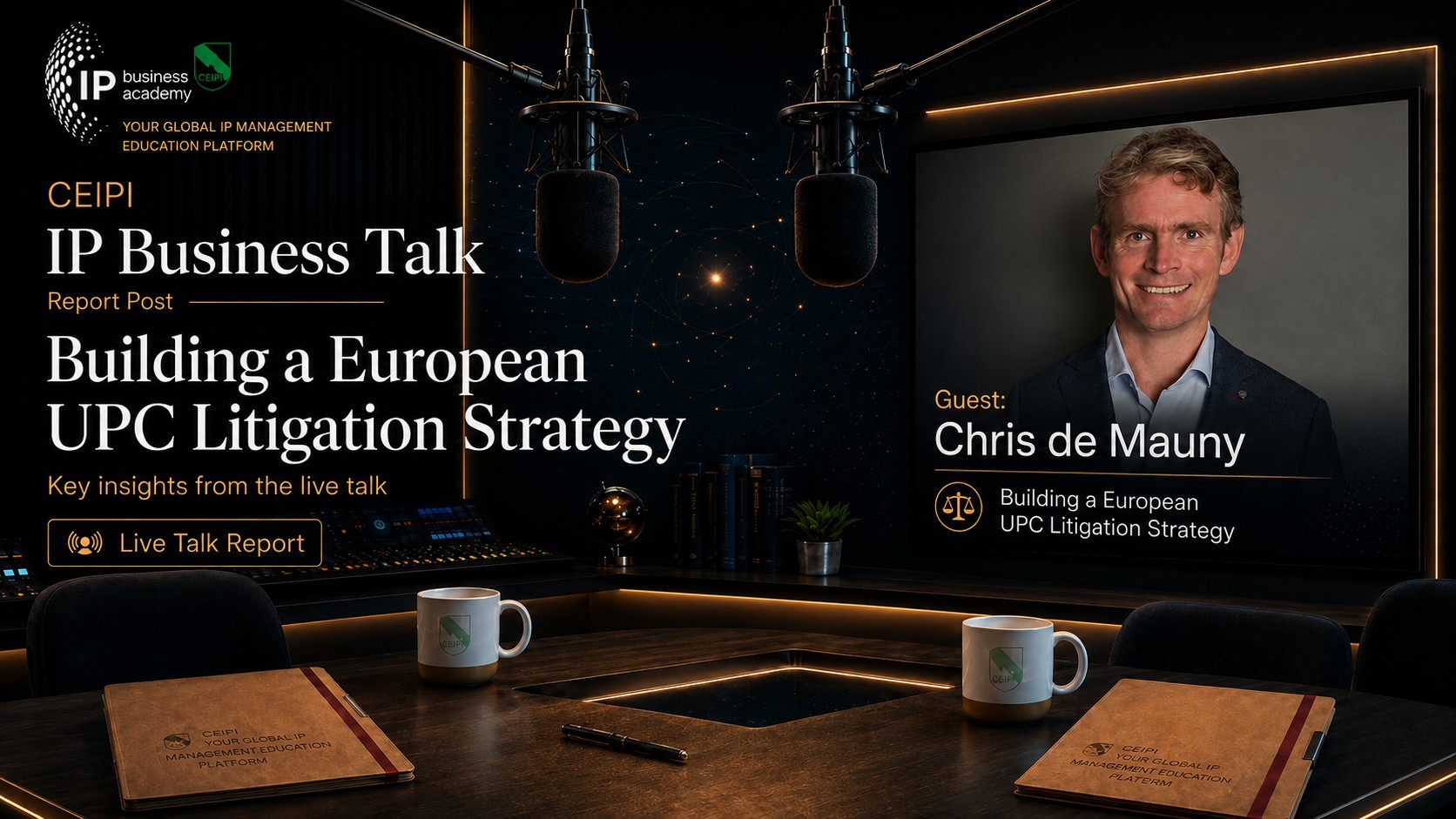
The Unified Patent Court has changed the architecture of European patent litigation. A company can now obtain remedies across a large part of Europe through a single proceeding, cases move comparatively quickly, and decisions taken in one forum may interact with EPO oppositions, national litigation and increasingly questions of extraterritorial jurisdiction.
In the CEIPI IP Business Talk, Chris de Mauny from Bird & Bird showed why these developments make litigation strategy an IP management issue. The starting point is the commercial objective of the dispute. Forum selection, timing, evidence, internal preparation and coordination across jurisdictions then need to be organised around that objective.
Commercial objectives come before forum choice
For de Mauny, the first question in European patent litigation is what the company actually wants to achieve commercially. The available forums can then be assessed according to how well their characteristics support that objective.
The UPC offers considerable leverage because a widely validated European patent can potentially produce a remedy across the participating UPC states through a single action. De Mauny highlighted both the geographical reach of such a decision and the speed with which a permanent injunction may be obtained. A decision within roughly 14 to 16 months can give a patent owner significant leverage in negotiations or enable it to exclude an infringing product from a substantial part of the European market.
National proceedings create a different strategic configuration. Where several countries are relevant, companies may need multiple cases progressing at different speeds, potentially producing different outcomes and requiring several legal teams to coordinate their work. The appropriate route therefore depends on the commercial objective, the strength of the patent, the infringement position, the importance of individual markets and the desired timing of the result.
Forum strategy continues inside the UPC
Choosing the UPC still leaves another strategic decision: which local or regional division should hear the infringement case?
De Mauny cautioned against deriving this decision simply from filing statistics. German divisions currently attract a large share of UPC litigation, yet the available outcomes do not establish a general advantage in the probability of winning a case there. The choice requires a more case-specific assessment. Relevant factors can include the experience of external counsel, the judges likely to hear the case, the need for preliminary measures or evidentiary seizures and substantive questions such as the doctrine of equivalence.
As UPC case law develops, the Court of Appeal will progressively create greater consistency. Until then, the prior experience and legal background of judges can remain relevant when assessing how particular arguments may be received. Forum selection is therefore becoming part of litigation design. The company needs to understand where its specific case, evidence and commercial objectives can be presented most effectively.
Experience is becoming a strategic asset in UPC litigation
The discussion also addressed an emerging characteristic of the UPC services market: litigation work is concentrated among a comparatively small group of firms and practitioners.
De Mauny noted that Bird & Bird itself is involved in approximately one seventh of UPC cases. In his view, clients have tended to place their confidence in lawyers who already had substantial experience in national patent litigation before the UPC opened. This creates an accumulation effect. The firms receiving UPC mandates gain further procedural experience, familiarity with the divisions and judges and an increasingly rich understanding of how the developing system operates in practice.
The UPC may be a relatively new court system, yet much of the expertise required to navigate it builds on experience from European patent litigation that existed before June 2023. For companies selecting counsel, practical litigation experience therefore becomes part of the strategic assessment alongside technical and legal expertise.
Litigation readiness starts inside the company
One of the strongest messages of the discussion concerned preparation. UPC proceedings can develop quickly, particularly where preliminary measures are involved. Effective litigation readiness therefore depends heavily on how rapidly information can move through the company. For patent owners, this begins with market intelligence. Potential infringements need to be detected and escalated quickly to people who can assess them and make decisions. A potentially serious infringement report that remains in an internal inbox for several weeks can materially affect the company’s ability to act with the required urgency.
Potential defendants face a similar organisational challenge. Where relevant patents are known, companies can prepare prior-art searches, validity analyses and potential technical responses. In many industries, however, the number of potentially relevant patents makes comprehensive preparation unrealistic. The more fundamental preparation is organisational.
Who understands the accused product or process technically? Who can explain possible design-around options? Who can assess the commercial consequences of an injunction? Which internal decision-maker can authorise the required response? Who replaces these people when they are unavailable?
A UPC dispute can suddenly require legal, technical and commercial teams that rarely work together in ordinary business to provide coordinated answers within a very short period.
The commercial impact of an injunction must be understood early
Technical infringement analysis alone does not tell a company how aggressively it should defend a case. De Mauny emphasised the need to understand what an injunction would actually mean for the business. Its effects can range from temporary inconvenience and a manageable product modification to a fundamental interruption of the company’s ability to serve a market.
That assessment requires technical and commercial input. Companies need to understand whether a workaround is feasible, how quickly it could be implemented, whether customers have substitutes, which downstream activities depend on the affected product and how broadly the economic consequences might spread. These questions influence litigation investment, settlement strategy and the commercial arguments that may become relevant when provisional measures are considered. Litigation readiness therefore becomes a cross-functional management capability involving IP, legal, technical teams, commercial functions and external litigation counsel.
The UPC creates a choice between different portfolio architectures
The discussion also considered whether the UPC and the Unitary Patent may be particularly attractive to smaller companies. De Mauny described the underlying strategic choice in terms of flexibility and simplicity. Traditional European patents can preserve a broad range of options. Companies can maintain national rights, use national courts where appropriate and potentially bring patents back into the UPC system depending on their opt-out position. This architecture allows a company to tailor enforcement to individual markets and circumstances.
The Unitary Patent creates a more integrated structure. A company knows which system it is using, has a centralised territorial position and can make use of the UPC for enforcement across the participating states.
For companies with limited resources, the simplicity of such an architecture may be attractive. At the same time, decisions concerning renewal fees, territorial coverage and exposure to central revocation remain connected to that choice. Portfolio design and litigation strategy consequently become increasingly interdependent. The way rights are constructed determines which strategic options will later be available when a dispute emerges.
UPC and EPO proceedings operate on different clocks
A further strategic challenge arises when UPC litigation and EPO opposition proceedings concern the same patent. The two institutions operate independently and may apply subtly different approaches to validity questions. De Mauny highlighted inventive step as an area where the developing UPC case law has its own characteristics. Timing makes coordination particularly important.
A UPC action can move through most of its first-instance lifecycle while an EPO opposition is still developing. Even where the EPO accelerates proceedings because UPC litigation is pending, the two systems can remain on very different timelines. This changes how arguments should be prioritised. A defendant facing an imminent UPC injunction hearing may need to optimise its validity arguments for the UPC even though an EPO appeal could later become equally important.
The position changes where an EPO proceeding is already advanced when UPC litigation starts. An upcoming decision from an Opposition Division or Technical Board of Appeal can then become highly relevant to the commercial risk surrounding an injunction, damages or settlement.
Companies therefore need to coordinate parallel proceedings according to their timing and commercial significance. European litigation strategy increasingly resembles the management of interacting proceedings rather than the management of isolated cases.
Extraterritorial jurisdiction expands the strategic map
The developing territorial reach of the UPC adds another layer. Recent cases have raised the possibility that a UPC dispute may, under specific jurisdictional conditions, address infringement of corresponding patent rights outside the UPC territory. The United Kingdom is particularly important because many European patent portfolios contain parallel rights covering both UPC states and the UK.
For international companies, de Mauny sees considerable interest in this development. A broader territorial reach can potentially allow more of a European dispute to be coordinated through one litigation strategy. At the same time, important boundaries are still being developed through case law. Questions concerning domicile, closely connected defendants, foreign patents and potentially irreconcilable judgments determine how far individual actions can extend.
The strategic implications also concern defendants. They need to consider when to challenge foreign patent rights, whether proceedings should be initiated in the foreign jurisdiction and how those actions might influence the UPC’s willingness to proceed with the corresponding infringement issues.
Timing again matters. De Mauny pointed to the importance of bringing revocation actions early enough for them to become relevant to the UPC’s procedural decisions. A foreign validity action initiated only after an adverse UPC validity decision may carry significantly less strategic weight.
From patent litigation to litigation architecture
The talk showed how strongly the UPC is changing the management context of European patent disputes. A European litigation strategy now brings together commercial objectives, patent portfolio structure, forum selection, choice of UPC division, evidence, preliminary measures, organisational readiness, EPO proceedings, national litigation and questions of territorial reach. Companies also need to prepare before a dispute becomes visible. Internal communication paths, responsibilities, technical expertise and commercial decision-making structures determine how effectively the organisation can use the speed of the UPC or respond when that speed is used against it.
The UPC therefore makes litigation preparation part of broader IP management. Patent portfolios create litigation options, internal structures determine how quickly those options can be exercised, and commercial objectives provide the criteria for choosing among them. The result is a European patent litigation environment in which companies increasingly need an architecture for enforcement and defence that exists before the first statement of claim arrives.
Chris de Mauny
 Chris de Mauny is a Partner at Bird & Bird and co-head of the firm’s San Francisco office. He is a patent litigation specialist, qualified as a barrister in England and Wales and registered as a Foreign Legal Consultant with the State Bar of California.
His practice focuses on patent disputes with an international dimension and on helping businesses understand how European litigation options interact with their wider commercial and litigation strategies. His work includes UPC proceedings, coordination with national litigation and European Patent Office proceedings, provisional measures, litigation readiness and the developing territorial reach of the UPC.
Bird & Bird’s UPC positioning
The discussion also illustrates how Bird & Bird approaches the UPC as a pan-European litigation environment. De Mauny’s perspective connects individual proceedings with the broader coordination requirements facing international companies: commercial objectives, multiple jurisdictions, parallel validity proceedings, internal readiness and the territorial consequences of enforcement.
This positioning becomes particularly relevant for companies headquartered outside Europe. From their perspective, the UPC is one element within a wider international litigation architecture. Understanding how it interacts with national European courts, the EPO and potentially proceedings outside the UPC territory becomes central to making the European system manageable.
The firm’s practical experience across a substantial number of UPC cases gives this coordination perspective a strong operational dimension. As the system matures, the ability to connect procedural knowledge with portfolio strategy, business consequences and cross-border litigation management is likely to remain a decisive element of UPC advice.