
Protecting AI-Enabled Industrial Systems as Competition Evolves with Duncan Magnus Park

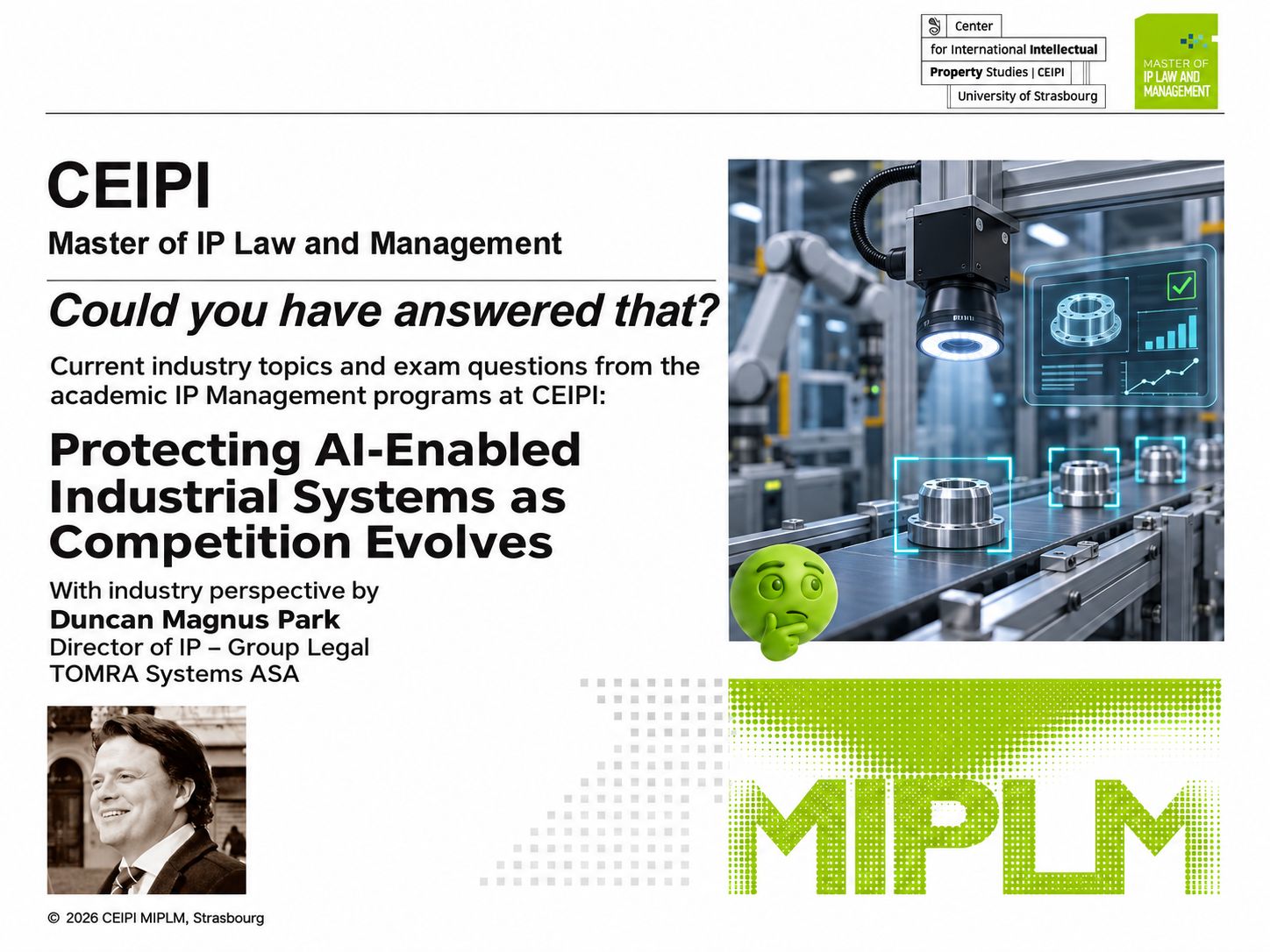
Industrial systems increasingly compete through the interaction of sensors, image processing, software and physical control. Customers value accurate recognition, reliable operation and higher throughput. Yet competing suppliers may achieve those benefits through very different technical architectures. For IP managers, the challenge is to develop protection that remains useful as both the technology and the competitive landscape change.
A portfolio built over several product generations can contain valuable technical disclosure alongside claims tied to earlier implementations. Pending applications therefore deserve renewed attention when market developments reveal commercially important uses of previously disclosed concepts. At the same time, the value of a patent position depends on whether the relevant technical features can realistically be identified in competing products.
Practice-based questions at the CEIPI IP Business Academy give students an opportunity to examine these choices in a business context. We are pleased to present this practical question with Duncan Magnus Park, Director of IP – Group Legal at TOMRA Systems ASA. The fictional company scenario abstracts the strategic challenge for teaching.
Duncan expanded the question to include trade secrets and defensive publishing alongside patent strategy. He explains its practical relevance in the following statement:
“The proposed exercise presents participants with a meaningful challenge that reflects the practical realities of developing and implementing a long-term patenting strategy. It requires consideration of multiple future development scenarios for both products and services, together with an assessment of how such innovations may be captured and protected through appropriately drafted patent claims. As artificial intelligence continues to influence the direction and pace of technological advancement, the ability to anticipate and protect future innovations has become an increasingly important issue for companies across many industries.”
Mini Case Study
A well-established European industrial technology company develops automated sorting and processing systems for demanding high-throughput applications. Its competitive position has been built over many years around sophisticated machine design, sensor technology, real-time processing and extensive application know-how.
The company has developed a substantial patent portfolio alongside successive generations of its products. Some patent families relate to image recognition technology, sensor-based detection, image classification, machine control and the interaction between physical processing equipment, digital functionality and digital platforms. As is typical for a continuously innovating technology business, parts of the portfolio are granted while other applications are still progressing through examination in major markets.
The competitive environment is also evolving. Historically, a relatively limited number of specialized technology providers have competed for many of the same industrial applications. New product generations increasingly use advanced image processing, machine learning, sensor fusion and automated decision-making to improve recognition accuracy, throughput and operating efficiency. New competitors may deliver similar customer benefits through technically different implementations.
This creates a new challenge for the company’s patent strategy. Patent applications originally drafted around earlier generations of technology may contain technical disclosure that is still relevant to today’s market, even though products, software architectures and AI implementations have evolved. At the same time, claims that are too closely linked to one implementation, one processing sequence or elements that cannot easily be observed in a competing system may have limited strategic value.
AI and machine learning can contribute to patentable inventions. In the European context, the relevant question is whether the claimed subject matter makes a technical contribution, for example through a specific technical application or implementation, while also meeting the other patentability requirements.
Management therefore wants to understand how the existing and future patent portfolio can be developed so that it protects the technical functions that matter economically in the market and remains relevant as both the company’s own systems and competing products continue to evolve.
Practical Question
How should an established industrial technology company develop its patent strategy when competitive differentiation increasingly depends on AI-enabled technical functions and competing systems achieve similar customer benefits through different technical implementations?
In particular, consider:
- At which technical levels should patent positions be created so that protection remains relevant across changing sensors, AI models, software architectures and product generations?
- How should existing patent families and ongoing prosecution be evaluated when technological and competitive developments reveal new commercially relevant implementations of previously disclosed concepts?
- Which technical features should claims focus on if patent positions are expected to remain practically relevant in relation to products and systems that can be observed and analysed in the market?
- How should the company balance broad platform protection with more application-specific patent positions around economically important sorting, classification and control functions?
- How should the company use trade secrets and active defensive publishing as part of its patent strategy in relation to technical functions and processes which cannot be observed and analysed in the market?
Why This Question Matters in Practice
In many industrial technology markets, innovation develops continuously while patent procedures extend over several years. The competitive environment visible when an application is first drafted may therefore differ substantially from the market situation during examination or at the time a patent is granted.
This is particularly relevant for software- and AI-enabled industrial systems. The underlying customer function may remain economically important while algorithms, sensor configurations and implementation details change. A patent portfolio that follows individual product generations too closely can therefore lose strategic relevance even though the underlying technical concepts remain valuable.
Competitive products can also provide information about which technical functions have become economically significant. This creates an important management question around the existing patent portfolio: whether earlier technical disclosures and still-pending applications provide opportunities to establish protection around functions that have subsequently become important in the market.
For IP managers, this means that portfolio development requires an ongoing connection between technology development, prosecution strategy and competitive observation. The objective is to build patent positions that protect technically meaningful and commercially relevant functions while remaining sufficiently robust to address alternative implementations and future product generations.
Duncan’s additional question makes the limits of external observation part of that assessment. Students must consider when confidentiality can preserve internal know-how and when deliberately publishing selected technical information may be appropriate. These choices have different consequences: disclosure gives up secrecy, while retaining knowledge internally requires effective confidentiality measures. The task is to justify a coherent combination in light of the company’s competitive objectives.
Here you can find the lecture of this practical question: Competitive Patent Strategy for AI-Enabled Industrial Systems
Duncan Magnus Park
Duncan Magnus Park is Director of IP – Group Legal at TOMRA Systems ASA in Norway. He brings around three decades of experience in the IP profession, with a focus on the relationship between intellectual property, sustainability and the circular economy. His work connects the management of intangible assets with the commercial and governance challenges facing technology businesses.
He contributes to IP management education through the CEIPI and European Patent Office university diploma in IP Business Administration. His lecture on IP in corporate compliance examines how intellectual property risk management relates to corporate governance, environmental and social responsibilities, and long-term business resilience. This perspective brings together industrial IP practice and the organisational decisions needed to make intellectual property part of responsible business management.