
IP Market Study Photonics & Optical Technologies 2026: When Light Becomes Industrial Infrastructure

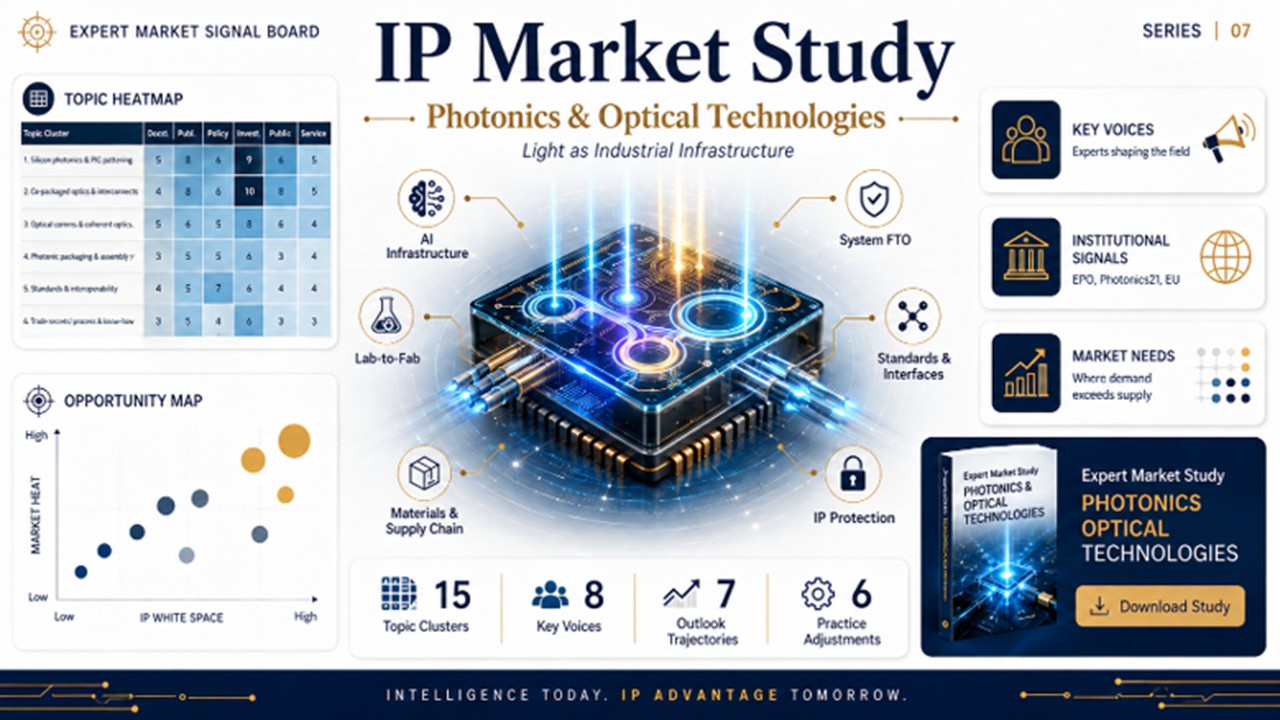
Photonics is no longer only a specialist field of lenses, lasers, optical sensors and laboratory equipment. Light-based technologies are becoming part of the industrial infrastructure behind artificial intelligence, data centres, semiconductor manufacturing, medical diagnostics, industrial production, autonomous systems and quantum technologies.
This development is expanding both the economic relevance of photonics and the range of intellectual property questions companies must address. The central issue is no longer only whether an optical component or manufacturing process can be patented, but where strategic control arises across materials, photonic chips, packaging, fabrication, calibration, software, data, standards and supply chains.
The new IP Market Report on Photonics & Optical Technologies examines this changing market from the perspective of patent attorneys, trade-secret and licensing specialists, and other IP service providers. It is designed as a market-intelligence and business-development companion for experts advising companies that develop, manufacture, integrate or scale light-based technologies, from silicon-photonics and optical-communications businesses to laser manufacturers, LiDAR developers, medical-optics ventures and quantum-photonics start-ups.
Photonics is moving into the industrial core
One of the clearest signals is the rise of silicon photonics and co-packaged optics in AI infrastructure. As computing systems require more bandwidth and greater energy efficiency, optical technology is moving closer to processors, switches and data-centre architectures. Competitive value therefore increasingly sits in the interaction between photonic devices, electronic components, packaging, coupling, thermal engineering and manufacturing processes.
This shift is accompanied by strong investment and consolidation across the photonics value chain. At the same time, Europe is expanding its lab-to-fab infrastructure, patent activity is accelerating and critical materials dependencies are becoming more visible. Photonics is therefore no longer discussed only as a promising enabling technology, but as strategic infrastructure shaped by capital, industrial policy, standards, manufacturing capacity and supply-chain resilience.
The industrialisation of photonics also depends on cooperation between many different actors. Universities, pilot lines, foundries, packaging specialists, materials suppliers, system integrators and customers may all contribute to the development of one commercial product. Each transition between these actors can transfer valuable knowledge and create new questions around ownership, access, confidentiality and future use.
The IP question is shifting from protection to control
A photonics company may own strong patents for a device and still depend on a foundry-controlled process, a specialist packaging partner, a critical substrate supplier or confidential calibration know-how. It may control the visible product without controlling the process window, qualification data or manufacturing access needed to produce it at scale.
The strength of a photonics company’s market position therefore cannot be assessed through patent counts alone. Companies need to understand which parts of the system can be reverse-engineered, which advantages are better protected as trade secrets, where third-party rights may restrict commercialisation and which supplier relationships create strategic dependencies.
This requires patents to be coordinated with trade secrets, contracts, freedom-to-operate work, standards strategy and supplier governance. The strategic task is to determine which layers must be owned, which can be shared, which should remain confidential and where contractual access or second-source rights are needed to preserve flexibility.
This is the central message of the report: photonics turns IP from a narrow protection function into a strategic control question. Good IP advice must reflect the complete technology and value architecture rather than treating patent prosecution, trade-secret protection, FTO and collaboration agreements as unrelated services.
Where the market opportunity is emerging
The report evaluates fifteen topic clusters across doctrinal activity, practitioner publications, policy attention, investment pressure, public visibility and service maturity. This makes it possible to identify areas that already attract substantial attention, but also those in which commercial demand is developing faster than the corresponding advisory market.
Classical patent services around optical communications, silicon photonics, LiDAR and biophotonics are comparatively mature. The larger gaps appear around packaging and coupling, fabrication trade secrets, system-level freedom to operate, lab-to-fab collaboration, materials dependencies and supply-chain resilience.
The strongest structural opportunity lies in the process, materials and supply-chain layer. These areas face high policy and commercial pressure, but European IP services remain comparatively underdeveloped. A second opportunity area is emerging around investment and transactions, where investors and acquirers increasingly need to understand whether a company controls the capabilities required to commercialise its technology, rather than merely whether it owns a portfolio of patents.
For IP experts, this creates space for more recognisable and commercially relevant service propositions. Examples include Photonics System IP Audits, Materials and Supply-Chain IP Resilience Reviews, Lab-to-Fab IP Structuring, fabrication know-how governance and system-level FTO linked directly to the client’s product roadmap.
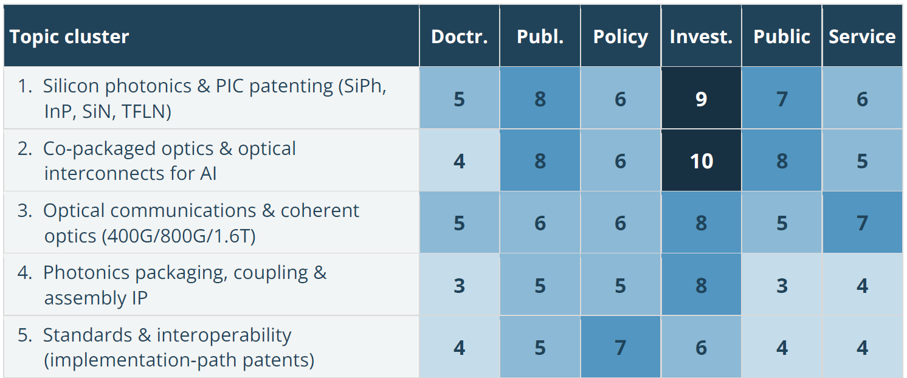
Excerpt from the IP Market Report Photonics Topic Intensity Heatmap. The Service column measures supply-side maturity, while gaps between service maturity and the demand-side indicators reveal potential opportunity zones for IP experts.
Key voices highlighted in the report
The report also identifies practitioners whose visible contributions are helping to shape the discussion around photonics, optical systems and closely related quantum technologies.
Ben Hunter, Senior Associate and Patent Attorney at D Young & Co, is highlighted as a key voice in photonics and quantum technologies; one selected contribution is Lighting the way to quantum advantage: key IP considerations for photonics.
Andrew Thompson, Partner and UK and European Patent Attorney at EIP, represents the intersection of photonics, semiconductors and deep-tech commercialisation; a selected contribution is Patents or Trade Secrets? When to Patent in Deep Tech Innovation.
Anne-Sophie Auriol, Partner and French and European Patent Attorney at Lavoix, is one of the report’s specialist voices on optics, photonics and optical claim construction; a selected contribution is Optique – étude d’une décision relative à un procédé de traitement d’images.
Iain A. McIntyre, Partner and US Patent Attorney at Carlson Caspers, is recognised for his continuous coverage of photonics litigation and patent-office proceedings through the Photonics IP Update series.
Edd Cavanna, Partner and UK and European Patent Attorney at Mathys & Squire, is highlighted for his work on quantum technologies and cross-jurisdictional patent strategy; a selected contribution is IP in the quantum industry: a global perspective on patent procurement.
Dr Shameena Bonomally, Associate and Patent Attorney at Page White Farrer, contributes an infrastructure-oriented perspective on photonics, quantum systems and semiconductor ecosystems; a selected contribution is The Technology behind the Quantum Infrastructure.
Andrew Fearnside, Senior Associate and Patent Attorney at Mewburn Ellis, is highlighted for his work across quantum technologies, photonics and ion optics; a selected contribution is Creating qubits: Making progress with photonics.
Together, these named practitioners make the developing market discussion more tangible and provide readers with direct points of reference for further exploration.
Why this Market Report is worth downloading
The full report provides a structured view of the European Photonics and Optical Technologies IP market. It covers current developments, key voices, fifteen topic clusters, concrete market needs, service opportunities for IP experts, implications for private practice and the outlook for the next 18 to 36 months.
For patent attorneys, law firms, licensing specialists and trade-secret advisers, it is not simply background reading. It is a practical map of where client demand is increasing, where service maturity remains low and where experts can develop a more visible and differentiated position.
The full IP Market Report on Photonics & Optical Technologies can be downloaded free of charge here:
👉 IP Market Report: IP for Photonics and Optical Technologies
The report is intended for IP experts working with silicon photonics, optical communications, AI infrastructure, lasers, metrology, LiDAR, medical optics, quantum photonics and the enabling suppliers beneath these markets.
Further reading
👉 Photonics in Motion: How Light-Based Technologies Turn IP into a Strategic Infrastructure Question provides the broader introduction to the transition from optical components to layered industrial systems.
👉 The Photonics Strategy Gap: What Light-Based Technology Companies Need, and What IP Advice Still Often Fails to Integrate explores the mismatch between the integrated challenges faced by photonics companies and the fragmented way IP services are often communicated.
👉 Beyond Patents: What the ASML–ZEISS Story Really Teaches About Sustainable Competitive Advantage uses the EUV ecosystem to show how patents, trade secrets, contracts, supplier relationships and accumulated capabilities work together to create a defensible industrial position.