
Practical Question Robotics/Autonomous Systems/ Mechatronics with Christoph Moisel: When Smart Machines Learn – Where Should IP Protect the Value in AI-Enabled Industrial Systems?

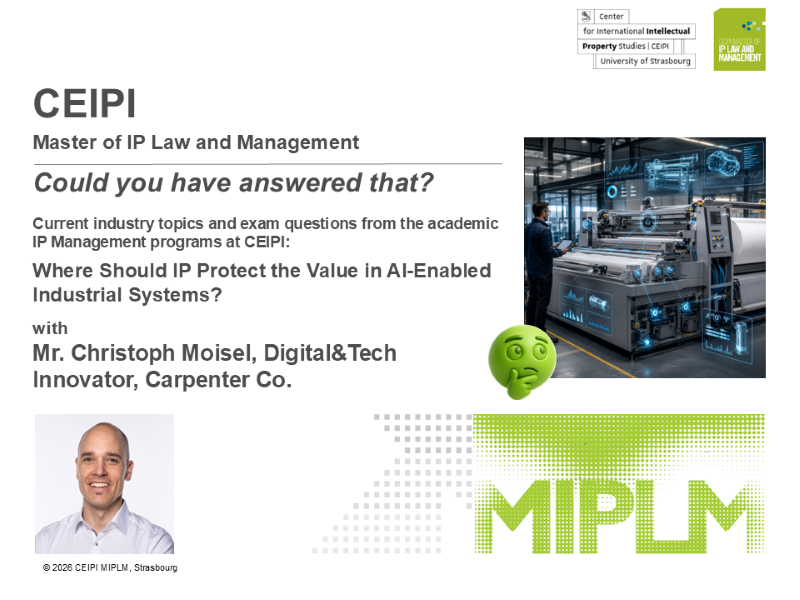
Robotics and autonomous systems are no longer only about building machines that execute predefined movements. They increasingly combine mechanical engineering, sensors, embedded software, AI models, control logic, operational data, cloud connectivity and human workflows into intelligent systems that sense, interpret, decide and act in the physical world. This is exactly the structural shift described in the CEIPI IP Business Academy analysis “The Robotics Strategy Gap”, where robotics is framed as a strategic control environment rather than as a collection of isolated protectable components.
In AI-enabled industrial production systems, value is not created by one actuator, one algorithm or one machine module alone. It emerges from the way mechanical reliability, sensor placement, process data, control software, historical production knowledge, predictive maintenance logic, adaptive parameter settings and customer-specific operational learning are combined into a system that can improve machine behavior over time.
This creates a strategic IP challenge for manufacturers of smart mechatronic systems. A next-generation industrial machine may become valuable not only because it performs a production task, but because it becomes the entry point into a digital service model: performance improvement, benchmarking, remote optimization, predictive maintenance and customer-specific process intelligence. The Robotics Strategy Gap analysis emphasizes that such companies increasingly need to decide what must be controlled in order to scale, collaborate, operate safely, attract investment, preserve freedom to act and build defensible market positions.
Yet the same integration that makes the machine commercially attractive can also expose the very control points that make it defensible. Sensor data, model-training logic, adaptive control routines, machine-specific process know-how, user interfaces, software architecture, cloud infrastructure and customer deployment data may all contribute to competitive advantage. Protecting only the visible machine may miss the strategic layer. Protecting everything through patent filings may be too slow, too costly or may disclose know-how that is better protected internally.
The Christoph Moisel case highlights exactly this tension in the context of AI-enabled smart mechatronic production systems. A European manufacturer of industrial foam-processing equipment is preparing the next generation of machines, moving from mechanically reliable equipment toward a data-driven architecture that supports automated process recommendations, predictive maintenance and adaptive parameter settings during operation.
This is closely connected to the shift described in the CEIPI IP Business Academy analysis “The Robotics Strategy Gap”. The article shows that robotics companies increasingly operate in a layered innovation environment where patents, software, data, trade secrets, safety architecture, standards, cybersecurity, contracts, suppliers, regulation and market access interact. In such an environment, IP can no longer be reduced to patent protection for hardware or software functions alone. It must help management decide where system control, dependency, scalability and bargaining power actually arise.
Here you find the findings of this study: “The Robotics Strategy Gap: What Autonomous Systems Companies Need, and What IP Advice Still Often Fails to Integrate.”
Against this background, the CEIPI IP Business Academy integrates practice-based questions from industry into its teaching. These questions help students understand IP not only as a legal protection tool, but as a management instrument for strategic decision-making in intelligent industrial systems. In robotics and autonomous systems, this means looking beyond isolated inventions and asking where the value-bearing layers of embodied intelligence actually lie.
We are therefore pleased to include this industry case study with Christoph Moisel, who brings a practitioner perspective from the field of smart machines, mechatronic production systems and AI-enabled industrial automation.
His practical question focuses on a central issue for robotics and autonomous systems in manufacturing: how a company should decide which parts of an AI-enabled machine intelligence architecture should be protected through patents, which should be kept as trade secrets, and which should be controlled through data access, software architecture and customer contracts.
The case shows why robotics and autonomous systems require a hybrid IP management approach that connects patents, trade secrets, data governance, software architecture, contracts and operational know-how into one coherent strategy. Here Christoph Moisel’s assessment:
“In my view, this task is highly relevant to real-world practice, and I see no need to change it. In my previous role, I actually discussed and initiated such patents on several occasions. We grappled with the exact questions described here. Striking the right balance between protection, business model flexibility, and speed is a highly challenging task that requires careful re-evaluation in each case, taking into account the many influencing factors. That is why I think it is excellent for students to engage with this topic.“
Mini Case Study
A European manufacturer of industrial foam-processing equipment is preparing the next generation of its production machines. The current machines are mechanically reliable and well known in the market, but customers increasingly expect higher uptime, lower scrap rates, faster changeovers and more transparent process control.
To respond, the company develops an AI-enabled smart machine architecture. Sensors are added to critical machine modules. Process parameters, vibration data, temperature profiles, tool wear indicators and product quality signals are captured continuously. The data are combined with historical production knowledge to support automated process recommendations, predictive maintenance and adaptive parameter settings during operation.
The commercial promise is significant. The machine could become more than a capital good: it could become the entry point into a digital service model based on performance improvement, benchmarking, remote optimization and customer-specific process intelligence. However, the development team is under pressure. Sales wants to launch quickly. Engineering sees value in the mechanical improvements. The digital team sees value in the data model and learning loop. Management wants to know what can create defensible market advantage before committing to a platform rollout across several machine families.
The IP question is difficult because the value is distributed across several layers: mechanical machine design, sensor placement, data acquisition, control logic, process know-how, AI-supported recommendations, user interface, cloud connectivity and customer-specific operational data. Protecting only the visible machine may leave the strategic control point unprotected. Protecting everything through patent filings may be too slow, too expensive and may disclose know-how that is better kept internal.
Practical Question
How should a manufacturer of AI-enabled smart mechatronic production systems decide which parts of the machine intelligence architecture should be protected through patents, which should be kept as trade secrets, and which should be controlled through data access, software architecture and customer contracts?
Why This Question Matters in Practice
This question becomes relevant when a traditional machine builder moves from selling equipment to offering digitally enhanced, data-driven or performance-based machine solutions. At that point, competitive advantage no longer lies only in mechanical quality or engineering experience. It may lie in the ability to capture operational data, translate it into process intelligence, improve machine behaviour over time and embed the customer relationship into a learning system.
The question is especially relevant for industrial machinery companies, automation suppliers, IIoT solution providers, smart manufacturing teams and R&D leaders responsible for digital product strategy. It also matters for IP managers, CTOs, product owners and business development teams who must decide where technical differentiation becomes economic leverage.
The issue becomes strategically important under three conditions. First, the machine generates data during real customer use that can improve future products or services. Second, the system combines hardware, software, AI models and process know-how in a way that makes the source of value difficult to isolate. Third, the company wants to scale the solution across customers without losing control over the learning loop.
In practice, the wrong IP decision can directly affect the business model. If critical control logic is disclosed too early, competitors may design around it. If everything is kept secret, the company may lack visible protection for investors, partners or strategic customers. If customer data access is not secured contractually, the feedback loop that makes the system smarter may never materialize. The economic challenge is therefore not simply to “protect the invention,” but to design an IP position that preserves freedom to scale, supports service revenues and secures the control points of industrial machine intelligence.
Christoph Moisel
 Christoph Moisel is a digital and technology innovator with a strong engineering background and deep expertise in IIoT, data analytics, AI, digital transformation and industrial R&D. He holds a Dr.-Ing. in mechanical engineering from the University of Siegen, where he also worked as a research associate, and has built his career at the intersection of mechatronics, industrial machinery, sensor-based systems and AI-enabled production technology. His work focuses on creating transparency in complex industrial processes, developing learning systems and translating digital technologies into practical value for users and manufacturing organizations.
Across roles at Albrecht Bäumer, Recticel Engineered Foams and Carpenter Co., he has led R&D, product innovation, digitalization, automation and AI initiatives in international industrial environments. His responsibilities have included company-wide product strategy, smart machine development, manufacturing digitalization across EMEA and APAC, AI application development, sensor and data acquisition architectures, dashboarding, process optimization and the alignment of AI initiatives across business units. Christoph Moisel is also named in multiple patents, has contributed to internationally peer-reviewed publications and combines strategic vision with hands-on technical leadership in building digital product strategies, innovation ecosystems and smart industrial solutions.