When Global Manufacturing Data Becomes a Strategic IP Asset in IIoT with Esteban Remecz

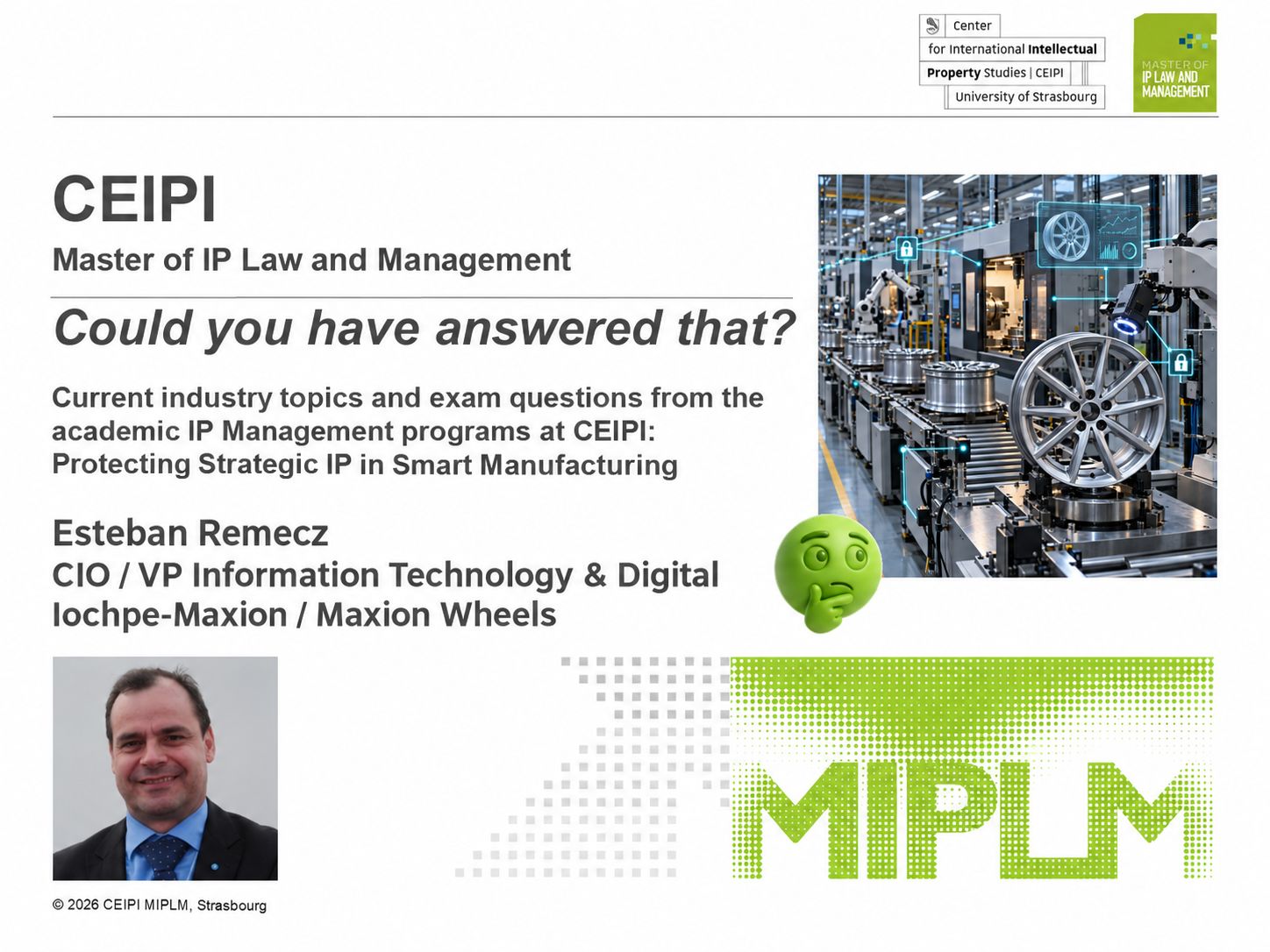
In Industrial IoT, the most valuable asset of a manufacturing company is often no longer a single machine, a single sensor or a single software tool. The strategic value emerges from the way industrial equipment, production data, ERP systems, analytics, AI applications and global IT governance are connected into one operating model.
This is particularly relevant for global automotive manufacturing. Wheel production, structural components, quality assurance, logistics and plant operations are deeply physical processes. But once these processes are digitally connected, measured and optimized across multiple sites, they become something more than production capacity. They become a data-driven manufacturing system.
The practical IP question is therefore:
When a global automotive manufacturer connects machines, production data, ERP systems, analytics and AI into a smart manufacturing architecture, how should IP management identify and protect the interacting system elements that create competitive advantage, and secure control over their use and further development as the system evolves?
The situation
A global manufacturer of automotive wheels and structural components operates across different regions, plants, production lines and customer requirements. Each site generates operational knowledge: machine performance, process stability, quality deviations, maintenance needs, energy consumption, material behaviour, tooling parameters and production bottlenecks.
Traditionally, much of this knowledge remained local. It was embedded in engineering experience, plant routines, supplier relationships or production know-how. In an IIoT environment, this changes. Sensors, industrial connectivity, ERP integration, data platforms and analytics tools make it possible to collect, compare, optimize and standardize production intelligence across sites.
The business opportunity is obvious. Better data can improve uptime, reduce scrap, accelerate troubleshooting, support predictive maintenance, increase quality consistency and enable more resilient manufacturing networks. AI tools can identify patterns that individual plants would not see. Global dashboards can turn fragmented operational experience into scalable decision intelligence.
But this is also where the IP problem begins. If the competitive advantage comes from the interaction of many elements, classical IP protection becomes incomplete. A patent on one sensor feature does not protect the data model. Copyright in software does not protect the process insight. Trade secret protection may cover know-how, but not necessarily the interfaces through which suppliers, integrators or platform partners access the system. Contracts may govern data access, but only if the relevant control points have been identified early enough.
The decision problem
The company must decide what exactly needs to be protected. Is the core asset the connectivity architecture between machines and systems? Is it the production data model that translates machine signals into operational intelligence? Is it the AI-based analytics layer that predicts failures or quality deviations? Is it the accumulated manufacturing know-how behind the dashboards? Or is it the global governance model that determines who may access, reuse, train on or commercialize the data?
For IP management, this is not a filing question alone. It is a portfolio architecture question. Some parts of the IIoT system, including specific combinations of interacting components, may be candidates for patent protection. A system architecture does not qualify automatically because it creates business value. In a European patent assessment, the claimed solution must meet requirements including novelty, inventive step and industrial applicability; for mixed technical and non-technical features, the inventive contribution must lie in a technical solution to a technical problem. Other elements may be more effectively protected as trade secrets, particularly production parameters, data cleaning methods, model training routines, plant-specific optimization logic or internal performance benchmarks.
At the same time, many of the most important value positions may not be protected primarily through registered IP rights. They may depend on contracts, access rules, data governance, supplier agreements, interface specifications, cybersecurity controls and internal documentation. In a smart manufacturing environment, IP protection becomes inseparable from system governance.
Why this matters
In Industrial IoT, suppliers, software vendors, machine builders, cloud providers, system integrators and analytics partners often touch the same value chain. Each of them may contribute technology. Each of them may also gain access to operational data, process knowledge or improvement logic.
This creates a strategic risk. A manufacturer may invest heavily in digital transformation, only to discover later that essential parts of the learning curve are visible to external partners. A platform provider may understand cross-plant production patterns. A machine supplier may gain insight into failure behaviour. An analytics vendor may help develop models that become valuable beyond the original project. A system integrator may learn how the manufacturer connects equipment, data and decision processes across the group.
These partners are essential to the transformation. The manufacturer therefore needs to define IP responsibilities, confidentiality obligations and data access and reuse boundaries from the start, and review them as the system develops and becomes operationally valuable. If this is not done, the company may lose strategic control over the very architecture that makes smart manufacturing powerful. It may own the factories, but not the data logic. It may own the machines, but not the analytics layer. It may own the process experience, but not the rights to reuse the digital models derived from it.
The IP management task
For a CIO-led IIoT transformation, IP management must move closer to the architecture of the system. It must understand where data is generated, where it is processed, where decisions are made, where external partners are involved and where learning accumulates over time.
The first task is to map the value layers and their interactions. These may include machine connectivity, sensor data, control systems, ERP integration, production models, analytics algorithms, AI training data, dashboards, process know-how, maintenance logic and supplier interfaces. The assessment should examine how data is prepared, how analytical models generate results and how those results feed back into production control. Which specific interactions deliver a technical improvement, and which knowledge and capabilities make that improvement difficult to reproduce?
The second task is to assign protection modes. Some technical solutions may justify patent filings after their patentability and strategic relevance have been assessed. Other elements require secrecy protocols, technical access restrictions, contractual data clauses or internal documentation standards. Data and algorithms should be assessed in their specific context and function within the system. Some interfaces may need to remain open for interoperability, while others must be carefully controlled because they define access to the strategic system.
The third task is to define ownership and usage rights early and revisit protection decisions as development progresses. IIoT projects often start as operational improvement initiatives. As they scale, accumulated data, models and relevant analytical algorithms may become strategic assets. Agreements should address access, reuse, model training and rights to improvements before partners create or exchange these assets. Patent filing decisions require a sufficiently developed technical solution that can be disclosed clearly and completely enough for a skilled person to carry it out; a commercially deployed system is not a prerequisite. This calls for staged reviews as solutions become concrete, before disclosures could compromise protection.
The boardroom question
The real decision for the company is therefore not simply: Do we protect our IIoT inventions?
The stronger question is:
Do we understand which parts of our smart manufacturing architecture create strategic advantage, and have we designed the IP, data and partner governance needed to keep that advantage under our control?
This is the kind of question that connects the CIO agenda with IP strategy. It shows that Industrial IoT is not just a technology deployment issue. It is a question of who controls the learning system behind industrial performance. For a global automotive manufacturer, the answer may determine whether digital transformation remains an efficiency program — or becomes a defensible source of long-term competitive advantage.
Here you will find the lecture “Industrial IoT: How IP Management Secures Competitive Advantage in Connected Manufacturing” regarding this exam question:
Esteban Remecz
 Esteban Remecz is Chief Information Officer at Iochpe-Maxion and Vice President and CIO at Maxion Wheels. He brings more than 25 years of experience in strategic IT leadership, governance and innovation, with a particular focus on smart manufacturing and Industry 4.0. His responsibilities include developing and implementing the group’s IT and digital strategy, supporting acquisition due diligence and integration, and advancing the use of Industrial IoT, big data and artificial intelligence in automotive manufacturing.
Earlier in his career, Esteban served as CIO for Asia Pacific at ZF Group. He holds a PMP certification and a postgraduate diploma in Digital Strategies for Business from Columbia Business School. A founding member and former chairman of the China CIO Alliance, he has also contributed to international executive networks through advisory roles with the Gartner C-Suite DACH community and the Global CIO Institute. His professional focus combines international IT leadership with the practical application of digital technologies to industrial operations.