Superfakes and Ultra-Dupes: Who Infringes When the Customer Finishes the Job?

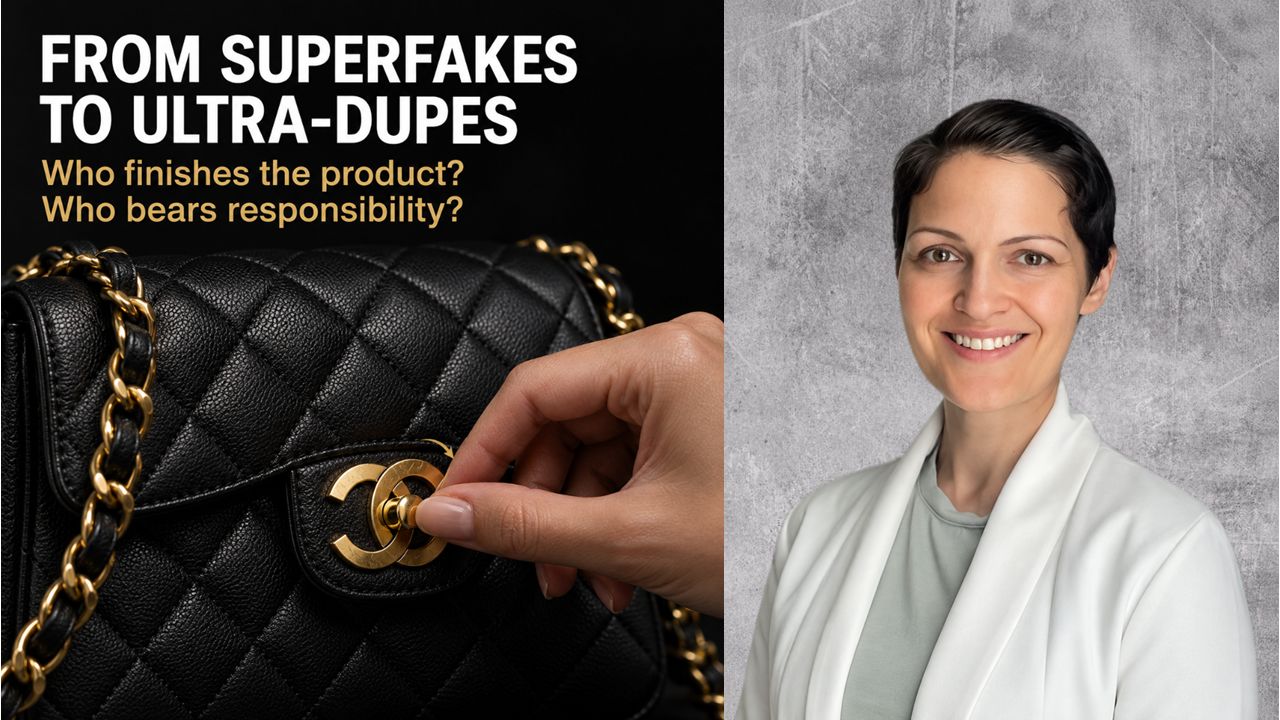
A couple of years ago, I wrote here about superfakes (https://ipbusinessacademy.org/superfakes-the-new-level-of-deception). At that point, the interesting development was quality, since counterfeits had become so good that the usual visual distinction between “real” and “fake” was becoming unreliable. Same materials, astonishing workmanship, packaging down to the last detail, to the point that sometimes even an experienced authenticator had a problem. The product was still legally rather boring though, in a sense that it had CHANEL written on it, or HERMÈS, or ROLEX. In other words, however sophisticated the object, somebody had put somebody else’s trade mark on it, and that was a clear case. Since then, imitation has developed a more interesting sense of humour.
We now have products which deliberately stop just short of the final protected element. The shape is there, the visual language, sometimes the typography, hardware, proportions and packaging – all are there. And in the more inventive versions, the customer can perform the last little “operation” themselves. Remove something, or attach. Turn something around, or change one letter, and suddenly the object reads as Chanel, Omega or another famous brand.
I have seen the expression “ultra-dupe” used for this emerging category. While it has no autonomous legal meaning, which is probably part of its charm, it describes something sitting along the continuum between inspiration and counterfeiting, and it creates a genuinely interesting legal problem. Who infringed?
Dividing the work
Imagine a handbag. The manufacturer produces a quilted bag with a chain strap and hardware deliberately constructed so that the buyer can make a small alteration and produce something visually extremely close to Chanel’s famous double-C sign. But the tiny twist is that, as sold, the protected sign is not quite there, yet after thirty seconds in the buyer’s hands, magically, it is.
The manufacturer can then make a rather seductive argument: we never put the Chanel trade mark on anything. And they actually did not! The customer, on the other hand, can make another one: I am a private individual modifying something I own.
Taken separately, both statements may contain quite a lot of truth. But if you put them together, we have a commercial system deliberately capable of producing the very result neither participant supposedly created. That is what makes ultra-dupes more interesting than traditional counterfeits, exactly because they can distribute legally significant acts across several people.
Law usually prefers identifiable acts and identifiable actors, but human ingenuity, as usual, reads the rules and starts playing with the spaces between the verbs, and apparently, this particular game is not even new. In the 1982 South African case Omega, Louis Brandt et Frère SA v African Textile Distributors, the defendant supplied watches bearing the word HOMEGAS. Retailers could remove the first and last letters, leaving OMEGA. Evidence showed the wholesaler knew this was happening and even supplied a special tool that facilitated the alteration. That factual pattern is almost suspiciously perfect for the ultra-dupe discussion. The product, as supplied, did not yet bear OMEGA. The final transformation happened downstream. Yet the choice of HOMEGAS, the structure of the product and the seller’s knowledge of what retailers were doing made it rather difficult to treat the later alteration as somebody else’s entirely independent act.
I would be careful not to over-read the case, as it predates the current EU trade mark framework, arose in a different jurisdiction and concerned passing off. But the architecture is remarkably familiar: one party designs and supplies the conditions for the imitation, another performs the final step, and the legal analysis has to look beyond the last pair of hands that touched the product. So yes, “distributed counterfeiting” has been around for rather longer than TikTok.
Is the customer the infringer?
Under EU trade mark law, usually not merely because s/he modifies and wears the product privately. Article 9 of the EU Trade Mark Regulation gives the proprietor the right to prevent third parties from using protected signs in the course of trade.
The Court of Justice has repeatedly described use in the course of trade as use in the context of commercial activity with a view to economic advantage, rather than use as a private matter. So a woman sitting at home, modifying her own bag and then carrying it around Brussels is in a very different position from the manufacturer selling thousands of bags.
EU design law makes the separation even clearer. Under the current EU Designs Regulation, acts carried out privately and for non-commercial purposes are expressly outside the exercise of EU design rights. The private customer therefore has considerably more breathing room than the commercial seller. Until, potentially, she stops behaving as a private customer, like resell the modified products regularly, or offer customisation as a service, or maybe run an online business around them. In other words, use them commercially in ways that cross the line from private conduct into economic activity.
Now the legal analysis changes, and “complicity” needs some care as a word. There is no single EU trade mark doctrine under which every knowing buyer becomes the accomplice of an infringer. Accessory liability, contributory infringement, unfair competition and criminal liability depend heavily on the jurisdiction and the particular conduct. Simply knowing exactly why the product was designed that way does not automatically turn a private buyer into a trade mark infringer. The manufacturer has a more difficult problem.
The thirty-second loophole
Suppose the manufacturer has genuinely made an ordinary bag which someone later decides to customise into something resembling Chanel. Theoretically, that might happen. People paint bags, replace hardware, attach charms and generally do strange things to objects after buying them. A manufacturer cannot realistically remain responsible for every transformation theoretically available to an imaginative customer. Now change the facts. The manufacturer designs the hardware specifically so that two components become interlocking Cs when rotated. The product photography shows the transformation, reviews openly and clearly celebrate the “hack”, maybe even influencers demonstrate it. The seller carefully avoids doing the last physical step themselves, fine. Still, that last fact begins to look considerably less impressive.
Trade mark infringement still requires a proper analysis of the sign actually used by the trader. Courts should not simply replace legal requirements with a general feeling that somebody is being cheeky, but what changes here is that the entire commercial context becomes evidence. What exactly was designed? How was it presented? Which features were chosen?What did the seller teach customers to do? Why? That last question can matter particularly where a famous mark is involved and the claim concerns unfair advantage rather than conventional origin confusion.
The law already has some experience with traders who deliberately want customers to think of another brand while simultaneously making sure customers know they are buying something else. “I wanted the customer to think immediately of Chanel, but obviously I did not want them to believe Chanel manufactured this €79 bag” may be factually accurate, but you would agree that it is hardly the end of the analysis.
Confusion can happen later
There is another complication. The purchaser frequently knows perfectly well that s/he bought a dupe. Ok… The person who sees the product later may know nothing about the transaction (this matters because trade marks do their work after sale too).
In 2025, the UK Supreme Court dealt with this in Iconix v Dream Pairs, involving the UMBRO logo and a sign used on Dream Pairs footwear. The Court confirmed that post-sale circumstances can matter when assessing trade mark infringement. Dream Pairs ultimately won the appeal on the facts, but the Supreme Court expressly rejected its attempt to confine actionable confusion to the transactional context. Someone encountering the shoes after purchase may perceive the sign differently from the purchaser who saw the Amazon listing, the price, the seller name and all the other contextual information available at checkout.
Now that distinction is particularly interesting for ultra-dupes. At the moment of sale, everybody may understand the “joke”. At the restaurant three weeks later, the observer sees only the bag. The customer may never have been confused, but the market still can be. There is a nice legal oddity here. Post-sale confusion may strengthen the case against the commercial trader without necessarily making the private owner of the product an infringer herself. Hence, the person who performs the final physical transformation and the person exposed to legal liability can therefore be different people.
What if the customer changes nothing?
Then things become simpler. A product does not acquire immunity merely because it avoids the famous word mark. Luxury products usually contain several possible layers of protectable subject matter: registered designs, unregistered designs, figurative trade marks, position marks, three-dimensional marks in the appropriate circumstances, copyright, and national unfair-competition rules. A manufacturer may therefore sell something clearly identified under its own name and still have a problem.
The difficult cases concern products where consumers know they are buying the cheaper alternative. That makes traditional confusion arguments less comfortable. Brands consequently reach for other rights and other theories: design protection, trade dress in jurisdictions that recognise it, copyright, protection of reputed marks, unfair advantage, passing off and unfair competition. That is also why the word dupe itself tells us surprisingly little about legality, while consumers use it as… a cultural category.
And now, the right to repair
Could the emerging European right to repair somehow support this new culture of modification?
At first sight, there might be a connection. Both concern what happens after a product has been sold. Both push against the manufacturer’s ability to control the object forever. Both involve third-party components, alterations and the customer’s growing expectation that buying something gives them meaningful freedom to do things with it. Legally, however, we have to separate several ideas that are often bundled together under the friendly label “right to repair”.
The EU Directive on common rules promoting the repair of goods (Directive (EU) 2024/1799) is principally consumer and sustainability legislation. Member States were required to apply their implementing rules from 31 July 2026. It creates and supports repair obligations for product categories already subject to EU repairability requirements. It does not create a general IP privilege allowing consumers or businesses to reproduce the appearance of luxury goods. Much more relevant for our discussion is the separate repair clause in EU design law. The current EU Design rules exclude protection for certain component parts of complex products where they are used solely to repair the complex product so as to restore its original appearance. Read that last part again. Restore. Original. Appearance.
Repair has a destination
Imagine that a genuine product has a damaged appearance-dependent component. An independent manufacturer produces a replacement part allowing the owner to restore the object to the appearance it had before the damage. That is the territory the repair clause is designed to address, subject to its conditions.
Now imagine an ordinary handbag being fitted with a replacement clasp that makes it look like Chanel. Nothing has been restored. An identity has been added instead where there was none. A product has moved towards the appearance of somebody else’s product rather than back towards its own original appearance. Calling this “repair” would require a fairly heroic interpretation of the English language before we even reach the legislation.
The same applies to tuning and customisation. The Court of Justice already made clear that restoration of original appearance is central to the repair exception. The current legislation builds that limitation directly into the statutory architecture and that produces a useful dividing line.
A third party making an appearance-dependent spare component for the repair of a genuine luxury product may potentially have a design-law argument. But a third party making a component whose purpose is to transform another product into the visual equivalent of that luxury product is doing something quite different.
The first preserves an existing identity, but the second clearly manufactures one.
Trade marks make the boundary harder still
Even a legitimate repair under design law does not hand the repairer a free trade mark licence. The Court of Justice made that very clear in Audi v GQ in 2024. The dispute concerned replacement radiator grilles incorporating an element designed for attachment of Audi’s four-ring emblem. The argument was essentially that aftermarket competition and repair should permit this.
The Court refused to import the design-law repair exception into trade mark law, because EU trade mark legislation contains its own rules. The design repair clause cannot simply be applied by analogy to cut down a trade mark proprietor’s rights. That decision is particularly relevant to the ultra-dupe discussion.
Suppose an aftermarket component is perfectly lawful from a design perspective because it genuinely repairs a complex product and restores its original appearance. A protected trade mark incorporated into that component presents a separate question. Yes, IP rights overlap, but exceptions generally do not migrate between them because it would be too convenient if they did.
Ownership still means something
There is a broader tension underneath all this. We are moving, quite rightly in my view, towards stronger consumer control over physical products after purchase. I believe that manufacturers should not be able to use IP rights as a universal mechanism for locking customers permanently into their own repair ecosystem. The European reforms clearly push against captive spare-parts markets, artificial restrictions on repair and premature disposal of products. At the same time, ownership of a physical object has never meant ownership of every intellectual property right embodied in it. Buy a Chanel bag and the bag becomes yours. The name CHANEL does not. Buy a car and you can repair it. The manufacturer’s trade marks do not enter the glove compartment together with the registration documents.
That distinction sounds painfully obvious until new technology and new business models begin distributing the acts of copying, modifying and manufacturing among different people. Then the obvious becomes operationally difficult rather quickly.
The strategic consequence for brands
Superfakes forced luxury brands to improve authentication. Ultra-dupes, in my view, require something more fundamental. Namely, brands need to understand exactly which parts of the product make the consumer recognise it as theirs, and which legal rights actually cover those elements. The logo is the easy bit. But… What happens when the logo disappears? Would the silhouette still be protected? The clasp? The quilting? A recurring graphical pattern? The shape of a bottle? The combination of packaging elements? A distinctive interface? The answer cannot be invented after the copy arrives.
And there is a second issue. Enforcement strategy will increasingly have to follow the architecture of the imitation itself. If the value appropriation happens across several steps, looking only at the final object may tell you remarkably little about whom to pursue. The manufacturer may have designed the transformation. A platform may have distributed it. An influencer may have taught customers how to complete it. The buyer may have performed the final physical act. Third parties may then encounter the finished product and attribute it to the original brand. In other words, there might be several actors and several legally relevant moments for one object, and that is a rather different enforcement map from raiding a warehouse full of bags stamped CHANEL.
Where does that leave the ultra-dupe?
Somewhere very useful. I think “ultra-dupe” does not need to become another legal category, as we already have quite enough categories to keep IP lawyers employed. But I consider its value to be diagnostic, because it forces us to stop treating infringement as something that necessarily arrives fully assembled. Liability then has to be reconstructed from the particular rights involved, the commercial acts of each participant, their knowledge and intention where relevant, and the way the product functions before and after sale.
The right to repair adds another boundary, although a narrower one than its attractive political label might suggest. European law is giving consumers and independent repairers more freedom to preserve the products they own. It is doing so around a very specific concept: repair means restoration. That freedom does not extend to turning one product into the commercial identity of another.
Superfakes made the fake difficult to see; ultra-dupes may make the infringing act difficult to locate, and for IP strategy, the latter may prove to be the more interesting problem.
Maria Boicova-Wynants
 Maria Boicova-Wynants is an IP lawyer, European Trade Mark Attorney, mediator and IP strategy consultant with more than 20 years of experience across intellectual property law, strategy and international business. She helps founders and executives align intellectual property with their business models, commercial priorities and growth ambitions. Her work combines legal expertise with an understanding of the human factors that influence business decisions.
Her practice encompasses trade mark and design protection, contracts, transaction support, negotiations and mediation. She also provides training on IP strategy, decision-making and risk awareness, helping organisations build their internal capabilities. Through her writing and educational activities, she makes complex IP issues accessible and connects legal developments with their practical consequences for businesses, creators and consumers. Practice and expertise