
When the invention is only part of the advantage 🎯IP Management Pulse #68


Subscribe for compact, in-depth IP intelligence: trends, cases, and research curated by the team of the IP Business Academy and the IPBA Connect Platform. Get practical insights into current developments in IP management and learn from leading experts in the context of business models, innovation and R&D.
Here you can find the latest issues in the archive and also subscribe. A fresh read with important IP Management content will be sent to subscribers every second Thursday at 7:00 (CET), so that they can start the day informed.
A scheduling note: IP Management Pulse is taking a summer break after this edition. The next issue will therefore appear on 24 October rather than 10 September as originally scheduled.
The next newsletter will cover the following topics:
Smart Automation Depends on More Than the Robot
Vanessa Loiola recently shared nine principles that distinguish “just automation” from smart automation. Viewed through an IP-management lens, her checklist points to an asset that is easy to overlook: the practical knowledge required to make robotic systems work reliably in their actual operating environment. The question is how companies can retain enough of this implementation know-how to adapt, maintain and improve automation without creating unnecessary dependencies.
GreenTech Competition Needs to Be Mapped by Outcome
Michael Liebreich has reopened the debate about how energy transitions should be measured, arguing that the focus should be on the services delivered rather than simply on energy inputs. For IP management, the same logic raises an important competitive question: what if very different technologies solve the same underlying customer or industrial problem? Traditional technology categories may then provide only a partial picture of the real competitive landscape.
Quantum Advantage Creates a Validation Dilemma
Sabrina Maniscalco, CEO of Algorithmiq, recently highlighted a fundamental challenge for quantum computing: how can technological advantage be demonstrated once classical systems can no longer reproduce the result? This creates a strategic tension for IP management. Companies need enough openness to make performance claims credible while still protecting the algorithms, methods and implementation knowledge behind that performance.
Litigation Leverage Starts Before Litigation
The UPC is changing not only how European patents are enforced, but also how portfolios need to be designed long before a dispute arises. A new article based on insights from Christof Augenstein looks at how decisions around claim scope, divisional strategy, validation and other prosecution choices can shape the enforcement options available years later. Litigation readiness can therefore begin much earlier than the litigation itself.

Know-how Management
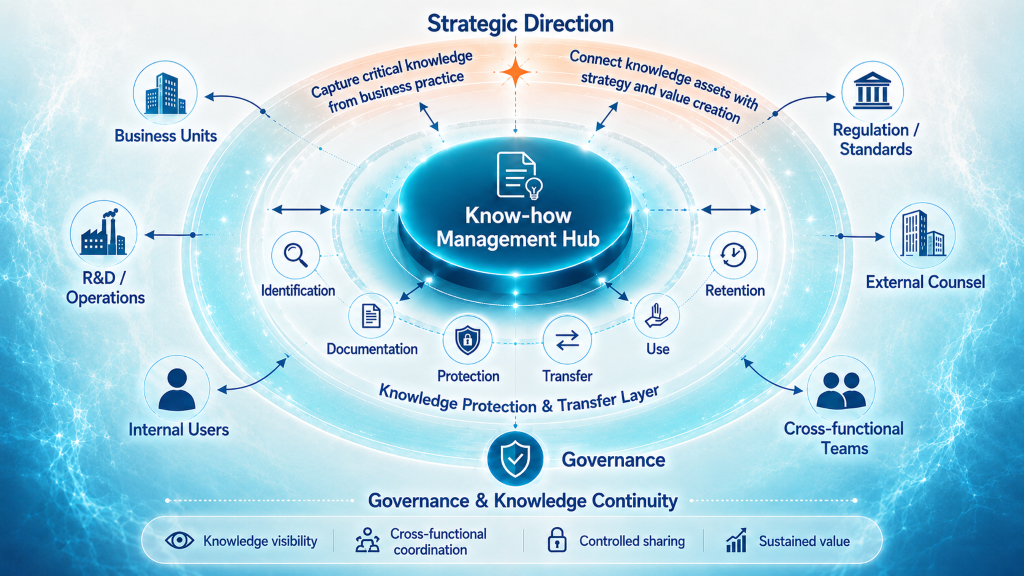
Some of the most valuable IP in technology-driven companies never appears in a patent portfolio. It can reside in experience, process details, technical judgment and the knowledge required to make complex systems perform reliably. Our latest dIPlex Deep Dive examines how companies can identify such critical know-how and manage the boundary between knowledge that needs to circulate and knowledge that should remain protected.
How IP Partners Can Build Authority Without Acting Like Marketers
Many IP partners remain uncomfortable with the idea of personal branding because it can sound like self-promotion. Giulia Donato argues that professional authority is built differently: by making visible how an expert thinks, which client decisions they are particularly good at navigating and what they notice that others may overlook. The result is a clearer market position without having to behave like a marketer.

When Digital Business Models Enter a Crowded IP Space
Digital transformation may feel new inside a traditional industrial company, while the relevant IP landscape is often already mature. Software-controlled systems, AI, connectivity and data-driven services have attracted patent activity for years. Our IP Management Learning looks at why IP management should therefore become involved before a new digital business model has been fixed.