Digital Twins of Factories 🎯 IP Management Pulse #63

Subscribe for compact, in-depth IP intelligence: trends, cases, and research curated by the team of the IP Business Academy and the IPBA Connect Platform. Get practical playbooks for positioning, LinkedIn, and business development. Learn from leading experts in the context of business models and R&D. Join the IPBA Connect community and turn IP knowledge into results — with dIPlex, live formats, IPBA Connect, and white papers as your launchpad.
Here you can find the latest issues in the archive and also subscribe. A fresh read with all important IP Management content will be sent to the subscribers every second Thursday at 7:00 (CET), so that they can start the day informed.
The next newsletter will cover the following topics:
Digital Twins of Factories
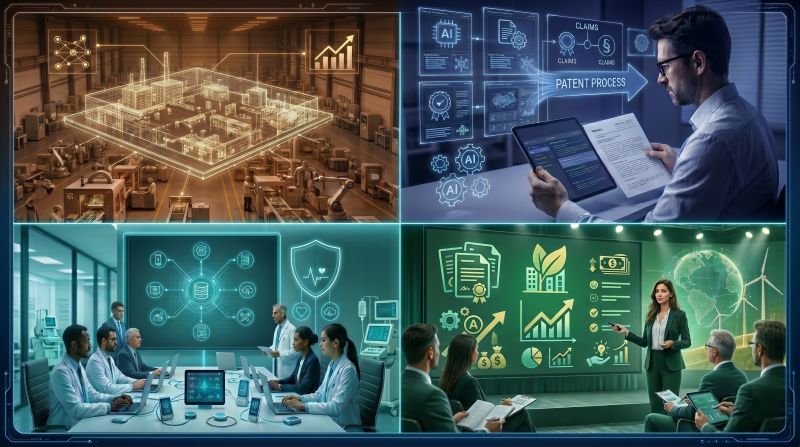
The concept of the Digital Twin becomes more and more important in industrial settings and now not only individual machines, but whole factory floors or factories are getting a digital counterpart. A current example can be seen in the AI-integrated digital twins employed by Unilever with assistance from Accenture. Their digital replicas are a tool to fulfil e.g. predictive maintenance tasks or improve the effectiveness and efficiency of workers.
Patent drafting software for inventors
New IP management software is entering the market nearly every day. While most of it is expert software aimed at IP professionals or at least persons responsible for IP in a company, some tools are created explicitly for the layman. One example are patent drafting tools, which are targeted at inventors. The importance of such tools is shown by the huge amounts of funding their developers receive, e.g. the $5.5 million received by tech startup Fearn.
From MedTech devices to platforms
Developers of MedTech devices are increasingly switching from producing individual devices to offering connected platform solutions. A current example is continuous glucose monitor producer Dexcom, which offers to purchase Nutrisense for its capabilities in the area of individualized dietary recommendations. Those capabilities enable the company to become more of a digital platform, instead of just producing measurement infrastructure.
Patents in GreenTech funding
The growth of new industries depends a lot on the availability of private and public funding opportunities. In both cases the presence of patents indicates to investors and public funding bodies that the venture is serious about its activities and able to defend them in the market. A current GreenTech example for this is the recycling startup GR3N, which owns patents for its novel recycling process and its recycling machinery.
OFB Fireside Chat about “AI in IP Management”
Artificial intelligence is becoming the major transformation topic in intellectual property management. Yet the central question is no longer whether AI tools will be used, but how they must evolve to create measurable value for industry and professional services.
In this Open Foresight Board Fireside Chat, Johannes Ernicke and Hannes Burger will discuss what companies expect from the intellectual property system and why the market needs more capable, specialized and business-oriented AI solutions. Building on the results of the Open Foresight Board study, the conversation will explore how industry demand can become a mandate for technology providers, patent departments and patent law firms.
Why IP Needs a New Narrative Role Inside the Business

Intellectual property experts possess insights into market access, competitive advantage and product strategy, yet businesses perceive IP as protection, cost and legal risk. This narrative frame develops through repeated interactions in which IP appears only when problems arise or decisions have already been made. Individual communication improvements help, but lasting change requires consistent organizational positioning. IP should be understood as a strategic capability that shapes what companies build, protect, scale and monetize. The most influential IP professionals act as strategic interpreters, translating technical and legal expertise into business decisions and becoming associated with better outcomes, not merely necessary processes.
Who Controls the Critical Layer in Remote Patient Monitoring?
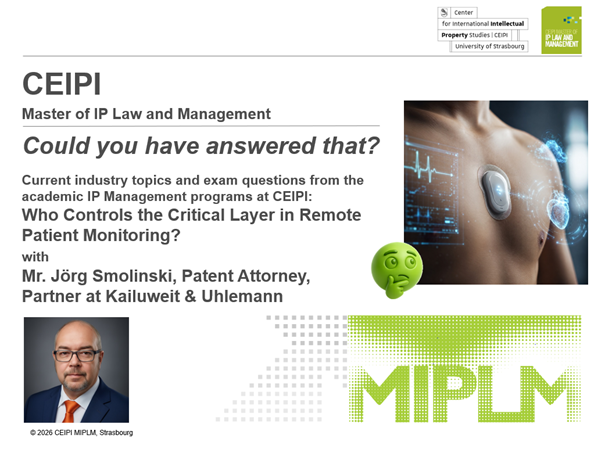
Remote patient monitoring systems create value not through wearable devices alone, but through the transformation of physiological data into clinically meaningful action. The case study examines a MedTech company combining sensors, an app, cloud-based signal processing and clinician dashboards. Its challenge is identifying the primary intellectual property control point before scaling. Protection may be needed around device architecture, signal processing, workflow integration, data pathways or service models. Choosing the wrong layer leaves competitors room to design around hardware or capture clinical relationships. Choosing the right one strengthens investment readiness, licensing power, freedom to operate and positioning in connected healthcare markets.
Intellectual property models in GreenTech
 GreenTech innovation requires intellectual property strategies that evolve across the technology lifecycle. Based on a publication about 57 European Inventor Award cases, the podcast episode shows that innovators usually begin with closed models, using patents and trade secrets to secure investment, define ownership and enable collaboration. During commercialization, universities and startups often shift toward exclusive licensing because they lack manufacturing capacity. In the diffusion phase, non-exclusive licensing becomes more important for global scaling. Fully open models remain rare because patents alone do not transfer the tacit knowledge needed for implementation. Effective GreenTech strategy therefore balances control, collaboration, licensing, speed and long-term value capture successfully.
When Music Meets Ice: Copyright Complexity in Olympic Figure Skating
Olympic figure skaters face a copyright landscape when selecting music. Multiple licences may be required for compositions, recordings, synchronization and worldwide broadcasting, often from fragmented rights holders. Time pressure and territorial differences increase risk. Centralized licensing, collecting societies, royalty-free music and commissioned works can reduce complexity and protect performance preparation.