
Synthetic Inventing for Digital Business Models

The original 360° IP Strategy made a demanding distinction between recognising a need for IP and creating the assets required to satisfy that need. A company may know that a customer-relevant advantage should be made exclusive, yet still lack the inventions and claims needed to create that position. Synthetic inventing closes this gap. It does not wait for an invention disclosure. It starts with the competitive effect the business wants and works backwards towards technical solutions capable of supporting a purposeful IP position.
That logic is even more relevant in digital business models. Customer value is frequently generated by the interaction of software, data, interfaces, automation, services and physical products. The strategically important invention may lie in a system behaviour, a feedback loop, a decision sequence, a data transformation or the coordination of several actors. Synthetic inventing therefore has to move beyond additional product features. Its modern task is to design exclusivity around the digital mechanisms through which value is created, delivered and improved.
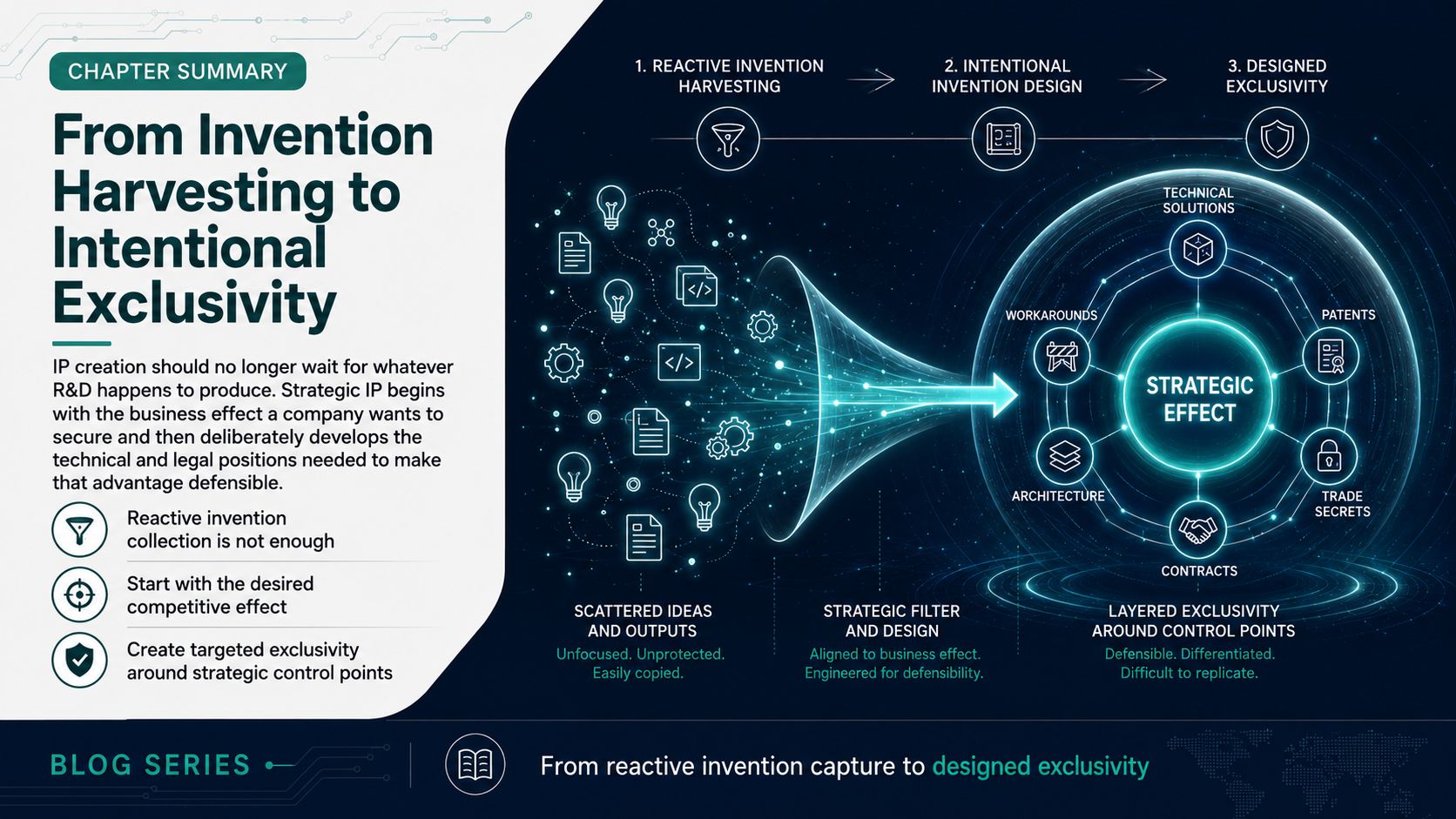
From invention harvesting to intentional exclusivity
Traditional patent processes usually begin with something that already exists: an engineer has developed a solution, recognises it as potentially inventive and reports it to the IP function. The organisation then evaluates novelty, inventive step, strategic relevance and filing options. This invention-harvesting logic remains necessary, but it is reactive. It can only protect what development happens to produce and what employees identify and report.
Synthetic inventing reverses the direction. The starting point is an IP need derived from the business model, competitive strategy and desired customer effect. Management may decide, for example, that competitors should not be able to offer the same reduction in downtime, seamless onboarding experience or automated quality improvement without entering a protected technical space. The question is no longer simply, “What have we invented?” It becomes, “Which technical solutions could create this commercially important effect, and which should be deliberately developed into protectable positions?”
This distinction prevents the patent portfolio from becoming a historical record of engineering activity. A technically impressive invention may have little influence on buying decisions, margins or market structure. A modest technical detail may determine whether a digital service is easier to integrate, more reliable or less costly to operate. Synthetic inventing prioritises the latter when it carries greater business impact.
The purpose is not to produce more applications, but to create the right exclusivity at the right point. Some findings will be protected by patents; others may be better secured through trade secrets, copyright, contracts, access controls or architectural choices. The strategic need comes first.
Synthetic inventing turns IP creation from a by-product of R&D into a directed management activity. It connects the desired competitive effect with deliberately developed technical solutions and prevents scarce patent budgets from being absorbed by inventions that are protectable but commercially peripheral.
The strategic object is now the digital system
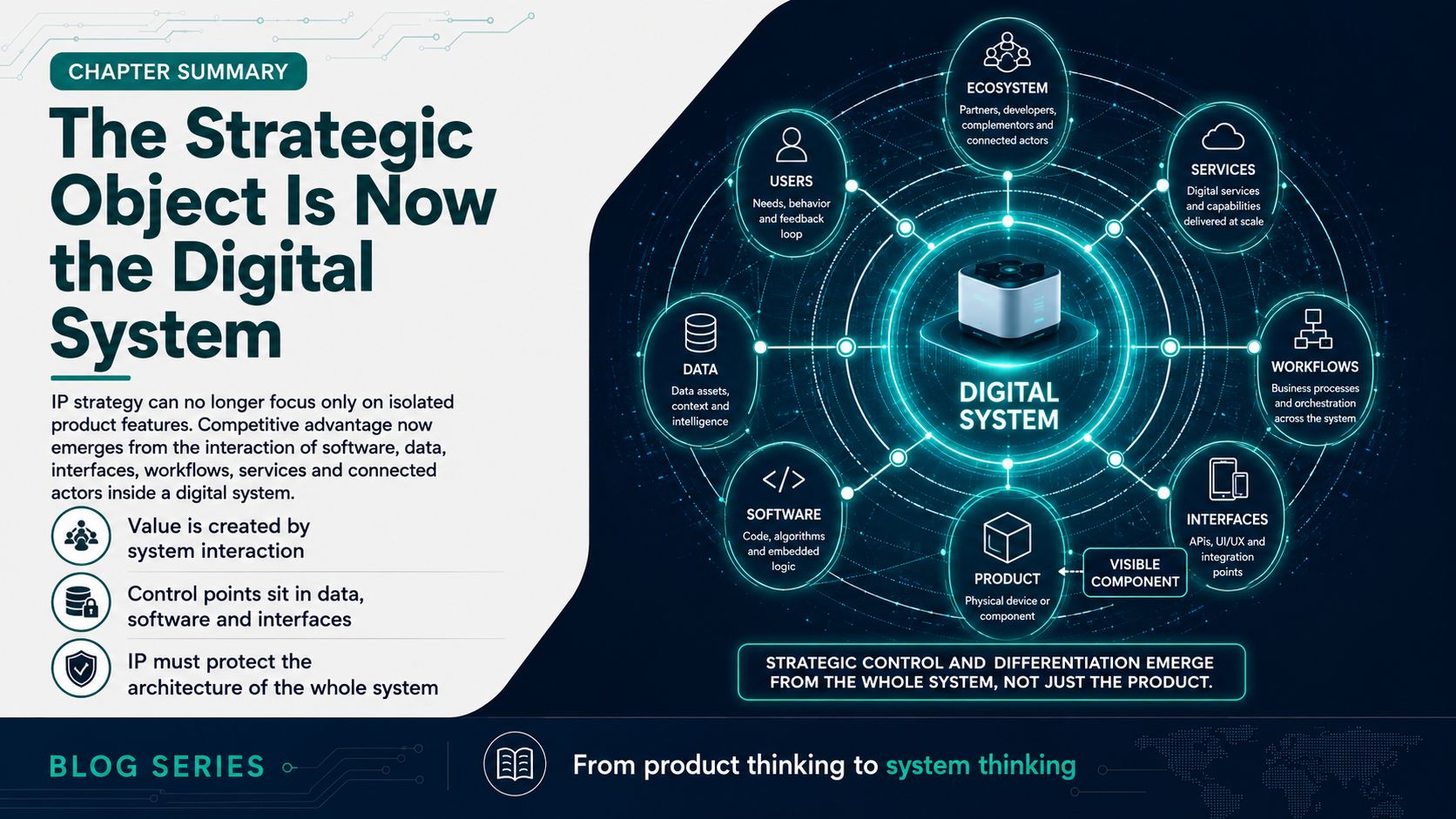
In a traditional product context, synthetic inventing could focus on the technical basis of a customer benefit embodied in a machine or device. Digital value creation expands the object of invention. A predictive-maintenance promise, for example, may depend on sensor placement, edge processing, data cleansing, model training, confidence thresholds, alert logic, user interfaces and service intervention. Protecting only one algorithm or sensor leaves most of the value architecture exposed.
Relevant search fields now include data pipelines, feedback loops, AI workflows, APIs, digital twins, orchestration logic, remote configuration, automated decision paths and service processes. These are not merely supporting elements around the “real” product. They may be the mechanism that creates availability, accuracy, convenience, learning effects or switching costs. Synthetic inventing must identify where technical interaction within the system makes the customer benefit possible.
The decisive effect may result from several known components combined in a new architecture. It may arise over time, when operational data improves a model and changes future system behaviour. It may depend on where computation occurs, how permissions are assigned or when data is exchanged. The invention environment is often a configuration of relationships rather than a standalone component.
Digital systems also evolve after launch. New releases, models, data sources and partner integrations change the customer experience and technical architecture. A patent position designed around the first product version may become strategically irrelevant even while the patent remains legally valid. Synthetic inventing must therefore follow roadmaps and anticipated system states, including functions not yet implemented but likely to become control points.
The modern invention target is the technical architecture that produces a valued system outcome. By examining interactions, sequences, dependencies and learning mechanisms, synthetic inventing can create IP positions around the way digital value works rather than around whichever component is most visible.
Model use, context and value flows before claims
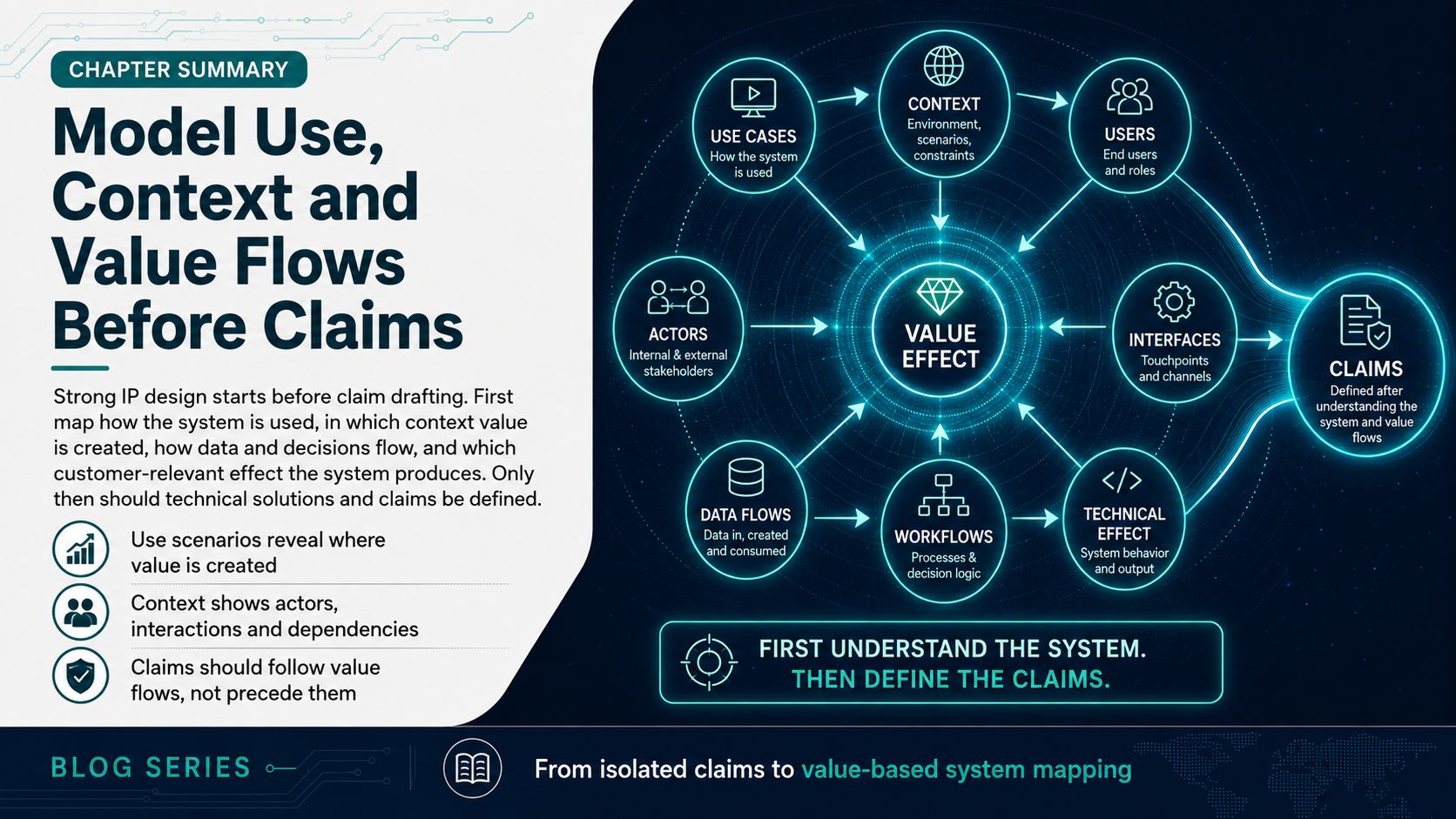
The original method begins from the customer’s experience and models the use scenario before translating it into a technical problem. That principle becomes more powerful in digital settings because the relevant use case may span multiple users, devices, organisations and moments. The customer may interact with a dashboard, while the decisive activity takes place in a cloud service, an edge device or a partner system.
A productive workshop should map the complete scenario in which the selected customer benefit occurs. The AEIOU logic remains useful: activities, environments, interactions, objects and users. For digital business models, it should be extended to include data sources, decisions, interfaces, permissions, feedback, evidence and monetisation events. The team should ask what initiates the process, which data is created, how it is transformed, which actor or system makes a decision, what response follows and how the outcome becomes visible to the customer.
The viewpoint must fit the problem. A user journey is appropriate when human interaction drives the value. A data-flow map may be better when the advantage arises through processing and transfer. A state-transition model can reveal inventions in autonomous systems. For a digital twin, the useful storyline may follow a physical asset from sensing through simulation to intervention.
The resulting map reveals “invention environments”: places where the system differs from previous solutions, creates a superior outcome, integrates a previously external service or performs a function in a distinctive way. These environments should be prioritised by customer relevance, willingness to pay, strategic fit, competitive activity, accessibility and the practical possibility of proving use. Technical sophistication alone should not decide.
The selected customer effect is then “technicised”. The team translates the valued outcome into the technical steps, states, signals and relationships required to produce it. Prior-art searching and iterative engineering can refine the solution into a genuine invention and define the intended prohibitive scope.
Use-scenario and value-flow modelling gives synthetic inventing its direction. It converts an abstract business objective into observable system behaviour, reveals where inventive technical contributions may sit and creates a disciplined bridge from customer value to patentable problem solving.
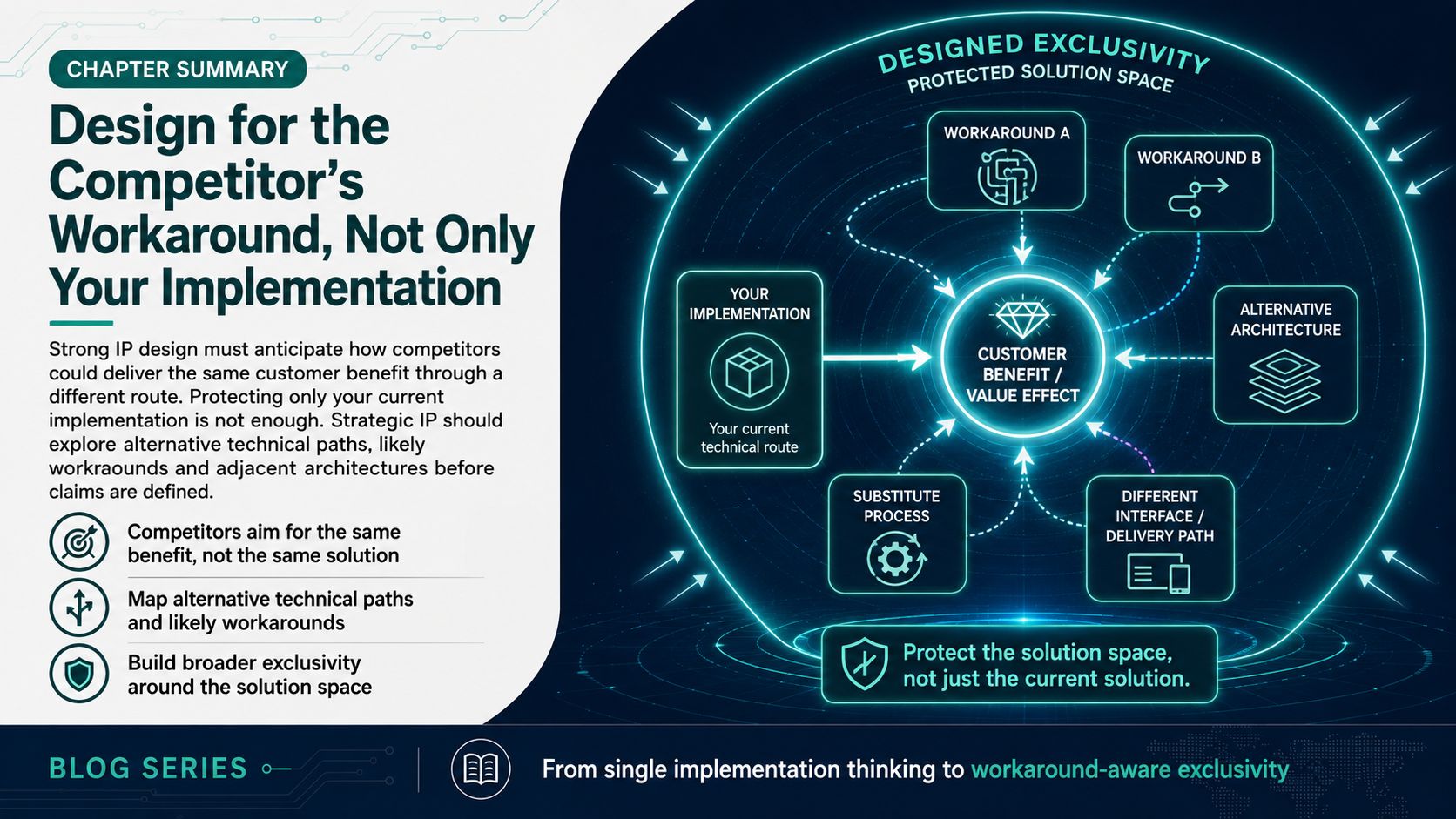
Design for the competitor’s workaround, not only your implementation
A patent that covers only the company’s chosen implementation may be easy to avoid. Competitors rarely need to reproduce every technical detail. They need to deliver an outcome that customers regard as equivalent. Synthetic inventing therefore has to explore circumvention before claims and portfolios are fixed.
The first type of workaround begins with the known technical solution. A competitor modifies an element, substitutes a component or changes the sequence while preserving the underlying principle. In a digital service, local processing may be moved to the cloud, a rules engine replaced by a model, one communication protocol exchanged for another, or a central controller made distributed. These alternatives can be explored with functional decomposition, morphological analysis and systematic variation.
The second type begins with the customer benefit. The competitor searches for a fundamentally different technical route to the same result. A company may protect an interface that simplifies manual configuration, while a rival removes configuration through automatic discovery. A predictive alert may be bypassed by redesigning the system to self-correct before an alert is required. A data-feedback loop may be replaced by simulation, synthetic data or federated learning. These alternatives demand separate inventive work because broad wording cannot turn one technical concept into ownership of every route to an outcome.
This perspective also improves portfolio design. One application may protect the current implementation, another a neighbouring architecture and another a future autonomous version. Some alternatives may be retained as trade secrets or defensive publications. Others may influence product roadmaps because the workaround is commercially superior to the original concept. Synthetic inventing thus becomes a source of strategic options, not merely a drafting exercise.
A strong exclusivity sphere is built by anticipating how a capable competitor would preserve the customer benefit while escaping the present solution. Treating technical variants and benefit-equivalent alternatives as distinct design tasks produces more resilient portfolios and can reveal the next generation of the company’s own offering.
Make synthetic inventing a continuous management capability
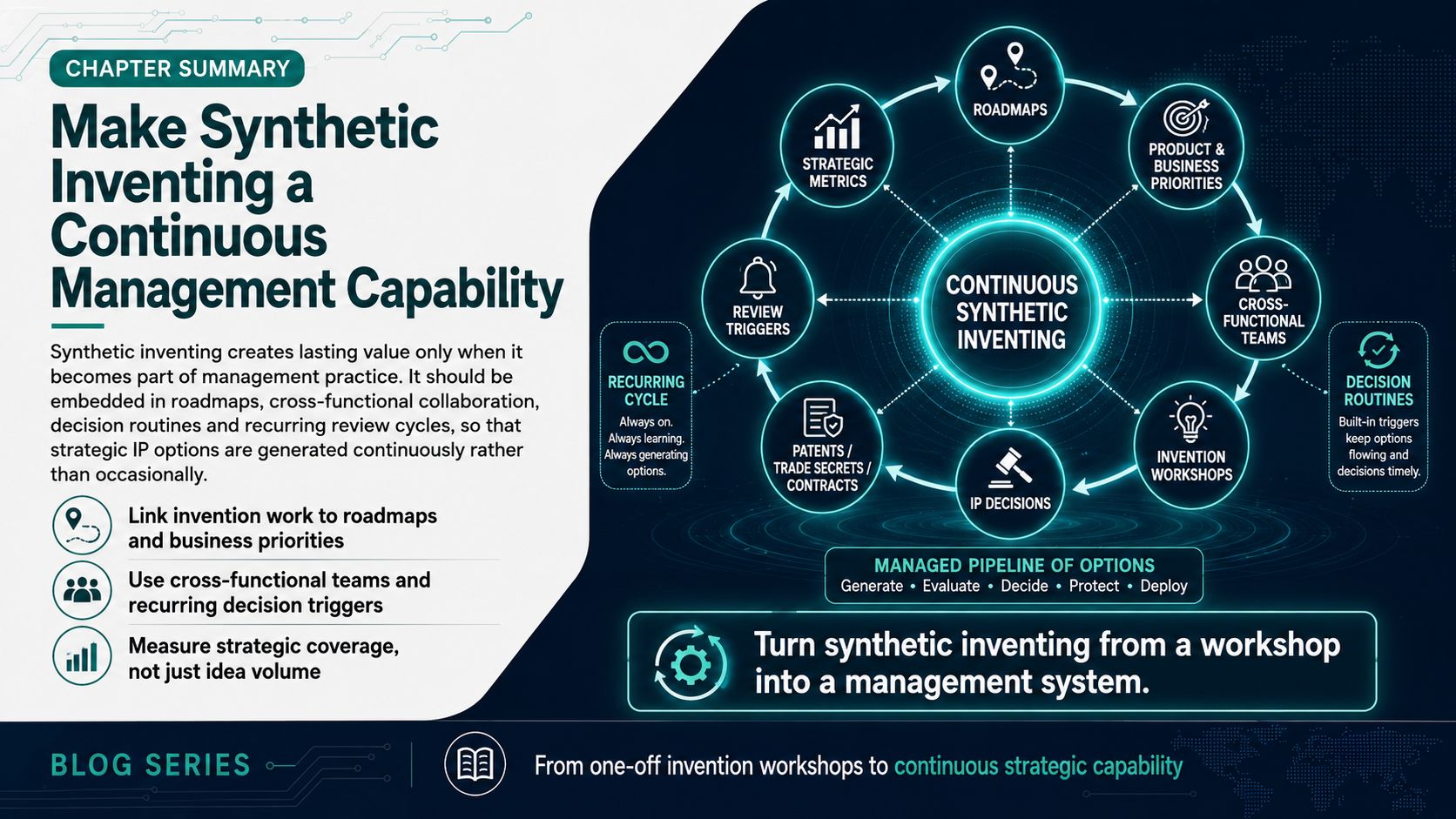
Synthetic inventing is most effective when integrated into innovation management rather than organised as an exceptional patent workshop. Digital architectures change continuously, and the relevant exclusivity needs change with them. Roadmap decisions, new APIs, model updates, data partnerships, outsourcing, open-source adoption and new service promises should all be triggers for renewed invention work.
The process requires a cross-functional team. Product management defines the valued outcome and roadmap. Sales and service explain substitution and customer behaviour. Software, data and engineering teams reveal the architecture and feasible alternatives. Competitive intelligence identifies white spaces and emerging approaches. IP specialists structure the invention search, prior-art analysis and protection options. Cybersecurity, procurement and partner management contribute where access, external dependencies or confidentiality shape the control position.
Each project should begin with a clearly stated business effect and end with decisions. Which invention environments will be developed? Which concepts require validation? Which assets should be patented, kept secret, published defensively or controlled contractually? Who owns each action, what evidence is needed and which roadmap event triggers review? The outcome should be a managed pipeline of strategic IP options rather than a collection of workshop ideas.
AI can widen the search space by supporting patent analysis, technology analogies, functional variation and the generation of alternatives. It can help teams test more combinations and identify adjacent technical fields. It does not determine which customer effect matters, which competitive position the company wants or which option fits the business model. Those remain management decisions requiring market knowledge, technical judgement and IP expertise.
Performance should be measured by strategic coverage, not idea volume. Useful indicators include the share of priority control points addressed, the range of credible workarounds considered, alignment with future system states, evidence readiness and the expected contribution to differentiation, bargaining power or margin protection.
Synthetic inventing becomes valuable at scale when it is connected to roadmaps, decision rights and recurring review triggers. Managed as a continuous capability, it allows the organisation to create IP before strategic bottlenecks become obvious to the market and before competitors occupy the technical routes needed for future value creation.
Supplementary content on the IPBA® platform:
AI-Based Patent Search for Synthetic Inventing
Explains the original customer-benefit-oriented method and shows how AI-supported patent searches can help identify prior art, comparable problem–solution patterns and possible white spaces during the iterative invention process. (IP Business Academy)
👉 Read more
AI-Assisted Inventing: New Case Study at the MIPLM
Demonstrates how white-space analysis, TRIZ principles and generative AI can be combined to produce alternative solutions for deliberately selected innovation fields rather than merely processing existing invention disclosures. (IP Business Academy)
👉 Read more
IP Design
Provides the broader management framework for proactively creating and structuring IP portfolios in line with business, technology and innovation objectives instead of treating IP as a record of past R&D results. (IPBA® Connect)
👉 Read more
Invention on Demand
Describes a structured route from a desired innovation field through the formulation of technical problems to alternative solutions, patentability assessment, commercial evaluation and implementation feasibility. (IPBA® Connect)
👉 Read more
Design Thinking and IP Design: Generating and Protecting Digital Innovation
Connects user-centred observation, problem definition, ideation and prototyping with the creation of protectable digital processes, interfaces, algorithms, use cases and system architectures. (IP Business Academy)
👉 Read more
The Impact of Generative AI on Innovation and Patents in Chemistry
Offers an industry example of AI-supported synthetic inventing and shows how white-space analysis and generated solution alternatives can contribute to strategically aligned patent portfolios. (IP Business Academy)
👉 Read more
Integration of IP in Innovation Management and Processes
Explains how patent landscapes, interdisciplinary workshops, technology repositories and recurring ideation activities can embed synthetic inventing in the organisation’s broader innovation system. (IPBA® Connect)
👉 Read more
Patent Avoidance Strategies
Adds the competitor perspective by examining invent-around approaches, technical substitutions and workarounds that may avoid existing patent claims while producing independently protectable alternatives. (IPBA® Connect)
👉 Read more
Portfolio Strategy for Immersive Digital Twins in Robotics Training
Provides a practical digital-system case in which patents, trade secrets, data governance, contracts, access rules and architecture must be designed together before competitors occupy the decisive control points. (IP Business Academy)
👉 Read more
Innovation in Medical Technology for Minimally Invasive Surgery: IP Design as a Leadership Tool at W.O.M.
Shows how customer requirements, technical capabilities and economic value levers can guide the predictable creation of patent positions focused on superior customer benefits rather than isolated engineering results. (IP Business Academy)
👉 Read more