
Fourteen Success Principles of Modern IP Strategy

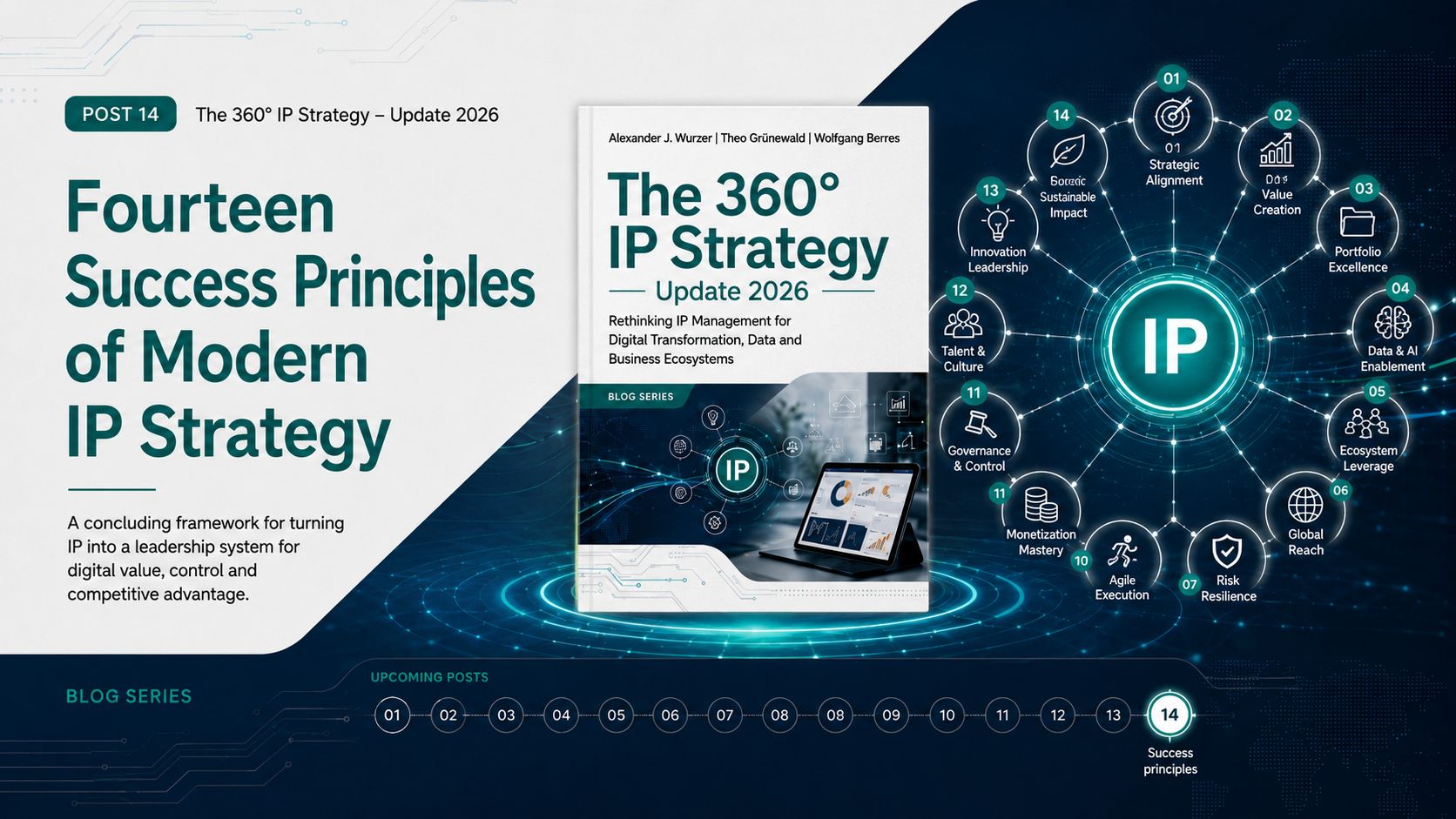
The original 360° IP Strategy ended by condensing its logic into ten success principles. Their message was clear: IP is a competitive instrument, it must be thought from the customer backwards, and it only creates value when it is integrated into market-oriented management. Those principles remain valid. What has changed is the object that companies must manage.
Competitive advantage now emerges through combinations of products, software, data, models, interfaces, services, evidence, brands, contracts and ecosystem relationships. The rights remain important, but they are only part of the control architecture. Decisions are distributed across functions and repeated throughout continuously changing innovation processes. Modern IP strategy must therefore connect market value with technical design, legal control, organisational governance and measurable learning.
The following fourteen principles conclude this update series. They do not replace the original 360° logic. They preserve its customer and business orientation while extending it into a management system for digital and intangible competitive advantage.
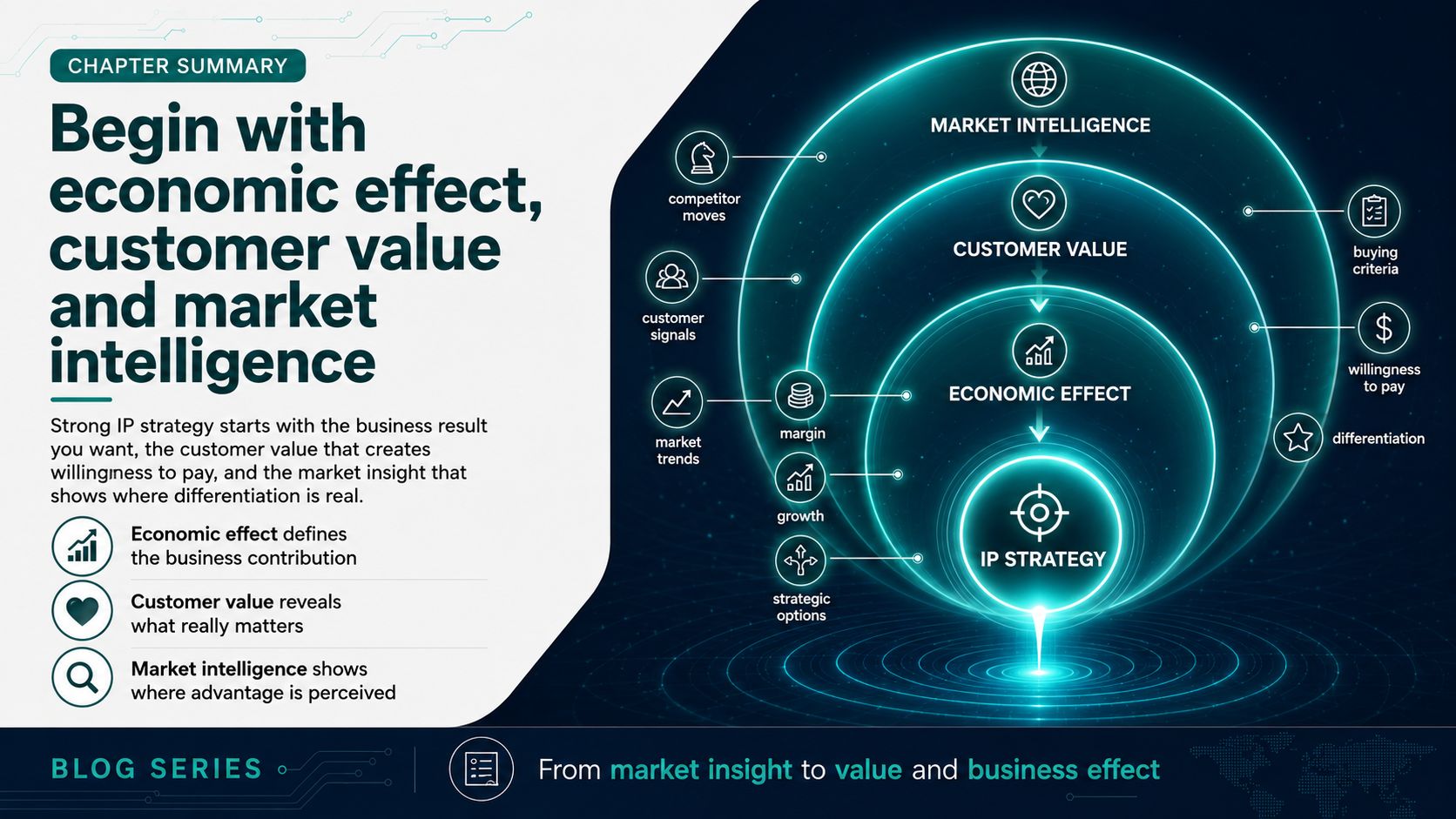
Begin with economic effect, customer value and market intelligence
The first principle is that IP must create a business contribution. A patent, trade secret, trademark, copyright position or contractual right is not valuable simply because it exists. Its strategic relevance arises from the effect it can produce: stronger differentiation, protected margin, market access, freedom of action, licensing leverage, customer trust, lower dependency or a more defensible ecosystem role. This principle forces every IP activity to answer a management question: what should become possible, more profitable or less risky because this measure exists?
The second principle is to begin with customer value. The customer does not purchase a patent portfolio. The customer purchases an outcome: reliability, speed, convenience, safety, integration, performance, status, lower total cost or reduced uncertainty. Modern IP strategy works backwards from that outcome. It identifies the capabilities that create the perceived benefit and asks which of them must be controlled so that competitors cannot offer an equivalent promise too easily.
The third principle is to make market intelligence a co-author of IP. Sales, marketing, product management, service and business development understand buying criteria, substitution, objections and emerging customer expectations. Their knowledge must shape protection priorities alongside technical and legal expertise. This does not mean that market teams draft claims. It means that the company uses their insight to determine where exclusivity would influence customer decisions and where protection would be commercially peripheral.
These three principles keep IP anchored in the market. Business contribution defines the required effect, customer value identifies what matters, and market intelligence shows where competitive differentiation is actually perceived. Without that sequence, IP becomes an internally impressive portfolio whose external economic purpose remains uncertain.
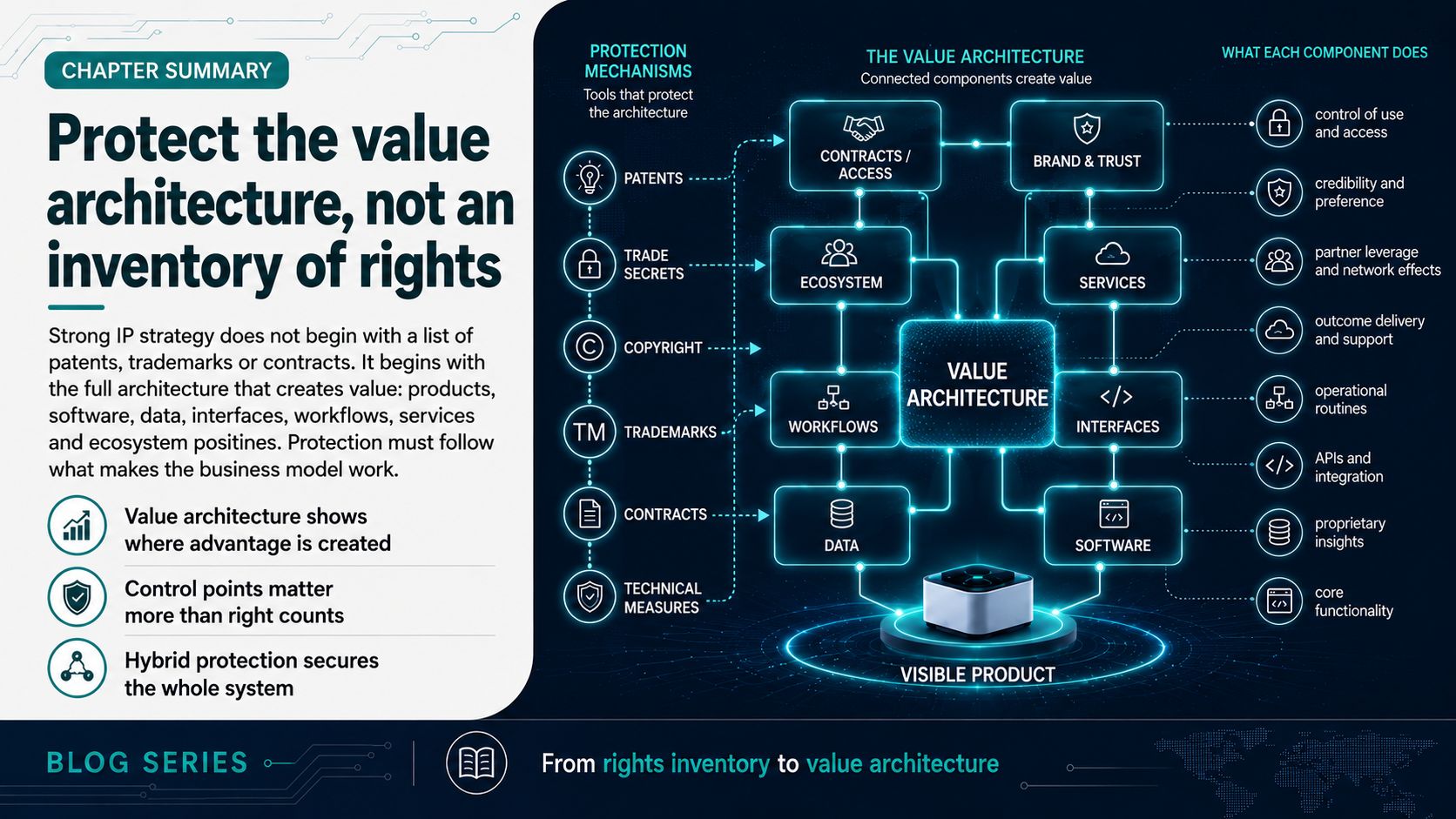
Protect the value architecture, not an inventory of rights
The fourth principle is to protect the whole value architecture. A modern offer may combine hardware, embedded software, cloud functions, training data, user interfaces, workflows, regulatory evidence, services and partner access. The strategically relevant object is not necessarily one product or one invention. It is the architecture through which the company creates, communicates, delivers and captures value. IP analysis must therefore follow the business model rather than the departmental structure or the existing portfolio.
The fifth principle is to think in control points rather than isolated rights. A control point is a place where access, use, imitation, substitution, interoperability, learning or dependency can be influenced. It may sit in a patented function, a confidential process, a data source, an API, a certification path, an installed base, a platform rule or a contractual relationship. The question is not merely what can be protected, but where control changes the behaviour of customers, competitors, suppliers or partners.
The sixth principle is to build a hybrid IP architecture. No single right can usually secure a distributed business model. Patents may protect visible technical mechanisms. Copyright may govern code and content. Trade secrets may protect models, processes and operational knowledge. Trademarks may concentrate reputation and trust. Contracts may allocate ownership, access and improvement rights. Technical architecture may limit exposure and preserve replaceability. The strength lies in the coordination of these mechanisms around one intended business effect.
The seventh principle is to treat software, data, interfaces, models and know-how as first-class IP objects. They must be mapped, assigned, documented and governed with the same seriousness previously reserved for registered rights. Ownership alone is insufficient. The company must know origin, permitted use, dependencies, access, modification history, reproducibility and evidence. Otherwise, an apparently valuable digital asset may be unusable, non-exclusive or impossible to defend.
These four principles expand the object of IP strategy from the portfolio to the business system. Value architecture reveals what creates the offer, control points reveal where strategic influence can be exercised, hybrid protection combines the available mechanisms, and digital-asset discipline ensures that the invisible foundations of value remain usable and defensible.
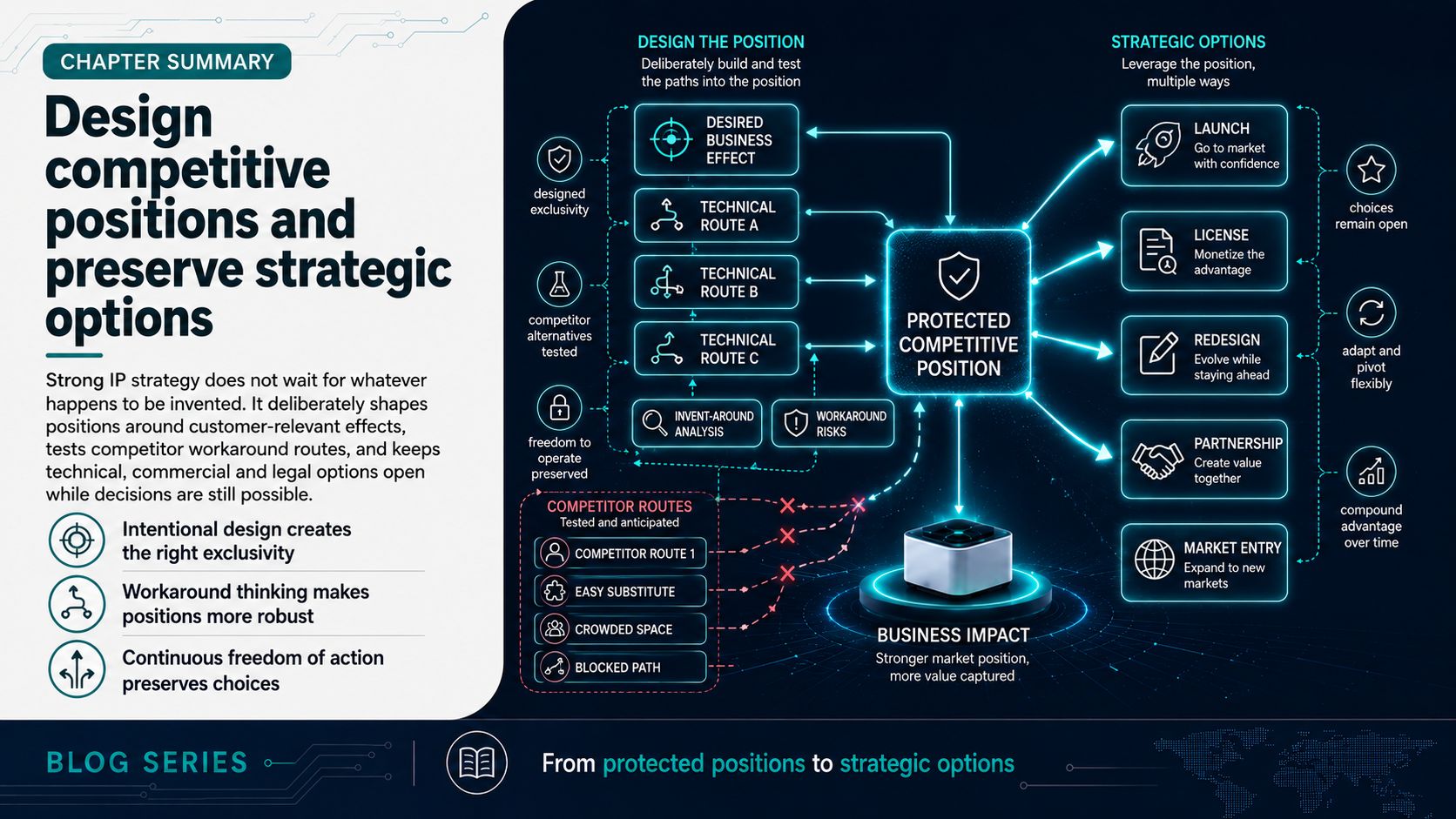
Design competitive positions and preserve strategic options
The eighth principle is to design exclusivity intentionally. Invention harvesting remains necessary, but it is not enough. A company should not depend entirely on what engineers happen to invent and report. Once a strategically important customer benefit or control point has been identified, technical and business teams should deliberately search for solutions capable of creating a defensible position. Synthetic inventing turns IP creation into a directed management activity rather than a historical record of development.
The ninth principle is to design for the competitor’s workaround. Protection fails strategically when a competitor can deliver the same customer outcome through an obvious alternative. Claim scope matters, but so does the architecture of substitution. Teams should model different technical routes, deployment choices, data flows, user interactions and business arrangements through which the benefit could be reproduced. This exercise improves patent design, but it can also reveal where secrecy, contracts, standards participation or ecosystem control would be more effective.
The tenth principle is to preserve freedom of action continuously. In software-based and connected offerings, the product never becomes completely stable. Releases, third-party components, model updates, new data sources and architecture changes continuously alter the risk position. Freedom to operate cannot therefore be reduced to one opinion shortly before launch. Risk screening must accompany roadmaps, major design decisions, collaborations and releases, with increasing depth as commercial commitment grows.
The purpose of these principles is not to promise permanent exclusivity or zero risk. Their purpose is to preserve options. Intentional design creates positions around what matters, workaround thinking tests whether those positions are robust, and continuous freedom-of-action management prevents the organisation from committing too early to a path that later becomes blocked, expensive or strategically dependent.
Turn information into evidence-based management decisions
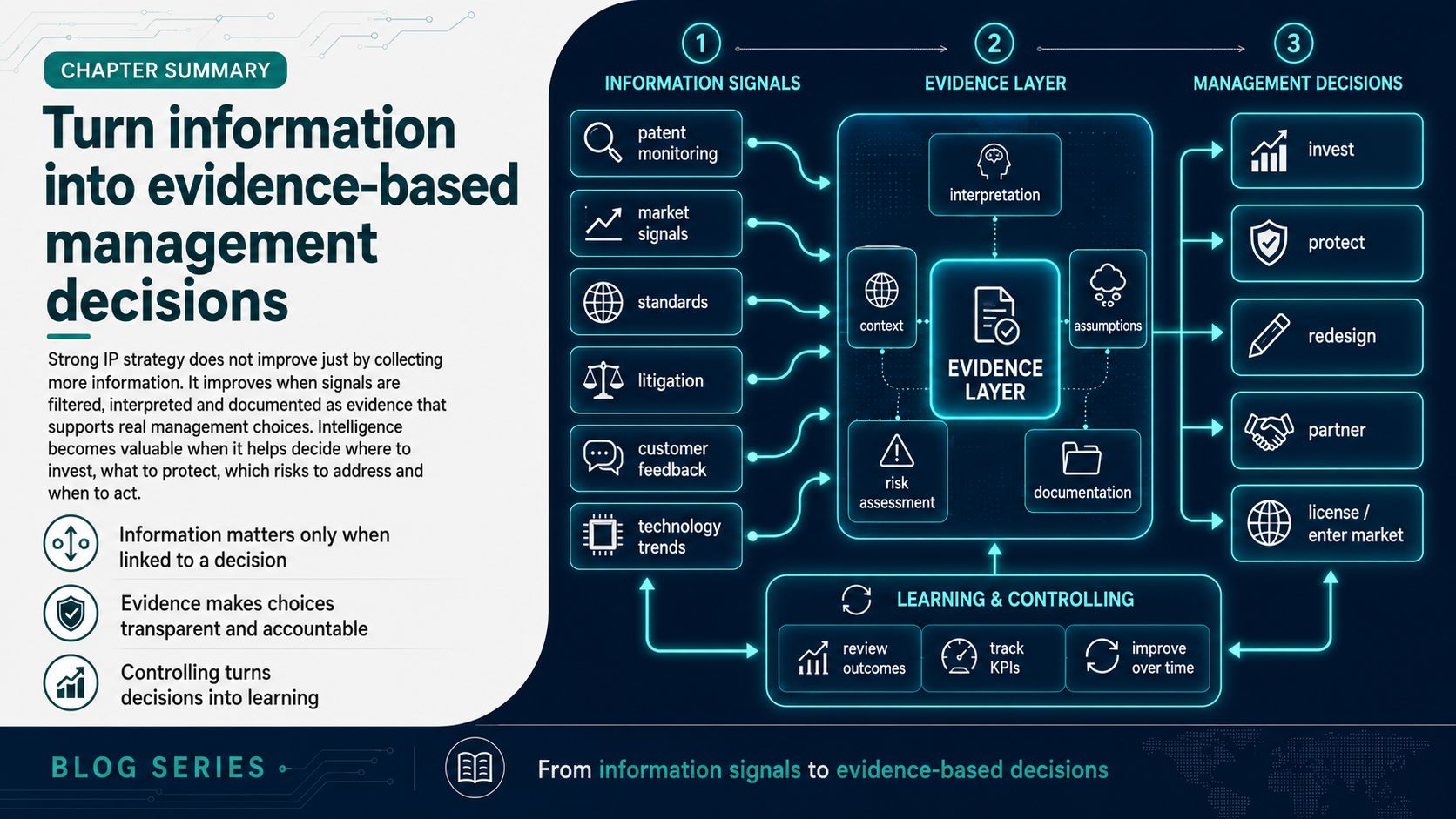
The eleventh principle is to build intelligence around decisions, not data accumulation. Patent monitoring remains essential, but relevant signals also appear in product releases, standards, litigation, partnerships, recruitment, scientific publications, regulation and platform behaviour. IP Intelligence should connect these signals with concrete choices: where to invest, what to invent around, whom to approach, which market to enter, what to protect and which assumptions to challenge. More information without a decision context only creates a larger black hole.
The twelfth principle is to make evidence and accountability part of every critical choice. Modern IP decisions often involve uncertainty and cross-functional trade-offs. The organisation should preserve the business objective, affected assets, available alternatives, legal and commercial assumptions, decision owner, chosen control mechanism, residual risk and review trigger. Evidence trails do not eliminate uncertainty, but they make decisions explainable, auditable and revisable when circumstances change.
The thirteenth principle is to measure business effects and learn. Patent counts, filing volumes and renewal costs describe activity. They do not prove strategic impact. Controlling should connect intended effects with leading and lagging indicators: coverage of relevant control points, evidence readiness, ownership gaps, freedom-of-action exposure, speed of escalation, protected differentiation, licensing options, margin support or negotiating leverage. The causal connection will rarely be perfect, but imperfect impact measurement is more useful than precise counting of the wrong things.
These three principles turn knowledge into organisational learning. Intelligence identifies relevant change, evidence makes choices transparent, and controlling tests whether the intended effect appears. Together they create a feedback loop in which IP strategy is not defended because it was once approved, but improved because results, risks and assumptions are continuously examined.
Operate IP as a leadership system, not a specialist programme
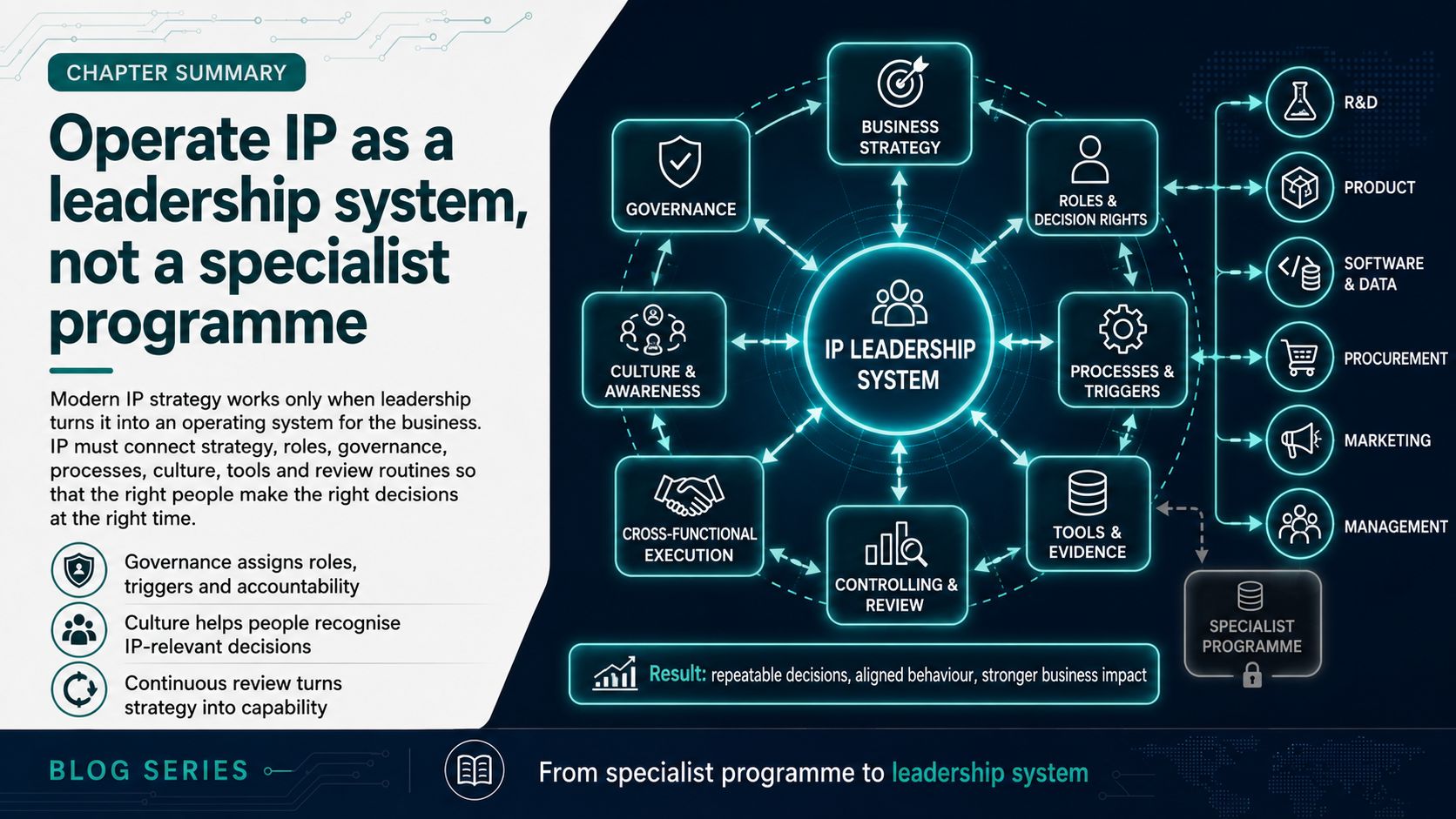
The fourteenth principle integrates all the others: operate IP as a management system led through governance, culture and continuous improvement. A modern IP strategy cannot depend on a few committed individuals or on the patent department being invited at the right moment. It needs defined triggers, decision rights, responsibilities, competences, interfaces, escalation paths, documentation and review routines. DIN 77006 and ISO 56005 reinforce this system logic, but the real objective is not formal conformity. It is dependable organisational behaviour.
Governance determines who prepares, advises, decides and accepts risk. Culture determines whether people recognise intangible value, involve the right expertise early and speak openly about uncertainty. Leadership determines whether IP priorities receive resources, whether conflicting objectives are resolved and whether behaviour follows the stated strategy. Processes and digital tools support this architecture, but they cannot replace management attention.
The IP function changes accordingly. It remains the centre of legal and methodological expertise, yet its broader role is to act as architect and moderator. It connects market intelligence, technology, software, data, procurement, marketing, compliance and management around shared decisions. It does not own every decision, but it helps the organisation ask the right questions, select suitable control mechanisms and preserve the quality of the resulting evidence.
Continuous improvement makes the system adaptive. A protection rule may become obsolete when a product becomes a service. A secrecy process may fail when development moves to cloud collaboration. A portfolio may protect yesterday’s architecture while the customer benefit shifts into data or integration. Reviews, audits, incidents, competitive signals and business results should therefore change the system rather than merely produce reports.
Proportionality is essential. A global platform company, an industrial SME and a technology start-up will not need the same committees, tools or documentation depth. The system should become more formal where value, dependency, exposure or irreversibility are high, and remain lightweight for routine matters. The test is not whether every possible control exists. It is whether important decisions are recognised early, made by the right people and supported by evidence adequate to their consequences.
Modern IP strategy is not a patent programme. It is a leadership system for creating, controlling and renewing intangible competitive advantage. Its success appears when customer value guides protection, business models determine priorities, critical choices become accountable, evidence survives organisational change and IP contributes visibly to profitable freedom, differentiation and strategic options. The fourteen principles form one coherent capability: think from the market backwards, design control deliberately, govern decisions across the organisation and learn faster than the competitive environment changes.
Supplementary content on the IPBA® platform:
IP Strategy
Provides a compact overview of the relationship between business objectives, asset identification, protection, commercialisation, risk management and the regular adaptation of IP strategy.
👉 Read more
Maximizing IP Value: Value-Oriented IP Management
Explains IP management as a continuous cycle of strategy, asset creation, competitive assessment, protection and exploitation rather than as the static administration of existing rights.
👉 Read more
IP Function Deployment
Connects customer needs, technological capabilities and protection objectives through a structured methodology inspired by Quality Function Deployment. It deepens the customer-backwards logic of the fourteen principles.
👉 Read more
From Apollo 13 to IP Strategy: How Managers Really Make Decisions
Shows how alternatives, uncertainty, consequences, assumptions and risk can be made transparent in complex IP decisions without pretending that perfect information is available.
👉 Read more
From Invention Discipline to Portfolio Power: The IP Habits That Make or Break Strategy
Demonstrates why IP leadership requires continuous stewardship after filing, visible decision relevance and the organisational courage to connect strategic ambition with execution.
👉 Read more
Organizing IP Management: From Legal Function to Strategic Business System
Describes the development of the IP function from legal support towards an asset centre capable of shaping business models, markets, ecosystems and long-term economic value.
👉 Read more
IP Design as a Leadership Tool: Steering Innovation Towards Success
Connects intentional IP creation with leadership, innovation culture, business objectives and market opportunities rather than treating protection as a downstream legal response.
👉 Read more
IP Lifecycle Management
Extends strategic thinking across the complete asset lifecycle, from identification and creation through protection, use, review, adaptation and eventual retirement.
👉 Read more
Lean IP in Action: How Agile Strategy Turns Patents into Business Value
Illustrates how value focus, early integration, portfolio pruning, competitive intelligence, mixed protection models and cross-functional planning create a more agile IP system.
👉 Read more
Strategic IP Management Decision Case with Ralf Klädtke: IP Autonomous Industrial Inspection
Provides a practical digital-system case combining AI, software, customer data, system architecture, patents, trade secrets, contracts and freedom of action around measurable business objectives
👉 Read more