IP Market Study Industrial IoT 2026: Why Connected Industry Turns IP into a System-Control Question

Smart Manufacturing has entered a phase where connectivity itself is no longer the story. The harder question is what companies can still control once industrial products generate data, depend on software, rely on standards, interact with platforms and become part of service-based ecosystems.
That is why Industrial IoT is becoming one of the most important IP strategy fields in Europe. In connected production, the economically decisive contribution rarely sits in one isolated component. It may sit in the interaction between sensors, control logic, edge processing, connectivity, machine data, software updates, digital twins, analytics and the service models built on top of them. This makes Industrial IoT a difficult field for classical IP communication. Patent protection matters, but it is no longer enough to ask whether a device, an algorithm or a technical feature can be protected.
The more important question is: who controls the data, software, interfaces, models, standards and commercial options in a connected production environment?
This is the starting point of the new IP Market Report on Industrial IoT. The report was prepared as a market intelligence and business development resource for IP experts — patent attorneys, design and trade mark specialists, law firms and adjacent IP service providers — who advise companies that build, connect and operate industrial systems.
Its core message is simple: Industrial IoT turns IP from a narrow protection function into a system-control question.
The market is moving at every layer of the connected-production stack
The report shows that the European Industrial IoT IP conversation is currently shaped by several developments at once.
Computer-implemented inventions define what can be protected when the technical contribution sits in control logic, edge analytics, software-defined behaviour or data processing. Digital twins raise questions about simulation, sensor integration, model updating and ownership of operational data. Industrial AI requires hybrid strategies in which patents protect the technical system-level contribution while trade secrets protect training data, model specifics and implementation know-how.
At the same time, standard-essential patents and FRAND disputes are moving into ordinary manufacturing. Industrial companies that embed 5G, Wi-Fi, Bluetooth, NB-IoT or other standardised connectivity may acquire licensing exposure they have not yet fully mapped. With the proposed EU SEP Regulation withdrawn and the Unified Patent Court developing its first SEP and FRAND case law, connectivity freedom to operate is no longer only a telecoms issue.
The regulatory layer is equally important. The EU Data Act changes the position of machine-generated data. The Cyber Resilience Act brings software bill of materials obligations into the discussion. NIS2, the AI Act and Digital Product Passports further widen the disclosure and compliance environment around connected products.
For Industrial IoT companies, these developments do not appear as separate legal topics. They appear as connected business questions.
Can we use the machine data our service model depends on?
What should we patent before an SBOM or product passport reveals more about the product architecture?
Which elements of a digital twin are patentable, and which should remain secret?
Where do standards create market access, and where do they create dependency?
How do we protect the system when value is distributed across devices, edge processing, cloud analytics and customer environments?
This is why IP advice in Industrial IoT must start from the architecture of value creation.
The strongest market signal: IP becomes decision support
The report’s market-needs section makes a point that is important for private practice: the Industrial IoT IP market is not primarily a competence problem. Many European IP experts already understand mechanics, electronics, software, sensors, automation, robotics or computer-implemented inventions. The difficulty is that this competence is often not visible in the language in which connected-product companies experience their problems.
A machine builder moving from product sales to predictive-maintenance services does not only need a patent application. It needs to know whether it can control the data behind the service. A sensor supplier does not only need protection for a hardware feature. It needs to understand how connectivity, customer data, embedded software and platform dependency affect its bargaining position. An industrial software company does not only need advice on whether an AI model is patentable. It needs a coherent patent, trade-secret, data-access and disclosure strategy.
That is the translation gap.
Industrial IoT companies increasingly need IP advice as decision support. They need help deciding what to patent, what to keep secret, what to disclose, what to license, what to standardise, what to open to the ecosystem and what to control contractually. This is a different advisory narrative from “we protect IoT inventions.” The more useful message is: “we help connected-product companies understand where control, dependency and defensibility arise in their system.”
Key voices shaping the European Industrial IoT IP debate
The report identifies a group of practitioners and institutions whose work helps define the European Industrial IoT IP conversation. The following examples show how different parts of the debate are developing.
Parminder Lally, Appleyard Lees, is relevant for the software and AI patentability layer of Industrial IoT. Her work helps frame how AI and software inventions can be protected across jurisdictions and why the European technical-effect analysis matters for connected systems.
Source: Software and AI Patentability: A Global Overview
Bruno Loubet, Plasseraud IP, contributes to the EPO mechanics behind Industrial IoT patenting, especially where sufficiency of disclosure, AI inventions, computer-implemented inventions and telecommunications standards meet.
Source: Sufficiency of disclosure and Artificial Intelligence: lessons from decision T 0048/24 (EBARA)
Bastian Best, BESTPATENT / Powerclaim, is a visible German voice on software and AI patents, especially on practical disclosure questions for AI-related inventions. This is directly relevant for predictive maintenance, industrial image analysis, anomaly detection and AI-based process control.
Source: 5 Things You Should Disclose in an AI Patent
Marjut Lattu, Berggren, focuses on the practical patentability of AI and computer-implemented inventions in Europe. Her work is useful for Industrial IoT because it explains that AI must be connected to a technical environment, a technical problem and a credible technical effect.
Source: AI as part of a patentable invention, what should you consider?
Darena Slavova, Mewburn Ellis, is particularly relevant for digital twins and the regulatory data layer around connected products. Her work shows how patentable elements of a digital-twin architecture can sit in sensor integration, predictive algorithms, simulation methods and data-processing systems.
Source: Digital twin technology in ship design and maintenance
Dr. Jochen Reich, Reich-IP / Softwarepatente.com, provides a German market-facing perspective on software patents, AI-related inventions and digital innovation protection. His work is relevant because many connected-industrial inventions are software-heavy but only patentable if the software solves a technical problem.
Source: Patente und künstliche Intelligenz: Herausforderungen und Chancen im digitalen Innovationsschutz
Mark Marfé, Pinsent Masons, is relevant for the SEP and FRAND dimension of Industrial IoT. His work helps explain why connectivity licensing and standards exposure are becoming important for manufacturers that embed wireless technologies into industrial products.
Source: ‘Internet of things’ spurs broad interest in standard essential patent licensing
Together, these voices show that Industrial IoT IP is not one narrow topic. It is a layered field: computer-implemented inventions, AI, digital twins, data governance, trade secrets, standards, connectivity and platform control all interact.
Where the opportunity lies for IP experts
The report’s Opportunity Map translates these market shifts into service opportunities for IP experts. It does not suggest that every firm should offer everything. The point is more strategic: IP experts need to package their expertise around the decisions connected-product companies actually face.
The most promising areas include machine-data governance under the EU Data Act, hybrid patent and trade-secret strategies for industrial AI, digital-twin IP and data ownership, connectivity FTO and SEP licensing exposure, SBOM and disclosure-aware trade-secret governance, distributed-system claim drafting, interoperability strategy and IIoT-specific IP due diligence for investors and acquirers.
The report goes into these opportunity areas in detail. The key takeaway for this article is simpler: the market is not only asking for more filings. It is asking for more integrated advice. Companies need advisers who can connect patentability with data access, trade secrets with cybersecurity disclosure, digital twins with customer-generated data, standards with freedom to operate, and portfolio strategy with investment readiness. That is where Industrial IoT becomes a business development opportunity for IP experts.
What this means for private practice
For private practice, the implication is clear. Industrial IoT should not be presented only as a technical field in a list of sectors. It should be translated into a set of recognisable client problems.
Where is the defensible control point in our connected system?
Which data can we use, share or protect?
Which parts of the architecture should be patented before disclosure obligations arise?
Where do standards create licensing exposure?
How do we protect a digital twin that depends on operational customer data?
How do we make an IIoT portfolio credible for investors or acquirers?
These questions are closer to how clients experience the market. They also make IP expertise more visible to CTOs, heads of product, founders, investors, operations leaders and business-development teams.
The strongest positioning will therefore not come from saying “we advise on IoT.” It will come from explaining how IP helps connected-industrial companies remain in control.
Why this Market Study is worth downloading
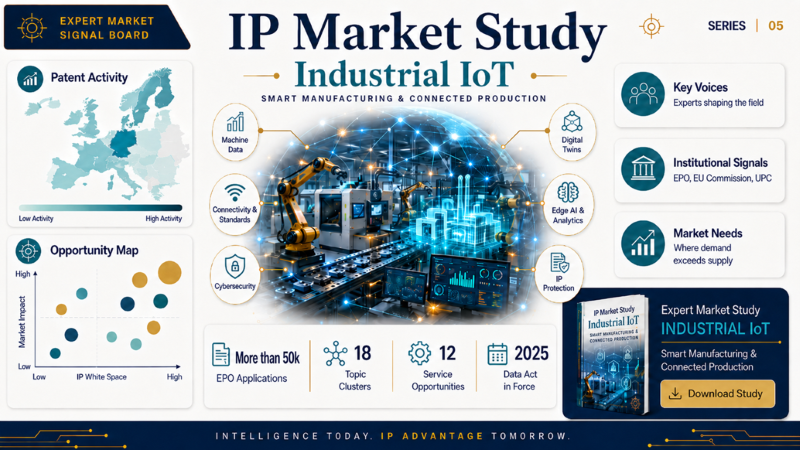
The full IP Market Report on Industrial IoT provides a structured view of the European IP market for connected industry, Smart Manufacturing and connected production. It covers current developments, key voices, topic clusters, market needs, opportunity areas for IP experts, implications for private practice and the outlook for the next 18 to 36 months.
For anyone offering IP services to machine builders, automation suppliers, sensor companies, robotics businesses, industrial software vendors, edge-AI providers, connected-product start-ups or manufacturers moving into data-based service models, this is not only background reading. It is a practical map of where demand is emerging, where service maturity is still low and where first movers can build a visible position.
The central lesson is simple: Industrial IoT companies do not only need stronger IP rights. They need IP advice that helps them understand what they must control.
The full IP Market Report on Industrial IoT is available here free of charge:
👉 IP Market Report: IP for Connected Industry
More background on the structural market logic behind the study is available in the Industry Focus on the digital IP lexicon dIPlex:
👉 Industrial IoT and the Shift from IP Protection to System Control
Further background articles on the IP Business Academy explain selected aspects of the Industrial IoT market logic from different angles:
👉 Industrial IoT in Motion: Why Smart Manufacturing Turns IP into a System Question